The shrine to England's first Christian martyr finished fourth in the poll that attracted thousands of votes on the BBC's Website and by post. The Dean of St Albans, the Very Revd Christopher Lewis said: "We are delighted that the Shrine has come in such a high position. It is a wonderful centre of pilgrimage and a special spiritual place for so many people." The Bishop of St Albans, the Rt Revd Christopher Herbert, said: "The result underlines the Shrine's place as an historic site of pilgrimage for people from across the UK and overseas." The Cathedral
St Albans cathedral is built on what is believed to be the site where Alban was executed. 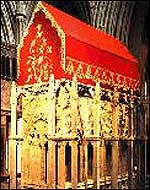 | | The shrine of St Alban |
It is recorded that St Germanus of Auxerre visited the site as early as 429 and the shrine is still a site of national pilgrimage, used as a place of prayer and meditation by visitors every day. Like many of England's shrines, it was demolished during the dissolution of the monasteries. The Purbeck marble pedestal was relocated in various locations in the Abbey in more than 2000 fragments. The altar and iron-work around the shrine, designed by Mr George Pace, a former Cathedral Architect, were dedicated in 1967 as memorial gifts. Restoration of the shrine was completed in 1993 and rededicated in the presence of HM The Queen Mother in the same year. There is general delight that the shrine has made the short list: The Bishop of St Albans, the Rt Revd Christopher Herbert:
"I'm absolutely delighted at this news. The shrine is a site of national and international pilgrimage, set in a beautiful Abbey at the heart of a living, worshipping community. The shrine is a place of prayer and meditation used by numerous visitors every day and justly deserves to be on the shortlist of the nation's most spiritual places." The Dean of St Albans, the Very Revd Christopher Lewis:
"This is wonderful news and underlines the special place that Saint Alban, as England's first Christian martyr, holds in the nation's spiritual heritage. The Shrine attracts many thousands of pilgrims each year, and the story of Alban's courage and sacrifice has maintained its powerful appeal through the centuries." Here are a selection of comments from just a few people who nominated the shrine of St Albans: Diana Rose: Still visited and part of a lively christian community. Nicholas Bates: A distinct feeling of continuity back through 1700 years and all the vicicitudes of the wonderful building which surrounds the shrine to the simple story of a brave young man who died for his new-found faith. Barry Forrester: People have been coming here for over 1700 years to honour Alban. The chapel is thus a holy place of pilgrimage. The shrine pedestal is a rare example of a medieval stone shrine, now beutifully completed with a red cover. Timothy Beecroft: For more than 1700 years, through many vicissitudes and changes of fortune, pilgrims have been coming here to pray at a site commemorating Britain's first martyr, a man who gave himself up for a stranger and an outcast. It never fails to move me. Melvyn Teare: It is peaceful. You are closer to yourself and to your God. There is no rush there is no hurry. You are guided if you wish in your prayers. You can light a candle as well.
Photograph used with the kind permission of The Fraternity of The Friends of St Albans Abbey. The story of St Alban
Alban lived in the Roman city of Verulamium during the 3rd century. He was a worshipper of Roman gods including the emperor, but gave shelter to a Christian priest fleeing from persecution. Influenced by the priest's prayer he became a Christian. 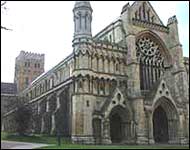 | | St Albans Abbey |
When the authorities discovered the priest's hiding place Alban exchanged clothes with him. The priest escaped but Alban was taken before a judge, who ordered that if he had indeed become a Christian, Alban should receive the punishment due to the priest. Alban declared his Christian faith, saying "I worship and adore the true and living God, who created all things." Despite flogging he refused to renounce Christianity and was sentenced to death. He was brought out of the town, across the river and up a hill to the site of execution where his head was cut off. There is a legend that on the hill-top a spring of water miraculously appeared to give the martyr a drink. It is also said that the original executioner refused to carry out the deed, and that after his replacement had killed Alban the executioners' eyes dropped out. | The Dappled Garden, Harpenden |  |  | | JO COLEMAN nominates a quiet place in Hertfordshire. Find out all about it and listen to Jo in the garden. |
| The Peace Pagoda, Willen |  | | | LUCY NEWMAN visit the Buddhist Temple and peace pagoda in Willen to see if Milton Keynes could have a spiritual side. |
| Shaw's Corner, Ayot St Lawrence |  | | | KATY LEWIS tells how she is always inspired by visiting the former home of a favourite writer. |
| 


 Jo Coleman in The Dappled Garden