Join Naomi and Nigel as they travel back in time to tell the story of The Great Fire of London through movement and dance.
Let’s Move with Naomi and Nigel!
The Great Fire of London
NAOMI: Hey, Nigel, are you ready to travel back through time?
NIGEL: Time travel…travelling back through history?
NAOMI: Exactly. Let’s go back over 350 years to an important event. The Great Fire of London.
NIGEL: Okay, and even more fun, let’s tell the story of the Great Fire of London using our bodies and movements.
NAOMI: Of course. Right we are going to pretend we are the people of London way back in history, 1666 to be exact.
NIGEL: Make sure you’re in a space giving your fellow Londoners plenty of room.
[WARM-UP]
NAOMI: First, we need to warm up our bodies, so join in and copy us.
NIGEL: Here we go. Okay, everyone, let’s go for a little walk around London, and there are lots of people out today.
NAOMI: Wave at our fellow Londoners, wave at another friend. Oh, look, a bakery. Let’s go inside. We’re going to make some bread.
NIGEL: Fold the dough. Now knead the dough. It’s very stretchy. It takes a lot of hard work to make the tastiest bread.
NAOMI: Can you stretch the dough even more?
NIGEL: And really bend your knees as you knead the dough. Oh, smell the freshly baked bread. Mmm, that bread looks ready to bake.
NAOMI: Mmm, what delicious smells coming from the oven! Mmm!
NIGEL: The bread smells so good. Good enough to eat.
NAOMI: Sparks are flying out of the oven. Pretend to be a fire spark. Leap and crouch. Big leap and crouch.NIGEL: Can you leap a bit further? The sparks are so bright and super hot!
NAOMI: Sparks grow and become flames. Twist and swirl your arms upwards from low to high.
NIGEL: Now roll your arms as if they’re a big cloud of smoke, starting with small flames that get bigger and bigger. Smoke billowing upwards from the ground to the sky.
NAOMI: Flames are climbing higher and higher.
NIGEL: Filling the streets of London with smoke. Look at the houses around the bakery. Show us the shape of a house. Here we go.
NAOMI: Tall, strong shape like a London house and bit by bit, the houses are crumbling with the fire.
NIGEL: Another house is crumbling. Stand tall and drop one arm, the other arm, bend your body right down and then stand back up.
NAOMI: One by one, the houses are being taken over by the fire.
NIGEL: One more time.
NAOMI: Can you put your warm-up moves together? Remember, we fold the dough.
NIGEL: Now knead the dough with a bend and stretch.
NAOMI: Mmm, smell that freshly baked bread. Oh, it smells so good. Now the sparks from the oven.
NIGEL: Leap and crouch, stretch your body.
NAOMI: Jump even higher. Sparks flying.
NIGEL: And now let’s move like flames in the Great Fire of London. Remember.
NAOMI: Let’s see your arms moving like flames.
NIGEL: And roll your arms like clouds of smoke.
NAOMI: The fire is twisting, turning, swirling.
NIGEL: The smoke is rising higher and higher and higher.
NAOMI: Well done everyone. Dancing flames be still.
[03 43 - POSSIBLE PAUSE POINT]
NIGEL: Wow, I’m certainly warmed up, ready to move and ready for some history. Let’s start the next part of our storytelling by using some of the actions we’ve just done to become flickering flames.
[PART 1: THE GREAT FIRE BURNING AND THE HOUSES BEING DESTROYED]
NAOMI: Yeah, we’re going to work in pairs. Now the bells of London St Paul’s Cathedral are going to count to five. You need to find a partner before the last chime. Will you be my partner, Nigel?
NIGEL: Absolutely. Yay!
NIGEL: Has everyone got a partner? Decide who will become the flames first. You do. Okay, I’ll become the flames first. The other partner will copy, just like they’re looking in a mirror Ooh, looking good today. If you’re the flames first, make a flickering flame movement anything you like when the music starts, there you go. Cool, yeah, start by pretending to be the tiny sparks of fire in the bakery where the Great Fire of London began. The sparks will gradually get bigger and bigger and hotter and hotter as the fire spreads.
NAOMI: So that means, your movement should get bigger and bigger too.
NIGEL: Yes, yeah, remember to use all of your body to make lots of different shapes.
NAOMI: In 1666, the wind blew, making the fire spread. So when you hear the wind blowing like this - [SFX - WIND] - it’s time to swap over.
NIGEL: If you were mirroring, now become the flames.
NAOMI: And if you were the leader, it’s your turn to copy your partner.
NIGEL: Swap over every time you hear the wind blow. Are you ready?
NAOMI: Let’s move!
NAOMI: Listen, there’s the wind. Swap over!
NIGEL: Don’t forget to use all of your body.
NAOMI: Okay, stop there, in your pairs.
NIGEL: When the wind blew and the fire spread, what happened to the buildings?
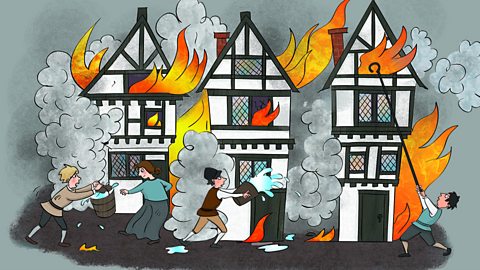
NAOMI: Well, in 1666, mostly the buildings were made of wood. So as the fire swept from building to building, they burned and collapsed in the flames.
NIGEL: Okay, so let’s tell that part of the story next.
NAOMI: Okay, let’s all become the buildings of London. Everyone stand strong, tall and rigid like a house.
NIGEL: Very good and then slowly and gradually collapse to the floor, piece by piece.
NAOMI: Good. Again in your pairs, choose who will start this time as the building and who will be the mirror.
NIGEL: Okay, if you’re the mirror, copy your partner’s moves. How many different ways can you crumble to the floor, using all of your shapes and actions?
NAOMI: Now the music’s going to play, and whenever you hear the wind blowing, swap over.
NIGEL: Are you ready?
NAOMI: Let’s move!
There’s the wind, swap over.
NIGEL: Remember to use your whole body. Start by standing strong and slowly collapse.
NAOMI: Okay, stop there, but stay in your pairs.
[08 08: POSSIBLE PAUSE POINT]
NIGEL: I guess if you were living in London in 1666 the Great Fire was frightening.
NAOMI: Yeah, definitely, fire is really dangerous. We should always keep away from it. Some Londoners use boats to escape from the fire.
[PART 2: THE GREAT ESCAPE]
NIGEL: Together in small teams. Let’s pretend we are rowing on the River Thames, the big river that flows through London.
NAOMI: Now, to make a rowing team, you and your partner need to join with another pair. You have until the bells of St Paul’s stop ringing again to get together.
[SFX - BELLS CHIME]
Hey, right, stand in the line like this that you’re getting ready to get on your boat.
NIGEL: Is everyone in your group ready? Naomi - um where’s the boat?
NAOMI: Oh well, we have to imagine that bit, Nigel.
NIGEL: Wow.
NAOMI: Right when the music starts, you and your team climb carefully into your imaginary boat.
NIGEL: Now hold on. I imagine that because it’s on an imaginary river, it’s unsteady and rocks as we get into it. Let’s give it a go.
NAOMI: Once you have your balance, sit in your boat. Right one behind the other, work together to row away from the fire.
NIGEL: Let’s push and pull our imaginary oars together. We all move in the same direction, at the same speed.
NAOMI: Use the beat of the music to help you row in time. But pay attention, as the speed of the music might change, so listen carefully.
NIGEL: That’s it. Keep going. Listen to the music and work together to row to safety. Everyone row to one side of the boat. Watch out, the waves are rocking your boat.
NIGEL: Row faster, keep in time with your team.
NAOMI: Okay, great teamwork, everyone stop there.
[11 07: POSSIBLE PAUSE POINT]
The Great Fire of London spread far and wide, Londoners wanted to put it out as quickly as possible.
NIGEL: Why didn’t they just call the fire brigade? Neenaw, neenaw.
NAOMI: Well, back in 1666 there wasn’t a fire brigade like we know today.
NIGEL: Ah, or telephones to ring them.
NAOMI: Londoners did use water to try to put the fire out, and the wind helped too.
NIGEL: Hang on. I thought you said the wind was the thing that made the fire spread.
NAOMI: Yes, I did, but on the third day the wind died down and this helped to end the fire.
[PART 3: WATER EXTINGUISHING THE FLAMES]
So now we’re going to move as the water and the wind. Your teacher is going to split your class in half.
NIGEL: You’ll need to stand in two long lines facing each other. Again. You’ll have until the bells of St Paul’s stop chiming to get into position.
[SFX - BELLS CHIME]
NAOMI: Everyone in two lines? Okay, one line is going to be fire. Remember how we moved like flames earlier.
NIGEL: The other line will become the wind and the water. Teacher, over to you to decide which line is which.
[SFX - BELLS CHIME]
NAOMI: Excellent work, teachers. Right fire line staying on the spot pretend to be the flames burning and flickering. Let’s see you all doing that.
NIGEL: Wow, I can really feel the heat here. The other line you are either the water being thrown onto the flames, like this: whish. Or the wind blowing strongly and then dying down whish, nice, the choice is yours. Water or wind. Try to work at different levels. You could be high or low, or fast or slow, or all of these. Let’s see your movements.
NAOMI: Very good, you’ll need to make your movement towards the person opposite you. So wave at the person opposite you. Hey, hey. So if you’re fire after the wind and water opposite you has moved, you decide if you’re going to be put out.
NIGEL: Or do you keep burning? Once you’ve made your movement return to your starting position? Are you ready to move, both lines together? Ready, let’s move?
Stop there! Good work.
[14 39: POSSIBLE PAUSE POINT]
Can you see how we are telling the story using our bodies and our movement?
NAOMI: The Great Fire of London lasted four days. Thousands of houses, churches and other buildings were destroyed. It changed London forever.
[PART 4: THE WHOLE STORY]
NIGEL: It’s a fascinating story. Let’s see if we can remember the movements we used to tell it.
NAOMI: We move like hot flames. The flames made the buildings collapse.
NIGEL: We rode away from the heat and danger in our boats and tried to put out the fire, moving like water, whish, and the wind. As a class, let’s create a performance. Let’s put all of our storytelling movements together.
NAOMI: First you need to get into your pairs again. The bells of London St Paul’s Cathedral are going to count to five. Find a partner before the last chime.
[SFX - BELLS CHIME]
NIGEL: Now you have found your partner, start by becoming the flames of the fire, mirroring each other, beginning with small movements, and growing into great, big flames.
NAOMI: Switching whenever you hear the wind blow.
NIGEL: Are you ready? Let’s move!
NIGEL: Here comes the wind.
NAOMI: Staying in your pairs and still mirroring each other’s movements, become the London houses slowly being destroyed by the fire. Are you ready? Let’s move.
NIGEL: Here comes the wind.
Some people escape to safety in boats. Move into your boat teams of four and row together. Try to row in time with each other. Are you ready? Let’s move!
NAOMI: So now we’re going to move as the water and the wind. Your teacher is going to split your class in half.
NIGEL: Here come the bells of St Paul’s again.
[SFX - BELLS CHIME]
Are you ready? Let’s move!
NAOMI: Amazing storytelling. Stop there, everyone.
[19 21: POSSIBLE PAUSE POINT]
NIGEL: That was great. We used our imaginations and our bodies to tell the story of the great fire of London.
NAOMI: I really felt like I was back in 1666. Let’s focus on how proud we all feel after such a fantastic team performance, as we all cool down together.
[COOL DOWN]
NIGEL: Let’s start by being the flames dying down gently. Now gently sway from side to side. That’s it.
NAOMI: Good work everyone. Now let’s rebuild those London houses. Start low and slowly stand up tall, stretching up like a house.
NIGEL: And let’s do that again. Build another house.
NAOMI: Feels nice, doesn’t it? Now reach up with your arm and wave at your fellow Londoners. Big friendly wave. Relax and smile. Now the fire is out.
NIGEL: Then finally, take a deep breath in, imagine clean, safe air filling your body and breathe out.
NAOMI: Well done everyone. Maybe there’s another story that you could try to tell through movement. Let your teacher know if there’s one that you’d like to try.
The Great Fire of London
The theme of this lesson is narrative dance - telling a story through dance movements. In particular it focuses on the dance skills of unison and mirroring.
Dance session summary
Warm-up
The children are transported back in time to 1666 and begin the story with movements for baking and then the flickering flames of the fire.
Part 1: The Great Fire burning and the houses of London being destroyed - mirroring movements
Naomi and Nigel guide the children to finding a partner. They give the children the time it takes for the bells of St Paul’s Cathedral to count to five to find a partner. The children will then use their imagination to recreate the flames of the Great Fire of London, one child leading and the other mirroring.
Part 2: The Great Escape - conveying feelings and emotions through movement
The next section covers Londoners’ attempts to flee the fire, focusing on rowing to safety. The children also explore the feelings and emotions of those trying to escape the fire, and how these emotions can be conveyed through body actions and gestures. In groups of four the children express this part of the narrative through uniform movements, working as a team. They have another set of bell chimes to get into their groups.
Part 3: Water extinguishing the flames
This section of the dance requires the class to be split in half, with the children standing in two long lines facing each other. The bells of St Paul’s Cathedral act as a countdown again. One line is the fire, the other is either water or wind. Teachers tell the children which line is which.
Part 4: The whole story - sequencing movements to create a narrative performance
The children explore sequencing their story, using dance movements to create a narrative performance. Naomi and Nigel recap the main elements of the story in order. They then direct the children to get into pairs, as they begin their narrative dance with the mirroring flames movements. The bells of St Paul’s allow the children time to pair up.
Cool down
The children cool down ready to return to the school day.

Resources
Teacher Notes
Download / print the guidance for using this dance session with your group (pdf)

Transcript - The Great Fire of London
Download/print the transcript of this dance session
Songs about The Great Fire of London. collection
Discover our collection of songs for KS1 about The Great Fire of London
Related content from BBC Teach
BBC Teach has a series of three popular animations about The Great Fire of London:
Why did The Great Fire of London happen?
What happened during The Great Fire of London?
What happened after The Great Fire of London?
There is also a collection of catchy songs that children will enjoy learning:
KS1 Music: The Great Fire of London
There is also a cross-curricular audio offering about The Great Fire of London bringing together dance, music and drama.
Curriculum relevance
Let's Move - with Naomi and Nigel! addresses the following learning objectives from the curriculum guidance of the four UK nations:
England
National Curriculum Programmes of Study for Physical Education in Key Stage One:
Pupils should develop fundamental movement skills, become increasingly competent and confident and access a broad range of opportunities to extend their agility, balance and coordination, individually and with others.
They should be able to engage in competitive (both against self and against others) and co-operative physical activities, in a range of increasingly challenging situations.
Pupils should be taught to:
Master basic movements including running, jumping, throwing and catching, as well as developing balance, agility and co-ordination, and begin to apply these in a range of activities.
Perform dances using simple movement patterns.
Scotland
Curriculum for Excellence - Physical Education as part of the wider Health and Wellbeing section. Outcomes:
I am learning to move my body well, exploring how to manage and control it and finding out how to use and share space.
I am discovering ways that I can link actions and skills to create movement patterns and sequences. This has motivated me to practice and improve my skills to develop control and flow.
I am developing my movement skills through practice and energetic play.
I am developing skills and techniques and improving my level of performance and fitness.
I am aware of my own and others’ needs and feelings especially when taking turns and sharing resources. I recognise the need to follow rules.
I can follow and understand rules and procedures, developing my ability to achieve personal goals. I recognise and can adopt different roles in a range of practical activities.
By exploring and observing movement, I can describe what I have learned about it.
I can recognise progress and achievement by discussing my thoughts and feelings and giving and accepting feedback.
Northern Ireland
The minimum content for Physical Education at KS1 is set out below:
Teachers should provide opportunities for pupils to develop knowledge, understanding and skills in:
Dance
Pupils should be enabled to: use different parts of the body to explore personal and general space and to move using simple actions; listen to, and move in response to, different stimuli and accompaniments; move in a controlled manner, at different speeds and in different directions, using different levels in space, (high, low), and different strengths (heavy, light); perform simple steps and movements to given rhythms and musical phrases; create, practice, remember and perform simple movement sequences; develop their movements progressively individually and in pairs.
Wales
Foundation Phase Framework. Physical Skills:
Personal
• develop coordination • develop gross motor skills • develop fine manipulative skills • develop confidence • control body movements • develop muscle tone, appropriate tension and balance • develop sensory awareness • use a range of small and large equipment and stimuli • link the basic actions in sequence and gradually improve their control and use of different shapes, levels and direction of travel.
Adventurous and Physical Play
• develop an understanding of how their bodies move • be able to move safely with increasing control and coordination • become proficient at the basic actions of travelling, including stepping, jumping and landing, transferring weight from feet to hands, balancing, rolling, turning, climbing and swinging, both on the floor and when using a range of equipment and apparatus • link the basic actions in sequence and gradually improve their control and use of different shapes, levels and direction of travel • understand, appreciate and enjoy the differences between running, walking, skipping, jumping, climbing and hopping • become knowledgeable about spatial awareness and relationships such as behind, underneath, below, over, under and on top of.
Health, fitness and safety
• recognise the effects exercise has on their bodies as they move • describe what happens to their breathing and how they look and feel after exercise • begin to understand that regular exercise improves health and fitness and that it helps body parts to work well • become aware of dangers and safety issues in their environment.
