Tiddalik 1 - Tiddalik 2 - Lakshmi 1 - Lakshmi 2 - Anansi 1 - Anansi 2
In the second part of Tiddalik the Frog the thirsty animals visit the wise Wombat. He tells them to stage a 'Funny Show' for Tiddalik: if they can make the frog laugh all the water might come out of his belly. The song contrasts bouncy and smooth phrases, while the music activity focuses on clapping with the beat and then with the off-beat.
Tutorial: 'Oh, dear! The streams are all dry!'
Tutorial: Learn the song 'Oh, dear! The streams are all dry!'
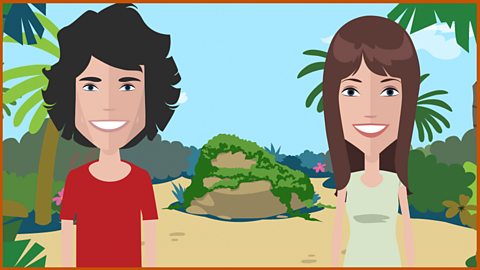
Join Andy and Rebecca to learn the song. The main learning objectives of the tutorial are:
- Identifying that the first two lines of each verse have short, bouncy notes (the musical term for this is staccato). The music here has a tense, worried feel - reflecting how anxious the thirsty animals are.
- Identifying how the third line of each verse is slow and smooth (legato) reflecting how sad the thirsty animals are that all the water has been drunk by Tiddalik.
- Paying attention to keeping in time as the music changes tempo.
- Identifying how the key changes from minor to major in the coda to give the song a bright, happy ending.
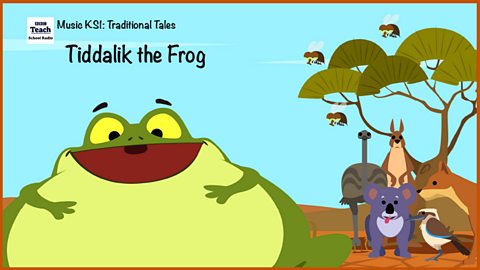
Story: Tiddalik the Frog, Part 2
Tiddalik has drunk all the water in the world. The animals devise a plan to get the water out of his belly. They hold a ‘Funny Show’ for him and when Snake accidentally ties herself in a knot Tiddalik finds it hilarious! He laughs so much the water bursts out of his tummy and returns to the streams, rivers and billabongs.
Story: Tiddalik the Frog - Part 2
Story questions
- Why is Tiddalik always grumpy? (He is always hungry and thirsty).
- What kind of animal is a kookaburra? (A bird).
- What is a billabong? (A stagnant pool of water).
- In what order does Tiddalik drink all the water? (The stream / the river / the billabong).
- How many different animals are in the story? (Tiddalik / Frogs / Kookaburra / Kangaroo / Dingo / Emu / Koala /…and the flies!).
Song: 'Oh, dear! The streams are all dry!'
Sing the song with Andy and Rebecca. In addition to the full vocal and backing track versions of the song there are individual clips for Verse 1, Verse 2, Verse 3, and the Coda. This allows you to navigate quickly to the individual sections of the song and to focus on specific sections while learning it.
Full vocal
Backing track
Verse 1
Verse 2
Verse 3
Final section (Coda)
Music activity
Focus: Pulse - the main beat / Clapping in time with the beat / Clapping with the off-beat
Music activity: clapping the on the beat and the off-beat
- Discuss how a pulse - or main steady beat - usually runs through a piece of music. This is what helps to 'hold the music together'.
- Andy and Rebecca clap the pulse and the children copy.
- Discuss how an off-beat is a beat which comes after the main beat. Andy and Rebecca clap the off-beat and the children copy.
- Children divide into two groups: A and B. They practise clapping on and off the beat with the presenters.
- Working in pairs and singing or using percussion instruments, the children can make up some of their own on or off the beat pieces.
Listening music: Grieg - 'In the hall of the Mountain King' from 'Peer Gynt'
This music was written in 1875 by Edvard Grieg and it's about a young man called Peer Gynt who is wandering in the mountains when he is captured by trolls. He runs away and the trolls chase him.
Listening music: 'In the Hall of the Mountain King'
- What is the group of instruments that is playing called? (An orchestra). Do the children know some of the families of the orchestra? (String / woodwind / brass / percussion families). Look at some pictures of the different families of the orchestra.
- The instruments are playing staccato. Refer this to the song, which also has staccato sections.
- Can the children hear when the orchestra plays more smoothly - or legato? This is towards the end of the piece, when the music gets faster.
- Dynamics: the music starts quietly and gradually gets louder.
- Tempo: what happens as the music continues? (It starts off slowly, but gradually gets faster).
Resources
Teacher's Notes. document
Guidance on all the content (pdf)
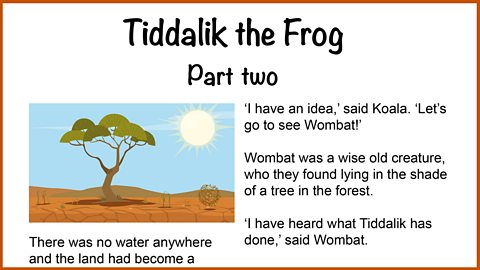
Illustrated story: Part 2. document
Download / print the illustrated transcript of Episode 2 (pdf)
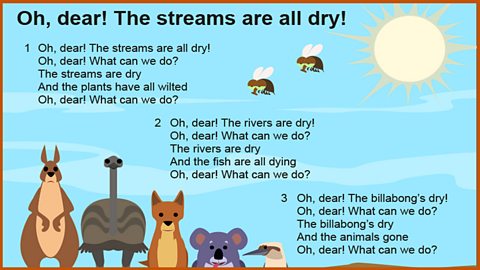
Lyrics: 'Oh, dear! The streams are all dry!' document
Download / print the lyrics for 'Oh, dear! The streams are all dry!' (pdf)
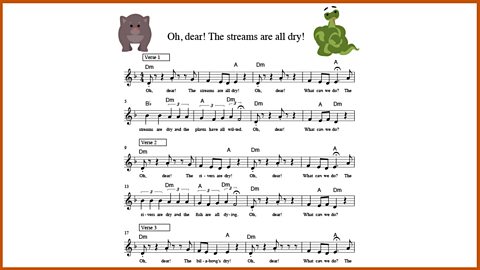
Music: 'Oh, dear! The streams are all dry!' document
Download / print the music for 'Oh, dear! The streams are all dry!' (pdf)
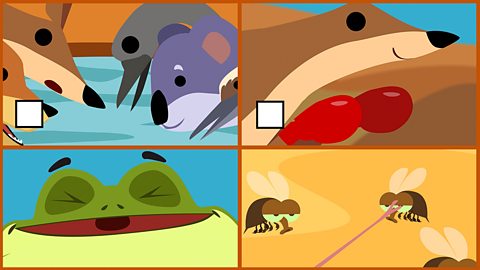
Sequencing activity. document
Sequence the events of the story (pdf)
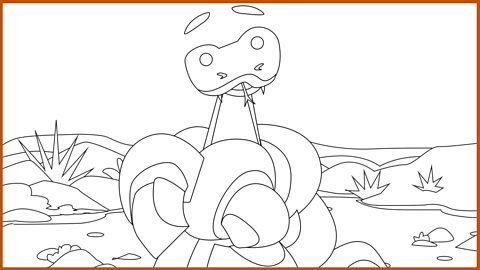
Outline drawing - Snake. document
Download / print Snake to colour in (pdf)
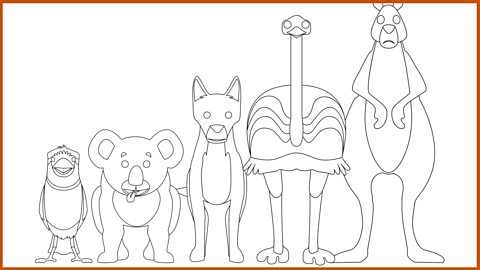
Outline drawing - the thirsty animals. document
Download / print the thirst animals to colour in (pdf)
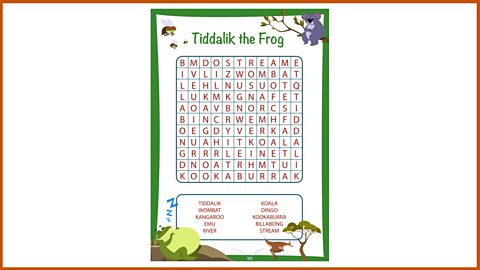
Word search puzzle. document
Download / print the word search puzzle (pdf)
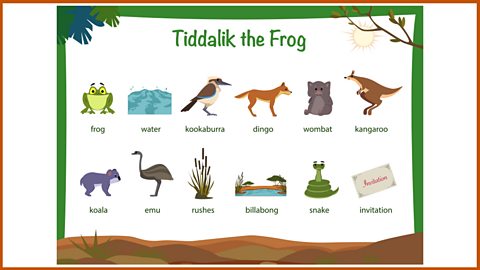
Vocabulary sheet. document
Download / print the vocab sheet (pdf)
Other episodes in this series
1: Tiddalik the Frog was thirsty, thirsty. collection
Age 5 - 7. Andy Day and Rebecca Keatley have songs and activities based on the famous Aboriginal story.
1: Down by the river it's as hot as can be. collection
Age 5 - 7. The songs and music activities explore the first part of an ancient Hindu story about the goddess Lakshmi.
1: Anansi the Spider. collection
Age 5 - 7. Andy and Rebecca begin a story about the trickster spider Anansi with more songs and music activities.