Tiddalik 1 - Tiddalik 2 - Lakshmi 1 - Lakshmi 2 - Anansi 1 - Anansi 2
The music activities and resources explore an ancient Hindu story about the goddess Lakshmi and a clever washerwoman who spies an opportunity when the Queen's new necklace comes into her possession. The music activity focuses on rhythm while the listening music for appraisal is an extract of sitar music played by Ravi Shankar.
Tutorial: 'Down by the river it's as hot as can be'
Tutorial: Learn the song 'Down by the river it's as hot as can be'
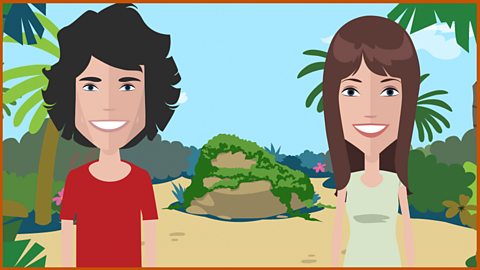
Join Andy and Rebecca for the tutorial. The main learning objectives are:
- Identifying the pulse and clapping along to it.
- Exploring the different word rhythms of the various actions in the chorus.
- Adding some actions to some of the words of the chorus - eg swimming actions, flying actions and washing actions.
- Understanding how the chorus gets a little longer each time as more actions are added.
- Listening for the onomatopoeia - words that sound like what they are illustrating - in the chorus.
Story: Lakshmi and the Clever Washerwoman, Part 1
The first part of a popular Hindu story set at Diwali about the goddess Lakshmi.
The King gives the Queen a beautiful necklace made of pearls. When she goes swimming she leaves the necklace on the riverbank and it is taken by a crow, who then drops it beside a poor washerwoman busy at her work. The washerwoman picks up the necklace and wonders what to do with it.
Story: Lakshmi and the Clever Washerwoman, Part 1
Story questions
- What festival are the King and Queen getting ready to celebrate? (Diwali - when the people light small lamps to welcome Lakshmi, the goddess of wealth and good fortune).
- What presents has the King given the Queen in the past? (An elephant / a sari covered in jewels).
- Why does the Queen think her necklace will be safe beside the river? (No-one would dare to steal from the Queen).
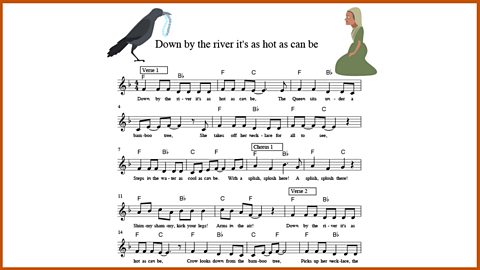
Song: 'Down by the river it's as hot as can be'
Sing the song with Andy and Rebecca. In addition to the full vocal and backing track versions of the song there are individual clips for Verse 1 + Chorus, Verse 2 + Chorus and Verse 3 + Chorus. This allows you to navigate quickly to the individual sections of the song and to focus on specific sections while learning it.
Full vocal
Backing track
Verse 1 and Chorus
Verse 2 and Chorus
Verse 3 and Chorus
Music activity
Focus: rhythms which are repeated (although the words are different) / Steady rhythms / Faster rhythms
Music activity: singing slow and fast rhythms
- Discuss how music often has rhythms which are repeated. In a song, rhythms can be repeated, although the words might change - eg ‘Scrub, scrub’ / ‘Flap, flap’ / ‘Splish, splosh’.
- Look at the steady word rhythms - eg ‘Scrub, scrub’ as well as the faster word rhythms - eg ‘Rubba-dubba’.
- The presenters clap and say these word rhythms and the children copy.
- The children can also add actions to these words.
- The presenters clap fast and slower rhythms and the children copy them.
- Singing, or using a percussion instrument, the children can make up some of their own fast and slow word rhythms with a partner.
Listening music: Sitar and tabla drum from India
Extract from Raag Bihag (Late Evening Raag) by Ravi Shankar
Listening music: extract from 'Raag Bihag' ('Late evening raag')
- The music is played by a famous Indian musician called Ravi Shankar.
- He is playing an Indian instrument called a sitar (accompanied by the tabla drum). A sitar is made of wood and can have up to 21 strings!
- The piece is called a raag or raga. A raga is a pattern of notes which can go up (ascending) or down (descending). It can be about a different time of the day, a season, mood or special occasion.
- Style. Can the children describe the music? There is a note which is lower than the rest, which plays underneath - the drone. There are also notes which go up (ascend) and go down (descend) over the drone. Is the music fast and exciting or atmospheric and dreamy?
Resources
Teacher's Notes. document
Guidance on all the content (pdf)
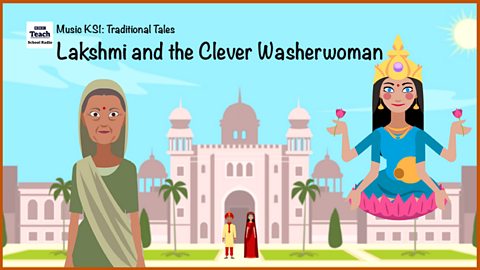
Illustrated story: Part 1. document
Download / print the illustrated transcript of Episode 1 (pdf)
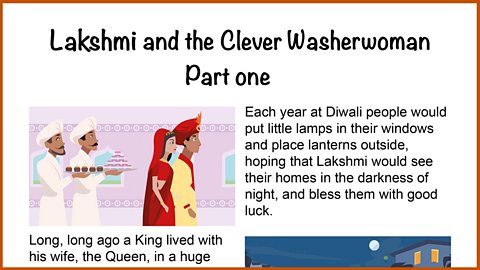
Lyrics: Down by the river. document
Download / print the lyrics for 'Down by the river it's as hot as can be' (pdf)
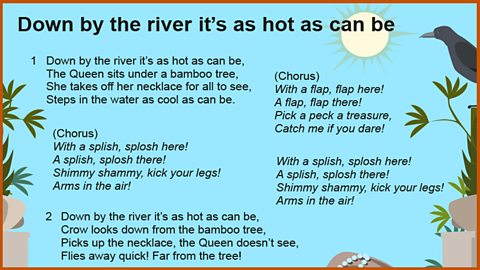
Music: Down by the river. document
Download / print the music to 'Down by the river it's as hot as can be' (pdf)
Sequencing activity. document
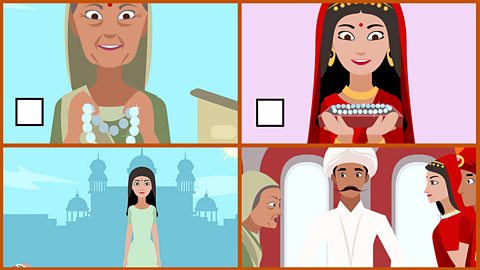
Sequence the events of the story (pdf)
Outline drawing - the palace. document
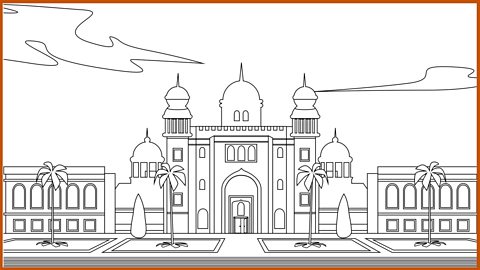
Download / print the palace to colour in (pdf)
Outline drawing - King and Queen. document
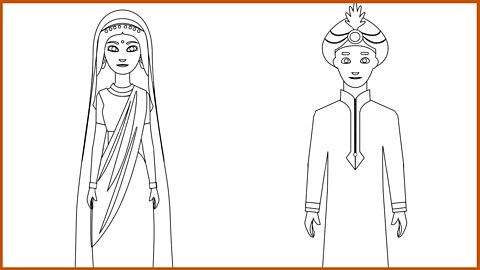
Download / print the King and Queen to colour in (pdf)
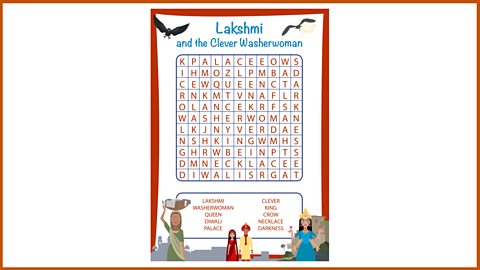
Word search puzzle. document
Download / print the word search puzzle (pdf)
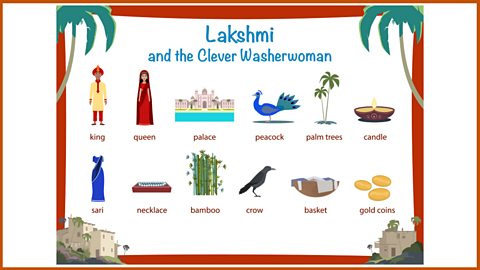
Vocabulary sheet. document
Download / print the vocab sheet (pdf)
Other episodes in this series
2: Lakshmi walks through the night. collection
Age 5 - 7. More songs and music activities with Andy and Rebecca based on the second part of the story about the goddess Lakshmi.
1: Anansi the Spider. collection
Age 5 - 7. Andy and Rebecca begin a story about the trickster spider Anansi with more songs and music activities.
1: Tiddalik the Frog was thirsty, thirsty. collection
Age 5 - 7. Andy Day and Rebecca Keatley have songs and activities based on the famous Aboriginal story.