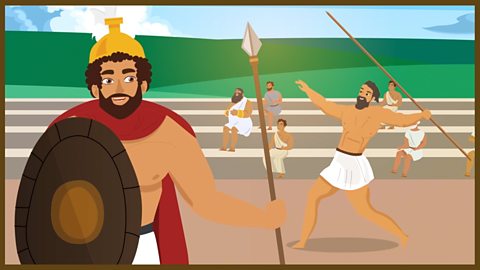
The song and other video content explores Ancient Greek society and culture and in particular life in Athens 2,500 years ago, when it was the most important of the Greek city-states.
The song
'Busy ancient city, Athens' - vocal
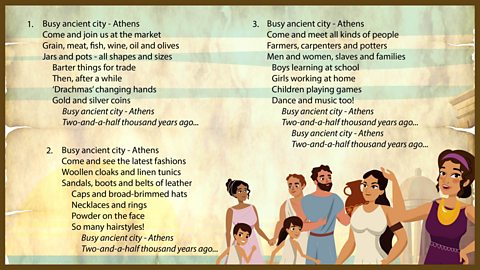
1 Busy ancient city, Athens
Come and join us at the market
Grain, meat, fish, wine, oil and olives
Jars and pots - all shapes and sizes
Barter things for trade
Then, after a while
Drachmas changing hands
Gold and silver coins
Busy ancient city, Athens
Two-and-a-half thousand years ago.
2 Busy ancient city, Athens
Come and see the latest fashions
Woollen cloaks and linen tunics
Sandals, boots and belts of leather
Caps and broad-brimmed hats
Necklaces and rings
Powder on the face
So many hairstyles!
Busy ancient city, Athens
Two-and-a-half thousand years ago.
[INSTRUMENTAL SECTION]
Busy ancient city, Athens
Two-and-a-half thousand years ago.
3 Busy ancient city, Athens
Come and meet all kinds of people
Farmers, carpenters and potters
Men and women, slaves and families
Boys learning at school
Girls working at home
Children playing games
Dance and music too!
Busy ancient city, Athens
Two-and-a-half thousand years ago.
Busy ancient city, Athens
Two-and-a-half thousand years ago.
Busy ancient city, Athens
Two-and-a-half thousand years ago.
The song is a celebration of everyday life in early Athens, exploring parallels between Ancient Greek life and contemporary 21st century life: food, sport, fashion, family and the roles of men, women, girls and boys.
The market scene focuses on trade, money, food, drink, jobs and farming, while hinting at the history of ancient warfare and slavery.
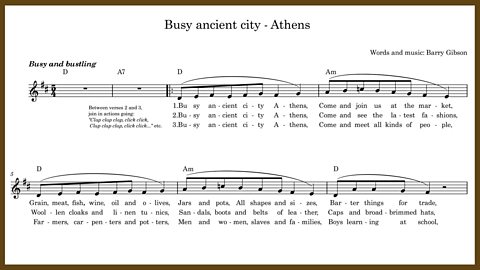
The tune has five beats in a bar and the accompaniment conjures up a sound world featuring panpipes, lyres and percussion, with some clap-and-click actions to join in. It can also be performed like a Greek circle dance!
Refer to the Teacher Notes for more information about the song, including follow-up music activities based on it and suggestions for cross-curricular study.

Context: what was life like in Athens 2,500 years ago?
ASPASIA:
Welcome to Ancient Greece!
Our civilisation is known for brilliant thinkers, fierce warriors, great poets, wonderful artists, amazing athletes, powerful gods, and stories about extraordinary monsters!
Our time is many years before your time, more than two thousand years ago. And our home is, what is in your time, the country of Greece and the hundreds of islands in the seas around it.
But Ancient Greece isn’t one big country. Our civilisation has grown from small, rival communities, often cut off from each other by mountains, rivers and the sea, to create the city-states - each like a mini country, with its own capital city.
The city-states all have their own governments, kings and queens and customs. We trade with each other and share ideas and stories. And sometimes we argue with each other and fight wars. But in doing so, we have created one of the most important civilisations of the Ancient World.
I am Aspasia, one of the most important women in the city of Athens. And this is my home, which has become a bit of an intellectual ‘place to be’ in the city. Famous writers and philosophers are always stopping by.
This is Athens in its Golden Age; the fifth century BCE - two thousand, five hundred years ago - a time when Athens is the most powerful of all the city-states.
Lots of the city-states have a particular god or goddess who is considered a special friend of the city. For Athens it’s Athena, the Goddess of warfare and wisdom.
Most Athenians - that’s the people of Athens - live here: below the Acropolis, a fortress built high up on the hill in the centre of the city.
Not many of the homes are like mine. Most are simply constructed from sun-dried mud bricks, usually built around a central courtyard. The size depends on how wealthy you are. But none of us have loos. We all have to go in pots. Yuck!
Nearby is the great port of Piraeus. Access to the sea is very important for trade and travel and so our main form of transport is by boat. The sea also gives us a plentiful supply of fish, octopus and squid. So fishing is big business, as long as you live near the water. But it’s hard to keep it fresh in a hot climate like ours. Transporting fish over long distances can get pretty smelly!
Farmers work the land around the city. It’s a hard life because the soil is dusty and the climate hot and dry. We grow grapes for wine - which we drink throughout the day - even at breakfast! And we grow olives for olive oil, which we use for cooking, lighting, and even washing!
The richer citizens might hunt deer and wild boar; but meat, for most people, is only for special occasions. Instead, we eat a lot of bread and porridge made from wheat, often with curdled milk or cheese, prepared and served by a slave. Most of us have them.
Many people make their living at the agora, the main marketplace in the city. Farmers bring their produce, such as grain, or oil, or olives; and craftspeople sell pots, clothing and leather items, like shoes and belts. And each city-state has its own money, the coins often made from electrum - a mix of silver and gold.
Most people wear simple tunics, made from wool or linen, under a cloak. In fact, men’s and women’s clothes are quite similar. But the kids wear shorter tunics so they can run around!
Not many women in Ancient Greece are as lucky as me. Women in general are considered less important than men. Girls aren’t allowed to go to school. Instead, they’re expected to marry young and learn how to look after a household.
Boys from wealthier families do get to go to school from the age of seven and they learn reading, writing, maths, music, poetry and the art of debating. We Ancient Greeks do love a good, heated discussion!
So, home again. And here comes Socrates - another famous philosopher. He doesn’t half go on!
We are transported back to the year 500 BCE (Before Common Era) to meet Aspasia of Miletus - one of the most important women in Athens.
Aspasia introduces us to the city-states of Ancient Greece and shares facts about the daily life of the citizens of Athens, the most powerful of all the city-states at that time. Aspasia shows us a statue of the goddess Athena - who has a special importance for the people of Athens - and the hill above the city called the Acropolis.
The topics Aspasia covers include work, home life, food, marriage and the lives of children.
She explains the importance of the sea as a source of food and transportation; the domestic arrangements of a typical household - including slaves; and the fact that boys can go to school to learn skills such as debating, but girls must stay at home and learn housekeeping.
Resources
'Busy ancient city, Athens' - instrumental
1 Busy ancient city, Athens
Come and join us at the market
Grain, meat, fish, wine, oil and olives
Jars and pots - all shapes and sizes
Barter things for trade
Then, after a while
Drachmas changing hands
Gold and silver coins
Busy ancient city, Athens
Two-and-a-half thousand years ago.
2 Busy ancient city, Athens
Come and see the latest fashions
Woollen cloaks and linen tunics
Sandals, boots and belts of leather
Caps and broad-brimmed hats
Necklaces and rings
Powder on the face
So many hairstyles!
Busy ancient city, Athens
Two-and-a-half thousand years ago.
[INSTRUMENTAL SECTION]
Busy ancient city, Athens
Two-and-a-half thousand years ago.
3 Busy ancient city, Athens
Come and meet all kinds of people
Farmers, carpenters and potters
Men and women, slaves and families
Boys learning at school
Girls working at home
Children playing games
Dance and music too!
Busy ancient city, Athens
Two-and-a-half thousand years ago.
Busy ancient city, Athens
Two-and-a-half thousand years ago.
Busy ancient city, Athens
Two-and-a-half thousand years ago.
Teacher Notes. document
Click to download / print the Teacher Notes (pdf)
Busy ancient city, Athens. document
Click to download / print the lyric sheet (pdf)
Busy ancient city, Athens - Music. document
Click to download / print the music sheet (pdf)
Download audio
Download the backing track of the song (mp3)

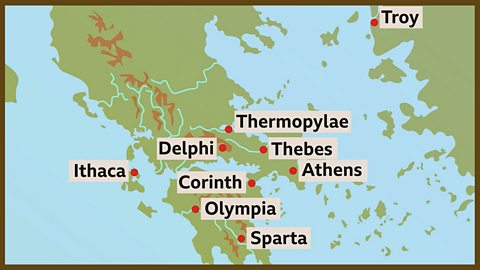
Map: some city-states of Ancient Greece. map
Click to download / print the map (pdf)
More from KS2 Music: Ancient Greece
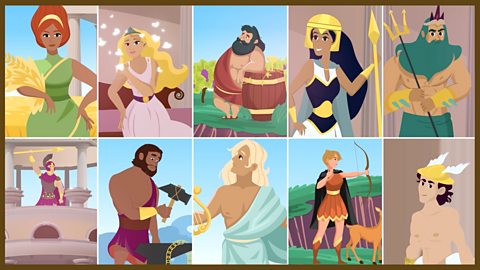
2. Myths and mysteries
Exploring Ancient Greek gods and goddesses and beliefs about the afterlife.
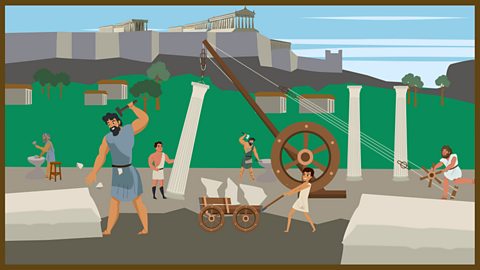
3. Build up stones and sculptures
Exploring architecture, theatre and other cultural activity in Ancient Greece.
4. Get training
The original Olympic Games of Ancient Greece and how they differed from the Games of today.