Press play to watch the Live Lesson now.
Curriculum links:
- National Curriculum, England - Key Stage 2 – Science
- National Curriculum, Northern Ireland - Key Stage 1 and 2 – The World Around Us
- Curriculum for Excellence, Scotland - 1st and 2nd Level – Sciences
- Curriculum for Wales - Progression steps 2 and 3 – Science & Technology
Learning objectives:
- Understand that light travels in a straight line and that objects can be seen because they emit or reflect light into the eye.
- Be able to identify different light sources.
- Know that light from the Sun can be dangerous to their eyes, and to never look directly at it.
- Use knowledge of the properties of light to show how it can be used in a creative way through the use of mirrors.
- Describe the relative movements of the Earth, Moon and Sun and understand our place in the solar system.
- Use simple models to communicate an understanding of size, scale, time and relative motion in our solar system.
- Understand that the Earth’s rotation gives us night and day.
- Observe, research and ask questions about features of our solar system.
What happens in the Live Lesson?
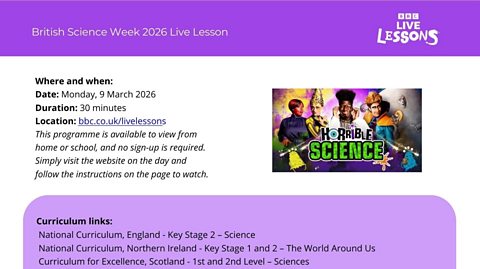
A Horrible Science inspired Live Lesson.
This Live Lesson is packed with curriculum-linked fun as children make a movie starring the Moon from CBBC's Horrible Science.
During the lesson, aimed at 7-11 year-olds, pupils will investigate light energy and learn about the Moon and our solar system to ensure their final script is science fact, rather than science fiction.
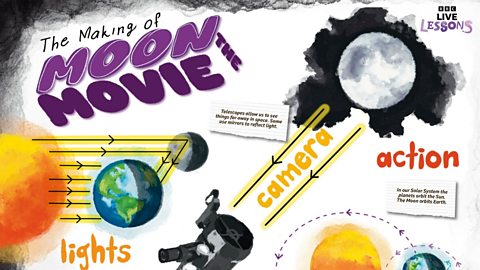
Presenters Grace Webb and 'The Rapping Science Teacher' Matt Green are on hand to guide them, while artist Venessa Scott creates a poster for classrooms capturing the key learning points.
Astronaut Tim Peake also makes a special guest appearance sharing facts about the Moon, as he marks the 10th anniversary of his mission to the International Space Station.
Teaching Guide. document
For downloading/printing
White Rose Science
White Rose Science have developed free follow-on resources aligned with this year’s British Science Week theme, ‘Curiosity:What’s your question?'. The resources include activity sheets, questions and teaching guidance and have been designed to lead on from the Live Lesson, but can also be used flexibly.
Mission Packs
Download the Mission Pack in preparation for the Live Lesson. There are 3 versions available. Choose the option which best suits your needs.
Pupils are still able to participate without access to the Mission Packs. All instructions will be on screen. We recommend that pupils have a notebook and pen or pencil to hand.
Mission Pack: digital. document
Designed to be opened and edited using a tablet. Pupils will be able to type in text boxes and use the pen tool to draw.
Mission Pack: printable booklet. document
To be printed double-sided on 2 sheets of A4 paper. Fold in half to create A5 booklet. Pages are numbered and should run from 1 to 8 when one sheet is placed inside the other. Designed to support black-and-white printing.
Mission Pack: printable A4 sheets. document
This is the best option if you do not have the option to print double sided. Designed to support black-and-white printing.
Extra resources
Recap the key points from the lesson
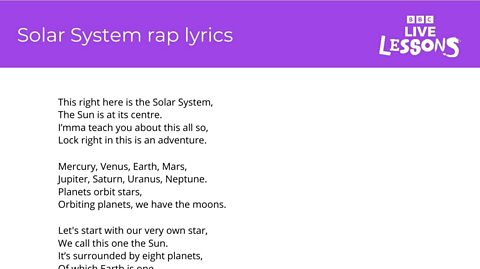
Keep the learning going after the lesson with a downloadable poster that sums up the key learning and Matt's orbits rap!
Press play to listen to the Solar System rap
Solar System rap lyrics. document
Download the lyrics to the Solar System rap
British Science Week Live Lesson poster. image
Click here to download Venessa's poster
Tim Peake's Lunar Lowdown
Moon facts with Tim Peake's Lunar Lowdown
How to get involved:
This programme was pre-recorded and accompanied by a live website commentary feed for schools.
We added as many messages as we could to this live commentary page on the day of the Live Lesson.
Please do not send any more emails about this lesson, as they will not be included.
Please note this live commentary page is now closed. document
Click or tap here to see if your school has had a shout-out.

What is Horrible Science?
Horrible Science is a comedy sketch series from the award-winning team behind Horrible Histories. It can be watched here on BBC iPlayer.
Horrible Science is also available in short video clips on BBC Bitesize - designed with classroom use in mind and aligned with the National Curriculum for Primary Science.
Read this article to find out how you can get the most out of Horrible Science in your classroom.

Where next?
How to use Horrible Science in the classroom. document
Find out how you can get the most out of Horrible Science in your classroom.

Watch again: British Science Week 2025 – Space Live Lesson. video
Join Tim Peake's astronaut training school in this interactive lesson.
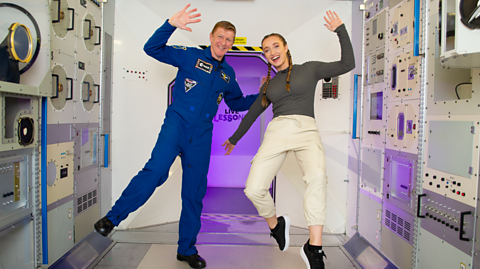
BBC Bitesize: Tim Peake
Learn more about Tim Peake with this KS2 guide from BBC Bitesize.