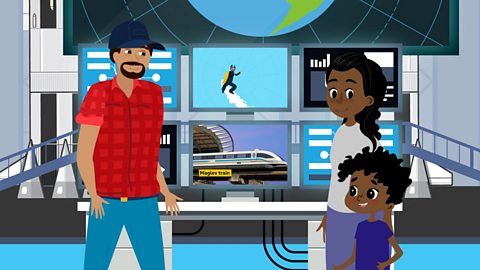
Rian and Maya travel through the UK in an electric car, learning about different forms of wheeled transport.
Aunt Maya: Put your seatbelt on please, Rian.
Rian: Why do we need to wear seatbelts, Aunty Maya?
Aunt Maya: For safety - just in case we need to stop suddenly or we bump into another car. The seatbelt stops you from flying forward and being hurt.
Rian: Oh, what a great idea seatbelts are! So what part of our journey are we doing today?
Aunt Maya: We're driving south from here in Scotland, all the way through England. Ready?
Rian: Let's go. It's so quiet in this car.
Aunt Maya: That's because it's an electric car. Many cars have an engine that uses petrol or diesel fuel to make them go. They let out smoke and pollution that is not very good for the planet or for us. But electric cars have a big battery that powers the motor and makes the car move. They cause less pollution because they don't make any smoke or fumes.
Rian: Like a bigger version of my remote-control car at home.
Aunt Maya: A bit like that, yes.
Rian: Can this car go really fast?
Aunt Maya: It can go fast, but we need to stick to the speed limit.
Rian: What's a speed limit?
Aunt Maya: A speed limit is the fastest speed you're allowed to travel. That's sign shows us that this road has a speed limit of 20 miles per hour.
Rian: Is that how fast we're going?
Aunt Maya: We are just a little slower than 20.
Rian: Why do we have to go so slowly?
Aunt Maya: It's for safety. We're in a town and there are people walking around, people on bikes and the roads are quite small.
Rian: That car looks different.
Aunt Maya: Yes, that is a very old car. It is different from cars today.
Rian: The wheels are really thin.
Aunt Maya: It doesn't drive as fast and it doesn't have any electric windows.
Rian: What? When were the first cars made?
Aunt Maya: The first motor cars were made more than 130 years ago in Germany and soon after cars were being made in factories all around the world. In America, someone called Henry Ford made a car that lots of people could afford to buy, so it didn't take long before cars were everywhere.
But cars weren't the first type of transport to use wheels. Wheels were an amazing invention. Some people even say it was the most important invention of all time. People from all over the world have been travelling with wheels for a long time. For example, some built carriages and chariots with wheels that could be pulled along by animals or people.
Rian: Pulled by people! That sounds like hard work.
Aunt Maya: And then of course, there are bicycles. The first bike was invented over 200 years ago in Europe.
Rian: Wow, that bike looks so different to bicycles today.
Aunt Maya: Not all that comfortable - which makes this next story even more amazing. Annie Londonderry became the very first woman to cycle all around the world. She set off from this part of America in 1894. She had to catch boats between some countries, but she cycled across Europe all the way through Asia and then caught a boat back to America from Japan. She finished her journey exactly a year later, where she had started.
Rian: Amazing! But she's not wearing a helmet. Mum always says you should wear a helmet when you cycle.
Aunt Maya: Well spotted. Bicycle helmets hadn't been invented when Annie made her journey. They didn't realise how dangerous it could be if you fell off and bumped your head. Now we know that helmets can help keep our heads safe.
Rian: This road we're on now is much bigger.
Aunt Maya: This is called a motorway and this one has three lanes on each side so more cars can go on the road.
Rian: And we're going faster.
Aunt Maya: Yes, the speed limit here is 70 miles per hour.
Rian: There are a lot of different vehicles on the motorway too.
Aunt Maya: Yes, lorries which transport things like food all over the country.
Rian: There's a van. My dad has a van for his work so he can carry all his equipment.
Aunt Maya: He does. And look - there's a passenger coach.
Rian: A coach can carry lots of people.
Aunt Maya: They transport more people in one journey than we can in a car.
Rian: My favourite type of car is a racing car.
Aunt Maya: They are pretty great. People race lots of different vehicles for fun.
Rian: Like monster trucks. When I'm older, I'm going to try and drive one of those.
Aunt Maya: An electric monster truck, I hope.
Rian: Rian Definitely.
Video summary
This short film was first published in 2022.
Maya and Rian drive an electric car travelling south through the UK.
They discuss speed limits and why we have them.
They look at some early cars - such as those built by Henry Ford - and how they differ from cars today.
They also compare some early bicycles to modern bicycles and Maya tells Rian about Annie Cohen Kopchovsky - 'Annie Londonderry' - the first woman to cycle around the world.
Maya and Rian discuss the different types of wheeled vehicles they see on the motorway, such as lorries, vans and coaches.
Questions to ask:
- Why do we have seatbelts?
- What is a speed limit? Have you noticed any speed limit signs around your local area?
- Where was the first car made?
- Who was Annie Londonderry and why was she famous? How long did her journey take her?
- Why are bicycle helmets important?
- How many different wheeled vehicles did you spot during the video? Can you think of any more that didn’t feature in the video?
Suggested activities
- Ask the children how many wheeled vehicles they can think of. Ask them to keep count of all the different vehicles they can see while watching the video.
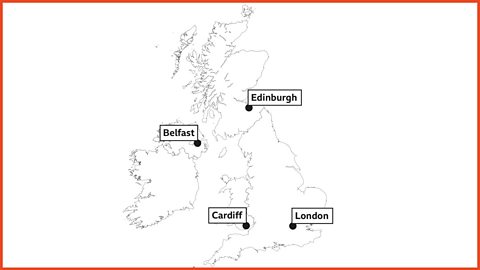
- Plot Maya and Rian’s journey from Edinburgh to Portsmouth using the map included in the Resources. Did they go near your school? Can you find where your school might be on this map? Label the four nations of the UK and their capital cities. Then mark on the four points of a compass.
- Look at the two bicycles shown in the video, old and new (or pictures of other old bicycles such as the Penny Farthing). How are they similar and how are they different?
- Look at the map showing Annie Londonderry’s journey around the world and investigate some of the places she visited (eg USA, France, Egypt, Japan). What can you find out about those places? Imagine you are Annie Londonderry arriving home after a whole year cycling around the world. How might she have felt? Role play being Annie returning home and take turns asking her questions about her journey.
- Make cycle / scooter safety awareness posters for children, or car speed awareness posters for drivers near school. What might the posters include?
- Draw and label two different wheeled vehicles- such as a coach, lorry or van - and explain what that vehicle is used for (eg transporting lots of people at once).
- Undertake a survey of the traffic that travels past your school. Use tally charts to count the number of cars, vans, motorbikes, etc that drive past. Use tables, graphs or charts to record your findings. Alternatively, do a survey of the different modes of transport that people in your school use to travel to school.
Resources
Teachers' notes. video
Download / print notes for the series (PDF)
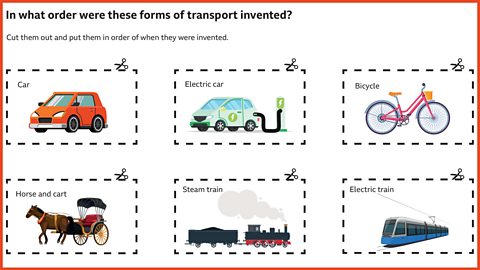
Sorting activity. document
Download / print (PDF)
Colouring activity. document
Download / print (PDF)
Other episodes in this series
1. Awesome animals. video
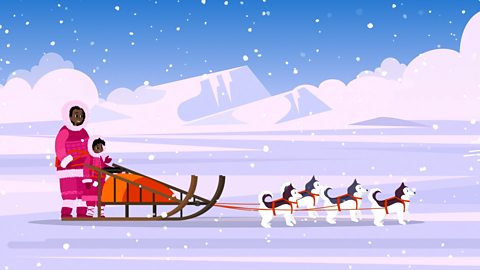
Rian and Maya set off, learning as they go how animals have been used throughout history for transport.
3. Brilliant boats video
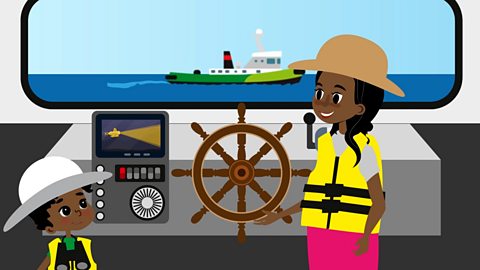
Rian and Maya travel by sea to the continent of Africa and look at the history of boats.
4. Fantastic flying machines. video
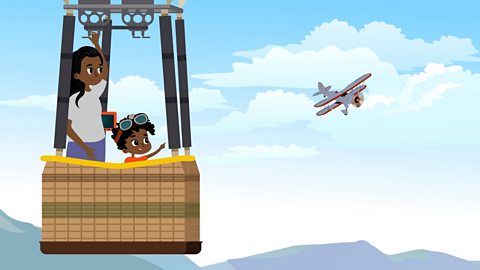
Rian and Maya travel through Africa in a hot air balloon and learn about different forms of air travel.
5: Tremendous trains. video
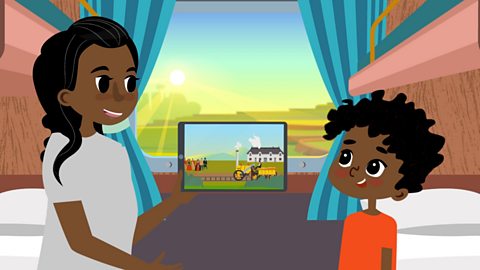
On a train journey across India, Rian and Maya learn about the history of rail travel.
6. The future of transport. video
Maya and Rian are in Australia, where they travel in a driverless car to a 'Future of Transport' exhibition.