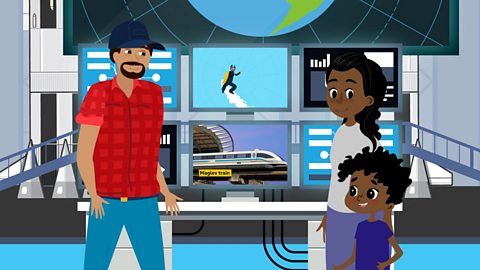
In this episode Rian and Maya take to the water, learning about different types of ships and boats.
Rian: Look at all these boats, Aunty Maya! There are so many shapes and sizes!
Aunt Maya: There are, Rian. Different boats are used for different things.
Rian: That one is huge!
Aunt Maya: That is a cargo ship. It's used to carry things like cars or food across the oceans.
Rian: That one's big too!
Aunt Maya: That is a ferry. It carries people and their cars across the sea.
Rian: What are those white sheets on that boat?
Aunt Maya: They are called sails - that is a sailing boat. Come into the cabin and I'll show you how it works. Take a look at this. The wind blows into the sails and pushes the boat along.
Rian: How does that one move?
Aunt Maya: That's a bit like our boat. It has a motor that turns a big propeller under the water that pushes the boat forward. It's a fishing boat. And there's another one. You can see all the fishing nets on the back.
Rian: That one looks fun.
Aunt Maya: That's a canoe. You use a paddle to push yourself through the water. And there's something you don't see every day - a hovercraft.
Rian: What's that big fan on the back for?
Aunt Maya: It's another kind of propeller. It turns in the air and makes the wind that pushes the boat forward.
Rian: Why is it called a hovercraft?
Aunt Maya: Because it hovers just above the water when it moves. Most other boats sit in the water.
Rian: Wow! And some boats go all the way under the water, don't they?
Aunt Maya: Yes, submarines.
Rian: There might be one under us right now.
Aunt Maya: Maybe. Ready to set off on our electric motorboat?
**Rian:**Yes. Where are we travelling today?
Aunt Maya: We are travelling south around Europe for this part of the journey - all the way to Africa.
Rian: So exciting! Let's go!
Aunt Maya: Boats are one of the oldest forms of transport. People have been using boats to travel and explore for thousands of years.
Rian: Like pirates?
Aunt Maya: Well yes, but even before pirates. Vikings who came from what we now call Scandinavia about 1000 years ago, used long wooden boats to explore Europe. They could carry many warriors and they travelled on long journeys to find other lands.
Rian: Who else used boats?
Aunt Maya: Many early towns around the world were built on rivers, so they were near a water supply. That meant boats could be used on the river for travel before any cars or roads existed - rivers like the Nile and the Niger in Africa and the Indus River in Asia. This is a boat made from plants called reeds that was used on the River Nile in Egypt.
Rian: That boat has lots of sails.
Aunt Maya: These were used about 500 years ago by Europeans travelling across the oceans to explore the world. They often spent many months at sea. Then later, scientists and explorers sailed around the world looking for new types of animals and plants.
Rian: Wow, do you have any stories about them?
Aunt Maya: One of my favourite stories is about Jeanne Baret. She was a woman from France who disguised herself as a man so that she could join an expedition going around the world. At the time women weren't allowed to make such journeys. Nobody realised she wasn't a man.
Rian: Wow!
Aunt Maya: She became the first woman to sail all the way around the world and she was an expert botanist.
Rian: What's a botanist?
Aunt Maya: It's a scientist who studies plants and flowers.
Rian: She sounds awesome. Do people still travel around the world on boats to discover new things?
Aunt Maya: They do. People go all around the world on adventures and some people even go underwater in submarines to explore the deepest parts of the oceans, like this.
Rian: To find new types of fish and underwater caves…?
Aunt Maya: Exactly! But many boats are used just for having fun.
Rian: Grandma has her little sailing boat.
Aunt Maya: She does and she's an excellent sailor. Some people even go on holidays on a boat. Those boats are called cruise ships. There's one.
Rian: It is massive!
Aunt Maya: It is. We'd better steer clear of that one.
Rian: Yeah, we should.
Aunt Maya: Onwards.
Rian: Woo-hoo!
Video summary
Maya and Rian look out from their boat at all the other different types of boat they can see in the harbour.
They discuss how different boats move - for example using sails, a paddle, or a motor.
We see a map displaying their route from England, south around Europe to Africa.
Maya tells Rian about Viking ships, as well as other civilisations and people that have used boats in the past.
Maya tells the story of Jeanne Baret, a botanist who disguised herself as a man so that she could join an expedition on a French naval ship.
Without realising it Jeanne became the first woman to circumnavigate the world.
Questions to ask:
- What different types of boats can you see in the video?
- What does ‘hover’ mean? Why is a hovercraft called that?
- Can you name any of the people in the past who used boats to travel?
- Why did scientists and explorers travel the world? What were they looking for?
- Who was Jeanne Baret?
- What is the name of the type of transport that travels under the water?
Suggested activities
- Ask the children about their experiences of boats and if they have ever travelled on a boat.
- Carry out some floating and sinking experiments. What materials float best? Which materials are waterproof or not? Try to create some small boats using different modelling resources and see if they float.
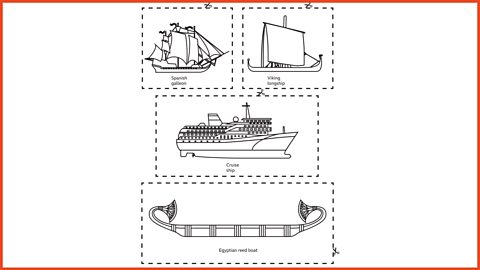
- Make models or draw pictures of Viking longboats and Egyptian reed boats.
- Use a map, globe or atlas to find out where Rian and Maya are travelling. Plot their journey so far.
- Find out more about the life of Jeanne Baret and some of the places she visited (Rio de Janeiro, Tahiti, Mauritius). Imagine you are Jeanne and her fellow travellers on their boat during a terrible storm. Role play how the boat rocks from side to side. Use untuned percussion instruments to create the sounds of the storm. Create an entry for a ship’s logbook, describing what happened. Now imagine the storm calms and the ship docks in a port. How does it feel to be on dry land again? Write another entry in the ship’s logbook. Alternatively, carry out the same activities but in role as Rian and Maya on their journey from England to Africa.
- Imagine you are underwater explorers in a submarine, exploring the deepest depths of the ocean. What might you see? Imagine you discover a sea creature that no one has ever seen before. What does it look like? Draw a picture of it or write a description of it.
- Sort pictures of different boats into groups according to different sorting criteria, using hoops to create large sorting diagrams. Criteria could include: different power sources (uses a motor/uses wind/uses paddles etc); historical or modern; or the children could sort them according to size etc.
Resources
Teachers' notes. video
Download / print notes for the series (PDF)
Sorting activity. document
Download / print (PDF)
Colouring activity. document
Download / print (PDF)
Other episodes in this series
1. Awesome animals. video
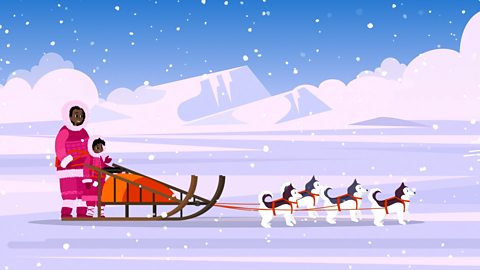
Rian and Maya set off, learning as they go how animals have been used throughout history for transport.
2. Wonderful wheels. video
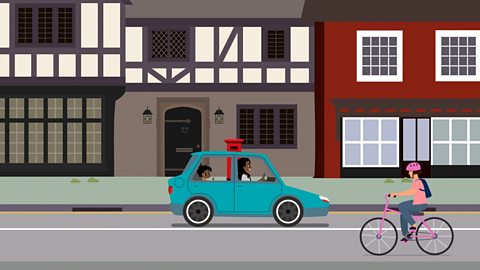
A journey through the UK in an electric car with Rian and Maya finding out about wheeled transport.
4. Fantastic flying machines. video
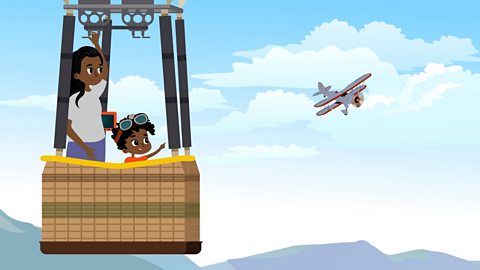
Rian and Maya travel through Africa in a hot air balloon and learn about different forms of air travel.
5: Tremendous trains. video
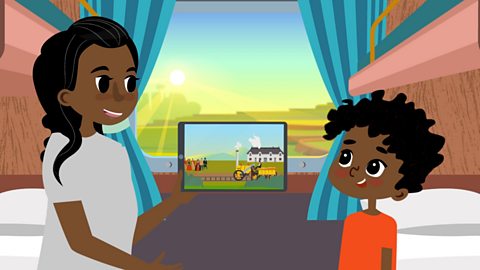
On a train journey across India, Rian and Maya learn about the history of rail travel.
6. The future of transport. video
Maya and Rian are in Australia, where they travel in a driverless car to a 'Future of Transport' exhibition.