Ade Adepitan visits Queensland, Australia, where drought has had a devastating effect on the landscape and local communities.
ADE: Hi, I’m Ade and I’m in Queensland, Australia. This part of the country has been going through a drought for a long time and it’s having a devastating effect on the landscape.
NEWS: Severe drought resulted in the past three months being the driest on record. That left the largest ever area of Australia, nearly 60%, at risk of fire.
ADE: I was visiting when around a third of this huge country was in drought.
NEWS: 2019 was Australia’s hottest and driest year on record and is likely to stretch water resources even further.
ADE: This place should be surrounded by acres of lush, green grassland. It’s a sheep farm and belongs to Geoff Elliot.
GEOFF: Hello.
ADE: How are you, mate?
GEOFF: I’m not too bad. Little bit of rain wouldn’t go astray.
ADE: Good to meet you, mate.
GEOFF: Likewise.
ADE: I hear you’ve got loads of sheep, can we have a look at them?
GEOFF: I’m just about to, on my way now to feed them. So why don’t we jump on board and…
ADE: Let’s do this.
Geoff would normally have up to 8,000 sheep, but with hardly any rain, he could only afford to keep 1,000.
GEOFF: We should be driving through grass where that timber ahead of us, you wouldn’t see it. That’s all buried in, all disappears under grass.
ADE: I can’t even imagine this under grass, it just looks like a rocky desert.
GEOFF: That’s right.
ADE: And they’ve got nothing to eat? I mean the ground looks absolutely barren.
GEOFF: No, so what they’re eating is what I’ve got on the back of the ute.
ADE: As there was no grass, Geoff was spending £400 a week on corn.
ADE: Here they come, the sheep!
GEOFF: Yeah, they know what’s going on.
ADE: Tucker time!
GEOFF: So if you notice the dam there, that’s their water supply.
ADE: That there?
GEOFF: That there.
ADE: That’s just like a little puddle.
GEOFF: That’s their water supply.
ADE: How can they survive on that?
GEOFF: Well they can’t. This hasn’t just happened this year or last year, it’s been going on for… since about five years. But at the moment, this has gone beyond a drought, this is… this is a disaster. This is the worst that man has experienced in this country.
ADE: Even for someone like Geoff, who’s toughed it out here for decades, farming this land is becoming too much.
Let’s get out. Let’s get amongst the sheep.
GEOFF: There’s definitely something happening in the climate. I mean, we can’t… that can’t be denied. We don’t get the rainfall. We don’t get the spring rain that we used to get a number of years ago. It’s… it’s very, very obvious that there’s change happening.
ADE: What’s it doing to your land?
GEOFF: Well, it’s slowly destroying it.
ADE: I mean this looks pretty tough.
GEOFF: Yep, it is tough. Yep, sorry about that.
ADE: No, that’s OK. That’s okay mate. That’s okay. Just take your time.
GEOFF: We want rain. It’s as simple as that.
ADE: Come on in guys! Grub’s up!
GEOFF: We will survive here. But I have neighbours that won’t. I…
ADE: I’m sorry, mate.
GEOFF: It’s serious. I fear for their … for their health and their safety. I think that this is a natural disaster, people are dying because of this, silently, unfortunately.
ADE: Australia is a rich, prosperous country. But it seemed to be struggling to cope with how hard it was being hit by climate change.
Video summary
Download/print a transcript of the video.
Ade Adepitan visits Queensland, where drought has had a devastating effect on the landscape.
Australia is a rich, prosperous country but it has suffered from drought for several years. In 2019, Australia’s hottest and driest year on record, nearly 60% of the country was at risk of fire. Ade meets sheep farmer Geoff Elliot, who would normally have up to 8,000 sheep, but with hardly any rain, he could only afford to keep 1,000.
This clip is from the BBC Two series Climate change: Ade on the frontline.
Teacher Notes
Download/print a pdf of the Teacher Notes.
Teacher Notes prepared in partnership with the Geographical Association.
Before watching the film
You may wish to use this film clip to deepen understanding of the impacts of climate change on people and their environment, in which case it would be helpful to have done some work already in this area and for students to know about the factors that cause drought and bushfires.
Alternatively, this film might be used to stimulate enquiry questions about drought and bushfires and find out more about where they happen, why they happen and how they impact on people’s lives.
During the film
You may wish to stop at relevant points during this short film to pose questions and check understanding or wait until the end. Useful questions might include:
- What do we mean by ‘drought’?
- What are the factors involved?
- What are the long-term impacts of drought?
You may want students to take on an empathic approach by understanding the situation better from the farmer’s point of view. For example, the farmer being interviewed says:
“This has gone beyond a drought. This is a disaster”
- What do you think he means?
- How serious is this problem and what is the worst that might happen?
- How is the farmer feeling when he talks about this disaster?
You might discuss the seriousness of this issue with the devastating figures such as ‘60% of the entire country being at risk of fire’ and considering the recent records of extreme weather. The farmer calls this drought a ‘silent killer’. What do you think he means?Are students surprised that this devastating drought happened / is happening in a rich country?
Following on from the film
Establish locational context. Use maps to locate the state of Queensland, Australia and identify areas historically most affected by drought. You might annotate maps with relevant data from meteorological and news reports to help ‘tell the story’ about drought and its impacts.
Establish what a drought is and how climate hazards like this are influenced by human -induced climate change. Identify other factors that may be involved – for example, older students may be making links between droughts and El Niño events.
KS3 students might watch the film again but this time look out for and collect numerical statistics given in the film and, working in pairs, perhaps use this to create an infographic alongside a map that explains some of the key features and impacts of this drought. Further research could be used to develop this.
You could ask students to identify the impacts of this climatic hazard in terms of economic, environmental, and social aspects and examine how they are linked. When enquiring about economic aspects, students could consider not just the financial decline for farmers but for other people looped into the supply chain. What are the impacts on other workers and on job security? How does this influence the price and availability of food for consumers?
In considering environmental impacts, students could consider the health of the soil and loss of biodiversity. When considering social impacts, students could explain how climatic hazards such as this can harm people’s well-being in hidden ways as well as ways that can be measured: mental health and physical health can both be affected by the trauma of drought. This enquiry could be developed into a case study about the impact of climate change in a higher income country.
You could ask students what advice they might offer, following their research, as to how mitigation and adaptation might feature in a response to this hazard?
This short film is suitable for teaching KS3 and KS4 students. It can be used alongside the other Ade Adepitan films about climate change or watched on its own. All the films build on students’ understanding of climate change issues and enable them to make global connections.
This film supports the KS3 geography curriculum by investigating our changing climate and how human and physical processes interact to influence and change landscapes and environments.
At KS4, the film supports understanding about the impacts of rapid climate change on environments and people’s lives. The film develops understanding about the economic, social and environmental consequences of climatic hazards (AQA) for example and changes caused to the natural environment. It also raises questions about land use and water scarcity.
This clip could be used to support the delivery of geography to KS3 and KS4 students. Specifically, this topic appears in OCR, Edexcel, AQA, WJEC KS4/GCSE in England, Progression Step 5/GCSE in Wales, CCEA GCSE in Northern Ireland and SQA National 4/5 in Scotland.
Rising sea levels in the Solomon Islands. video
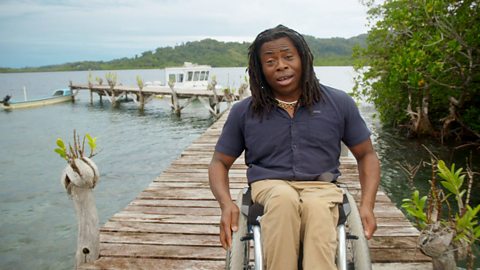
Ade Adepitan travels to the Solomon Islands to see the dramatic effect rising sea levels are having on local communities.
Kelp reforestation in Tasmania. video
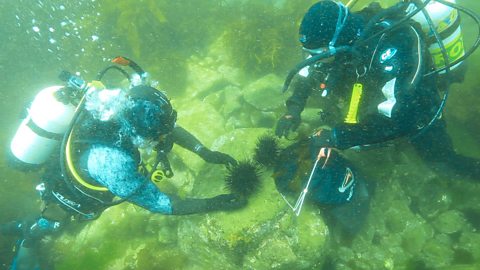
Ade Adepitan travels to Tasmania to find out about the work being done to protect the carbon-capturing underwater kelp forests.
Renewable energy in Tasmania. video
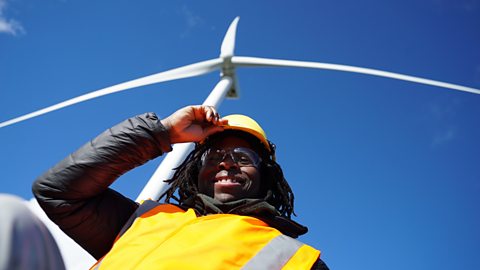
Ade Adepitan visits a wind farm in Tasmania that will help the island to reach a major milestone: producing all of its electricity from renewable sources.
Reducing food waste in Sydney, Australia. video
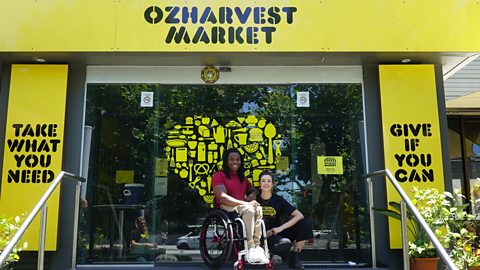
Ade Adepitan visits Sydney to learn about an organisation that redistributes food that would otherwise be wasted.