Ade Adepitan travels to the Solomon Islands to witness the dramatic effect rising sea levels are having on local communities.
ADE: Hi, I’m Ade. I’m in the Solomon Islands out in the Pacific Ocean and these islands are beautiful but they’re under threat because of rising sea levels which puts them on the front line of climate change.
The Solomon Islands are one of the most heavily forested countries in the world.
Finally I’ve seen some signs of life. We’ve been on this boat for about half an hour, maybe more, and this is the first person I’ve seen. How you doing?
The population here is small and most people live off the land or the sea.
I think this is where we’re headed to, we’ve got a load of houses right on the water, all built on stilts.
I’d come to a village called Kia to pick up Gladys Habu.
GLADYS: Hello.
ADE: Hey Gladys, welcome on board.
Gladys wanted to take me to a nearby island called Kale. It was one of her favourite places to visit as a child.
GLADYS: So this is a photo that I took. My grandparents actually lived here. Some of my best childhood memories were here at Kale. So that is unfortunately what’s left of Kale island.
ADE: Is this it? Wow. So ten years ago, that looked like this?
GLADYS: Yeah. It was so beautiful, so thick with forest.
ADE: And it’s gone! That’s astonishing.
Kale used to cover 50,000 square metres, but as sea levels have risen, Kale has disappeared.
GLADYS: It’s quite devastating, I remember I would have to walk around with mum and dad with me because we’d lose our way if we go on our own. That’s how big Kale was.
ADE: I just can’t imagine that, I can’t imagine that there was a dense forest over there and now all we can see is seawater.
Kale is one of the first islands in the world to disappear beneath the waves because of climate change. And as the sea level continues to rise, Gladys’ village is now under threat.
GLADYS: We used to have our house just in front there but the tide’s just coming up higher and higher each year. It’s really hard, it’s become a daily challenge for all of us.
ADE: Beaches have disappeared, and houses are falling into the sea.
GLADYS: Our country doesn’t contribute much to the emission of greenhouse gases and global warming and yet we are the ones facing this and it’s not something we brought upon ourselves, this is something that people from the Western countries did to us and we are facing the consequences of their own doings, so I feel for my people because we can’t afford this and this is all we have.
ADE: The Solomon Islands produce less than one hundredth of 1% of global greenhouse gases. But along with other low-lying Pacific islands, they’re paying the highest price.
Video summary
Download/print a transcript of the video.
Ade Adepitan travels to the Solomon Islands to witness the dramatic effect rising sea levels are having on local communities.
The Solomon Islands produce less than one hundredth of 1% of global greenhouse gases. But along with other low-lying Pacific islands, they are paying the highest price as rising sea levels puts them on the frontline of climate change.
Ade talks to Gladys Habu and visits Kale Island, one of the first islands in the world to disappear beneath the waves because of climate change. And as the sea level continues to rise, Gladys’ village is now under threat.
This clip is from the BBC Two series Climate change: Ade on the frontline.
Teacher Notes
Download/print a pdf of the Teacher Notes.
Teacher Notes prepared in partnership with the Geographical Association.
Before watching the film
You may wish to use this film clip to deepen understanding of the effects of climate change on people and their environment, in which case it would be helpful to have done some work already in this area and for students to know how this contributes to sea level rise.
Alternatively, this film might be used to introduce the idea of sea level rise and serve as an enquiry question to investigate why this is happening. It would be useful to find out what students already know or think about sea level rise, and where in the world they think that the impacts are felt the worst.
During the film
You may wish to stop at relevant points during this short film to pose questions and check understanding or wait until the end. Useful questions might include:
- Why do you think these islands are so heavily forested?
- Why are houses built by the coast? Why are they built on stilts?
- The island has disappeared in just ten years. It was about fifty thousand square metres in size. How big is that? What does it compare to in size in our locality?
- The Solomon Islands produce less than one hundredth of 1% of global greenhouse gases. Why do you think this is?
Following on from the film
Establish locational context.Use maps and globes to establish where the Solomon Islands are in the world, and accurate geographical vocabulary to create a short description that summarises this. You may want students to create their own sketch maps or digital maps of the area, marking in Kale and Gladys’ village home of Kia.
Ask students to search for the island of Kale and use aerial map views to discuss what it looks like. Students might use aerial views to identify other islands in the Solomon Islands that look like they too are disappearing and cross reference these with maps showing height above sea level.
You could ask students to explain what is meant by sea level rise and why it is happening. Use students’ original ideas to challenge misconceptions and reinforce accuracy. These islands are described as being at the ‘forefront of climate change’ but why is this? What is it that makes them so vulnerable? This is an opportunity for students to research why sea level rise might be happening more rapidly in some locations than others and identify other vulnerable coastlines such as the Maldives.
Students could investigate why the people who live here have such a tiny carbon footprint compared to us. What are the differences in lifestyle and resource use? Is it fair that the people who live in the Solomon Islands are bearing the brunt of climate change when they contribute so little to the causes of it? This is a good context for discussion about interdependence and social justice.
You may also wish at this point to introduce or reinforce the terms ‘mitigation’ and ‘adaptation’ and ask students to think of the adaptation strategies available to people who live there. How might they adapt their homes against the rising water for example? Or cope with the loss of more land?
The heavily forested islands help to capture carbon – a mitigation strategy. But what other mitigation strategies might there be and who is involved? This is a good opportunity to make the wider links between actions we take in one part of the world and impacts in another. For example, how reducing our carbon footprint can help slow climate change and impact positively on other people’s lives and other environments.
This short film is suitable for teaching KS3 and KS4 students. It can be used alongside the other Ade Adepitan films about climate change or watched on its own.
This film supports the KS3 geography curriculum by investigating our changing climate, how human and physical processes interact to influence and change landscapes and environments and how human activity relies on effective functioning of natural systems.
At KS4, the film supports understanding about the impacts of rapid climate change on environments and people’s lives.
The film might also be used for example, to contribute to case studies about coastal management and human impacts on environments (CCEA), and on vulnerable coastlines (WJEC).
This clip could be used to support the delivery of geography to KS3 and KS4 students. Specifically, this topic appears in OCR, Edexcel, AQA, WJEC KS4/GCSE in England, Progression Step 5/GCSE in Wales, CCEA GCSE in Northern Ireland and SQA National 4/5 in Scotland.
Students and teachers over the age of 16 can create a free Financial Times account. For a Financial Times article about Pacific Islands leaders meeting due to the concern of the sea level rises from 2024, click here.
Kelp reforestation in Tasmania. video
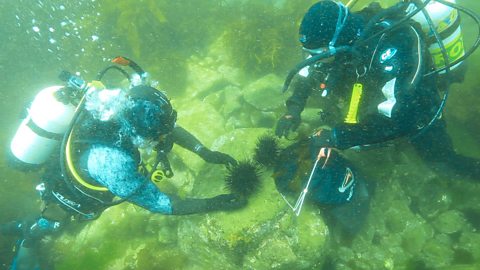
Ade Adepitan travels to Tasmania to find out about the work being done to protect the carbon-capturing underwater kelp forests.
Renewable energy in Tasmania. video
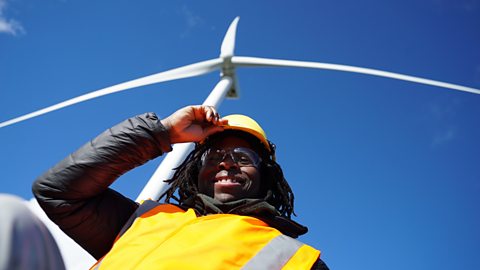
Ade Adepitan visits a wind farm in Tasmania that will help the island to reach a major milestone: producing all of its electricity from renewable sources.
Drought in Queensland, Australia. video
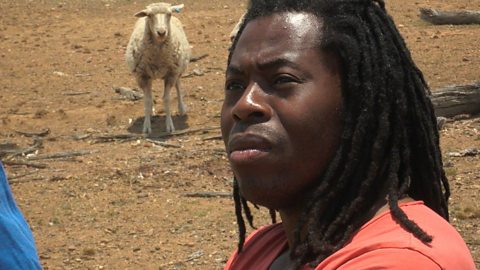
Ade Adepitan visits Queensland, where drought has had a devastating effect on the landscape.
Reducing food waste in Sydney, Australia. video
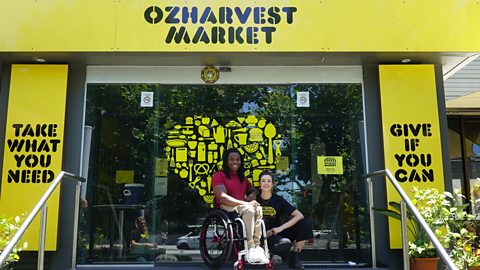
Ade Adepitan visits Sydney to learn about an organisation that redistributes food that would otherwise be wasted.