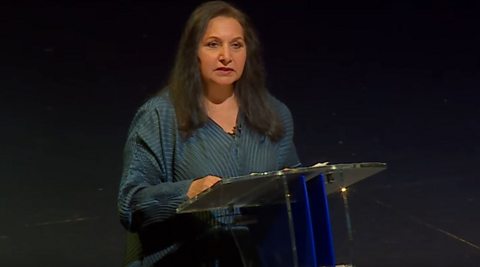
IMTIAZ DHARKER:I was looking at a book one day and on the tissue paper at the back I saw that my father had written my date of birth very carefully in his beautiful handwriting but looking at it I felt a connection to him that we had lost for years and in this poem I wrote I was really trying to think about what matters what's worth writing in books.
IMTIAZ DHARKER:Birth, death, family, relationships and how the scraps of paper we threw away are the things that tell the real story of our lives. And also how something as fragile as tissue, tissue paper, human skin can be more precious than all the things that we build to try and make ourselves feel safe and secure.
IMTIAZ DHARKER:The temples and churches and mosques and the monuments. Tissue. "Paper that lets the light shine through, this is what could alter things. Paper, thinned by age or touching, the kind you find in well-used books, the back of the Koran, where a hand has written in the names and histories, who was born to whom,
IMTIAZ DHARKER:the height and weight, who died where and how, on which sepia date, pages smoothed and stroked and turned transparent with attention. If buildings were paper, I might feel their drift, see how easily they fall away on a sigh, a shift in the direction of the wind. Maps too.
IMTIAZ DHARKER:The sun shines through their borderlines, the marks that rivers make, roads, rail tracks, mountain folds, fine slips from grocery shops that say how much was sold and what was paid by credit card might fly our lives like paper kites. An architect could use all this, place layer over layer,
IMTIAZ DHARKER:luminous script over numbers over line, and never wish to build again with brick or block, but let the daylight break through capitals and monoliths through the shapes that pride can make, find a way to trace a grand design with living tissue, raise a structure never meant to last,
IMTIAZ DHARKER:of paper smoothed and stroked and thinned to be transparent, turned into your skin."
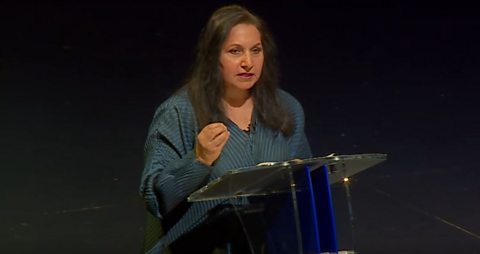
Imtiaz Dharker performs and describes her poem Tissue.
She describes how the poem came about after the found notes her father had written in the end pages of a book, and talks about how she was inspired by this writing of names and dates in the leaves of something so permanent yet so fragile.
This clip is from the series Contains Strong Language.
Teacher Notes
Pupils could create a chart of themes they think the poem covers, and how Imtiaz’ use of language and pace supports or enables this.
As a vocal exercise, pupils could look at whether the meaning of the poem changes from being read on the page to being read aloud.
Does anything else jump out at them which they hadn't previously noticed?
Curriculum Notes
This topic is relevant for teaching English Literature at KS4 & GCSE/National 4 & 5.
More from the series: Contains Strong Language
Daljit Nagra performs his poem Singh Song! video
Daljit Nagra performs his poem Singh Song!, and gives insight into the background of the poem.
Daljit Nagra performs his poem X. video
Daljit Nagra performs his short poem X, and gives insight into the background of the poem.
Daljit Nagra performs In a White Town. video
Daljit Nagra performs his poem In a White Town, and gives insight into the background of the poem.
Daljit Nagra performs Darling and Me. video
Daljit Nagra performs his poem Darling and Me, and gives insight into the background of the poem
Imtiaz Dharker performs This Tide of Humber. video
Imtiaz Dharker performs and describes her poem This Tide of Humber.
Imtiaz Dharker performs The Trick. video
Imtiaz Dharker performs and describes her poem The Trick.
Imtiaz Dharker performs The Right Word. video
Imtiaz Dharker performs and describes her poem The Right Word.
Imtiaz Dharker performs poem Honour Killing. video
Imtiaz Dharker performs and describes her poem Honour Killing.
Imtiaz Dharker performs Blessing. video
Imtiaz Dharker performs and describes her poem Blessing.