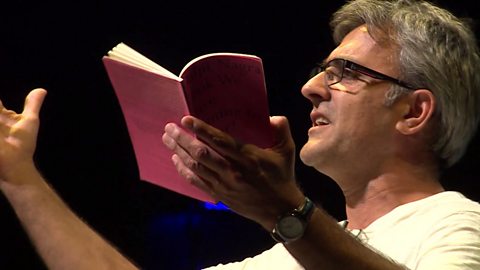
IMTIAZ DHARKER:The great first world war poet, Wilfred Owen was killed in 1918, when he was only 25 years old and in his poems he speaks about the waste of war. To me it seems-- Well Owen's war was fought in the trenches but to me it looks as if the nature of conflict has changed. Young men and young women still go to war
IMTIAZ DHARKER:but more and more war is being fought with fear and with suspicion and with loaded words. So in this next poem you'll hear words like terrorist but it's more to do with how you can take a single image and give it different meanings. Tony said, "I make film and I know that I can take the same set of shots and edit them different ways
IMTIAZ DHARKER:and make different stories out of the same thing" but you see that happening around you all the time. Different news channels, different peoples’ versions of the truth depending on who is telling it. The Right Word "Outside the door, lurking in the shadows, is a terrorist. Is that the wrong description?
IMTIAZ DHARKER:Outside that door, taking shelter in the shadows, is a freedom-fighter. I haven't got this right. Outside, waiting in the shadows is a hostile militant. Are words no more than waving, wavering flags? Outside your door, watchful in the shadows, is a guerilla warrior. God help me. Outside, defying every shadow, stands a martyr.
IMTIAZ DHARKER:I saw his face. No words can help me now. Just outside the door, lost in shadows, is a child who looks like mine. One word for you. Outside my door, his hand too steady, his eyes too hard, is a boy who looks like your son, too. I open the door. Come in, I say. Come in and eat with us. The child steps in and carefully, at my door, takes off his shoes."
Imtiaz Dharker performs and describes her poem The Right Word.
She describes how the poem is inspired by different representations of the same event, and how simply using different words and language can drastically change our perceptions of an event or person - in this case, a gunman hiding in the shadows outside a house, and whether he is a terrorist, a freedom fighter, a killer or a lost child.
This clip is from the series Contains Strong Language.
Teacher Notes
Pupils could create a chart of themes they think the poem covers, and how Imtiaz’ use of language and pace supports or enables this.
As a vocal exercise, pupils could look at whether the meaning of the poem changes from being read on the page to being read aloud.
Does anything else jump out at them which they hadn't previously noticed?
Curriculum Notes
This topic is relevant for teaching English Literature at KS4 & GCSE/National 4 & 5.
More from the series: Contains Strong Language
Imtiaz Dharker performs This Tide of Humber. video
Imtiaz Dharker performs and describes her poem This Tide of Humber.
Imtiaz Dharker performs The Trick. video
Imtiaz Dharker performs and describes her poem The Trick.
Imtiaz Dharker performs poem Honour Killing. video
Imtiaz Dharker performs and describes her poem Honour Killing.
Imtiaz Dharker performs Blessing. video
Imtiaz Dharker performs and describes her poem Blessing.
Imtiaz Dharker performs This Room. video
Imtiaz Dharker performs and describes her poem This Room.
Daljit Nagra performs his poem Singh Song! video
Daljit Nagra performs his poem Singh Song!, and gives insight into the background of the poem.
Daljit Nagra performs his poem X. video
Daljit Nagra performs his short poem X, and gives insight into the background of the poem.
Daljit Nagra performs In a White Town. video
Daljit Nagra performs his poem In a White Town, and gives insight into the background of the poem.
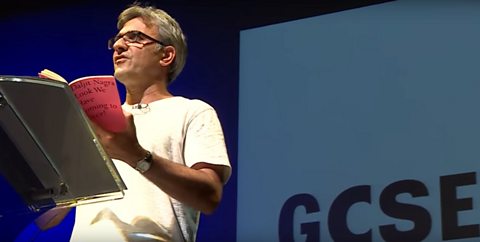
Daljit Nagra performs Darling and Me. video
Daljit Nagra performs his poem Darling and Me, and gives insight into the background of the poem