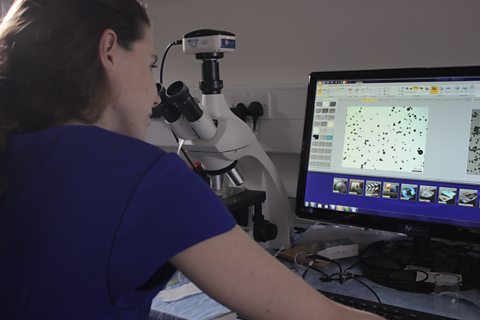
Fran Scott explores how PhD student Jon Sumanik-Leary from the University of Sheffield is developing a DIY wind turbine for isolated Third World communities.
Conventional wind turbines (and other forms of renewable energy including solar panels) are difficult to repair when broken.
Jon’s design is simple. It allows people with little background in engineering to build and repair the turbine with relative ease.
Fran Scott builds a turbine and tests it in a wind tunnel.
This clip is from the series The Imagineers.
Teacher Notes
Students can create their own wind turbine.
Instructions for the class:
Using A4 paper, paper clips, cork, (optional - motor, wires), a ruler, and a hair dryer. Draw a rectangle measuring 2cm by 5cm, and draw your blade design.
Trace the design onto card and cut it out. Students could compare 3 or 4 blades to check efficiency.
Stick 1 paper clip onto each blade and insert the straightened end into the smaller end of the cork. Try and ensure the blades are all at the same angle and an equal distance apart.
Students could try and secure the cork onto a ruler with an elastic band, and use a hair dryer to see if the blades will turn.
A further extension could be to try and incorporate a small motor and wires into the design by attaching them to a ruler and securing the cork to the motor shaft.
Again, test using a hair dryer.
Curriculum Notes
This clip will be relevant for teaching Design & Technology and Physics at KS3 and GCSE in England, Wales and Northern Ireland and 3rd and 4th Level in Scotland. Appears in AQA, OCR, EDEXCEL, CCEA, WJEC, SQA.
More from The Imagineers:
Earthquake engineering. video
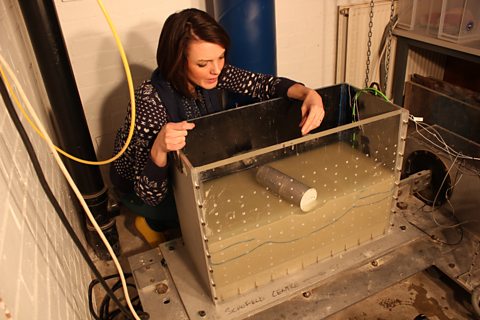
Dr Bernali Gosh is working as a seismic engineer to plan the new underground network needed in Delhi and evaluates experimental models of the effect of earthquakes on buildings on this type of soil.
Inventing clothes inspired by nature. video
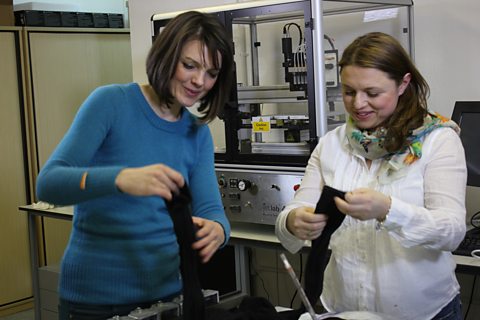
Fran Scott describes how Dr Veronika Kapsali from Northumbria University is researching fabrics with several uses and touches upon the development of multi-functional clothing inspired by nature.
Inventing future fabrics. video
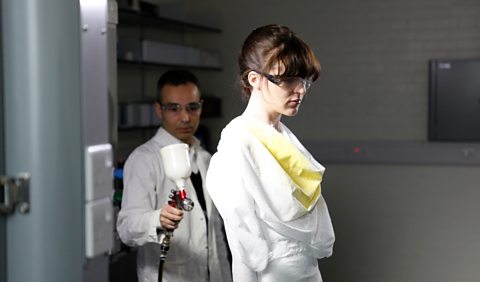
Engineer Dr Manel Torres from Imperial College in London invented Fabrican – a fabric sprayed from a can that can be used in fashion, healthcare and even to help clear up an oil slick.
Inventing smoke-free stoves. video
Two students from the University of Nottingham are working to develop a smoke-free stove. Their stove creates sound waves which move a magnetic in a coiled wire to make an electric current.
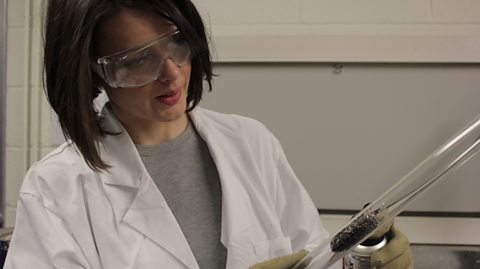
Nano-bubbles and drug delivery. video
Dr Eleanor Stride is using engineering to tackle a major challenge for medicine. She is using nano-technology to explore how to give cancer medication which are less poisonous than current treatments.