PRESENTER:If an oil tanker carrying the equivalent to two million barrels of crude oil ran aground, it would result in a slick that would be catastrophic to the environment for hundreds of miles. If this happened, how could we clean it up? This is a question that's been asked of engineers for decades. And to date, no one has come up with a definitive answer. But now, there's a seed of an idea with massive potential for solving the problem, which I'll come back to later. It started with the fusion of fashion and science, the day designer Dr Manel Torres dreamed up Fabrican. The fabric you can literally spray from a can.
PRESENTER:Where did you get your inspiration for this?
MANEL:My inspiration comes from basically the fashion industry. The process of manufacturing clothes is very, very slow. And for designers it can be very frustrating. I realised it would be ideal to find the way to speed the process of manufacturing clothes. What give me the inspiration was the, the silly string. I was in Barcelona, on a wedding, and I saw a friend of mine that he was getting covered with the silly string. And then I thought, well here is the solution - a spray-on fabric.
PRESENTER:'Refusing to let a lack of knowledge of chemical engineering stand in his way Manel took on the challenge of learning the science required. And 12 years later, he runs a research and development lab and has become known as the chemist tailor.'
PRESENTER:You've got a can there…
MANEL:Yes
PRESENTER:is this your spray on material?
MANEL:Yeah. This is one example.
PRESENTER:So can we spray some?
MANEL:Yes.
PRESENTER:OK. Do I have to stand back or…
MANEL:No, no, no you can just be…
PRESENTER:And is it safe?
MANEL:It is totally safe, you know. And…
PRESENTER:Oh my word.
MANEL:So like…
PRESENTER:Oh I should have bought all my clothes that have got holes in.
MANEL:Totally.
PRESENTER:From his lab in Imperial College London, Manel learned how to formulate solvents and fibres to make a liquid material that when sprayed, forms a non-woven fabric.
MANEL:We have this portfolio of all different feels so that you have this material which is softer.
PRESENTER:Yeah, this feels a bit like cotton wool.
MANEL:Yeah.
PRESENTER:It feels really nice.
MANEL:You see because this one has cotton fibres. Each formulation, each liquid fabric that we have have different feels, according the components. We have a whole range of different materials…
PRESENTER:Oh my word.
MANEL:They are created from the spray.
PRESENTER:No way?!
MANEL:Oh, this one which is very, very fine.
PRESENTER:That's phenomenal.
PRESENTER:12 years of lab work enabled Manel to create and design clothing in a different way. And how better to prove his invention works. You wanted a way to be able to make clothes quickly, to see your design worked or not.
MANEL:Yeah.
PRESENTER:
Have you done that?
MANEL:These fabrics create these dresses instantly, but these dresses, they feel different. They are different from what we wear. I mean, it's totally a new concept - new style. It needs to slowly, slowly, crawl and go from the lab to…
PRESENTER:Yeah…
MANEL:to the street. It will be fantastic for everyone to have an instant garment.
PRESENTER:'Not only do Manel's spray on clothes fit perfectly, they can be peeled off to wear again, washed and there's even a way to turn them back into their liquid form for the ultimate in recycling. And now, having achieved his goal of faster fashion, Manel's begun to look at other uses for his invention. which has brought us to a paintball arena. The fact Manel's fabric comes out of an aerosol makes it 100% sterile. Which means it could be invaluable in first aid. Rahul here, is our pretend wounded solider.'
MANEL:This gentleman had a problem in his arm and we will be able to illustrate you how we could cast his wrist.
PRESENTER:But you are all right, aren't you?
INJURED SOLDIER:Yeah.
PRESENTER:Yeah, yeah OK, good. Just checking.
PRESENTER:Let's do it. So you're just spraying it straight on?
MANEL:Yeah.
MANEL:We have the first layer, which will be the bandage.
PRESENTER:Yeah.
MANEL:Now we will apply the cast and the cast is another formulation which it hardens. This formulation, in a few minutes will be very hard.
PRESENTER:OK.
MANEL:So it will immobilize that part.
MANEL:Now it needs to cure, that will…
PRESENTER:Yeah…
MANEL:Take three, four minutes. And it will be something as hard as this. And as you can see you know, you can tap it and it's very, very hard.
PRESENTER:'The list of potential uses for this invention goes on and on Which brings me back to my original question.'
PRESENTER:So Manel, when I introduced this film, I hinted that your spray on fabric might be a solution to clearing up oil tanker disasters. And I've spilled some oil, a rather large amount of oil…
MANEL:Yeah, I can see.
MANEL:You really created a big catastrophe.
PRESENTER:I like to challenge you…
MANEL:And we will, we will start to, you know, solve the problem.
PRESENTER:Spray, let's spray.
PRESENTER:Oh my word, you can see it sort of soaking up into it.
MANEL:Yeah. The whole idea will be to surround all the disaster areas so that you have all the oil contained.
PRESENTER:Oh, so it's sort of like a buffer…
MANEL:Yeah…
PRESENTER:It's trapping it in one place.
MANEL:And then you can lift it up and you can see how the oil is being absorbed.
PRESENTER:You can actually see it…
MANEL:Yeah…
PRESENTER:in the material. This is brilliant. It's got amazing potential this, could totally be a solution. That is brilliant.
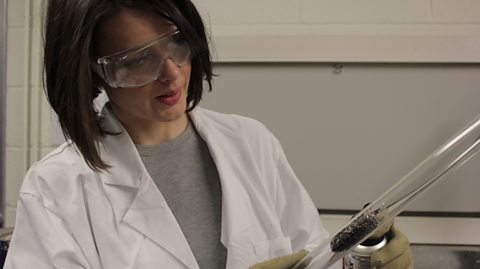
Fran Scott meets Dr Manel Torres from Imperial College in London to talk about his invention Fabrican – a fabric that is sprayed from a can.
Inspired by silly string, he sprays the material onto the arms and bodies of fashion models to make new garments.
The fabric is so sterile it can also be used as a bandage.
It can be made to set hard and so could also be used as a cast for broken bones. But perhaps most amazingly, the fabric absorbs oil, and so could be used to clean up after oil tanker disasters, which can cause catastrophic environmental damage.
This clip is from the series The Imagineers.
Teacher Notes
Students could use this clip as an introduction to the topics of new and smart materials. This can be followed by a research activity and could lead on to a discussion of nanotechnology.
Curriculum Notes
This clip will be relevant for teaching Design & Technology and Chemistry at KS3 and GCSE in England, Wales and Northern Ireland and 3rd and 4th Level in Scotland. Appears in AQA, OCR, EDEXCEL, CCEA, WJEC, SQA.
More from The Imagineers:
Earthquake engineering. video
Dr Bernali Gosh is working as a seismic engineer to plan the new underground network needed in Delhi and evaluates experimental models of the effect of earthquakes on buildings on this type of soil.
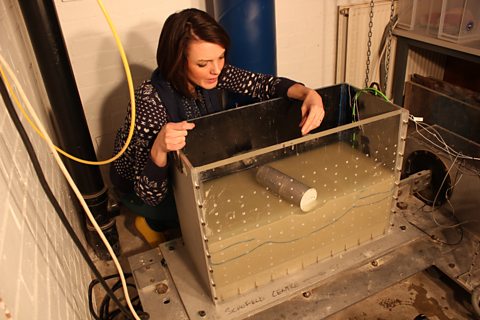
Inventing clothes inspired by nature. video
Fran Scott describes how Dr Veronika Kapsali from Northumbria University is researching fabrics with several uses and touches upon the development of multi-functional clothing inspired by nature.
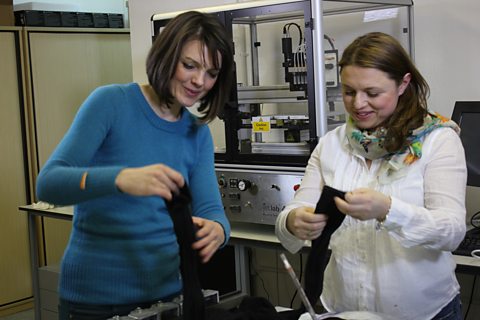
Inventing DIY wind turbines. video
Fran Scott describes how PhD student Jon Sumanik-Leary from the University of Sheffield is developing a DIY wind turbine for isolated Third World communities.
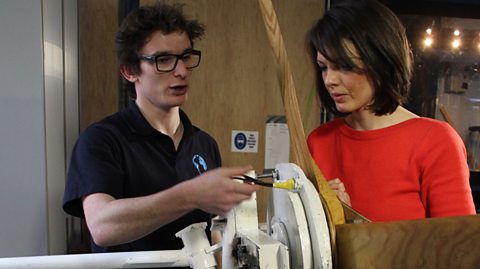
Inventing smoke-free stoves. video
Two students from the University of Nottingham are working to develop a smoke-free stove. Their stove creates sound waves which move a magnetic in a coiled wire to make an electric current.
Nano-bubbles and drug delivery. video
Dr Eleanor Stride is using engineering to tackle a major challenge for medicine. She is using nano-technology to explore how to give cancer medication which are less poisonous than current treatments.