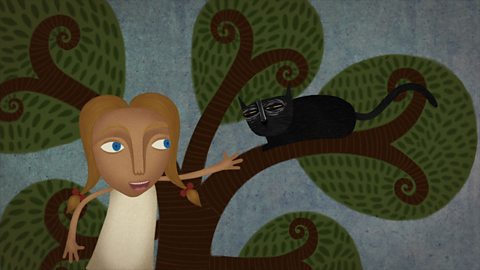
NARRATOR:'Along a great river, there are two villages. The first one, way up river, is a farming village. Full of, well - farmers. Now this village isn't a very happy place. There's never enough water to feed the crops. And the people are very hungry. Rotten crops, rumbling tums, bad tempers. You get the idea.'
NARRATOR:'However, some way down river, there's a fishing village. Full of, well - fisherpeople. Now, they depend on the river for all their food. And they have lots of lovely fish to eat. But one day…'
FISHERGIRL:GASPS
NARRATOR:'Oh no! They discover that their lovely fish filled river has dried up completely. No water. Nothing! No fish at all. Not even a gold fish!'
NARRATOR:'With no fish to eat people start to go hungry.'
NARRATOR:'And so, a fearless fishergirl, from the village sets off to find out why the river has dried up. Packing the last of the fish paste sandwiches she follows the dry river all the way to the farmers village. There she meets a farmer boy.'
FARMER BOY:"Welcome to our village,"
NARRATOR:'He says.'
FARMER BOY:"It's a great place. We have plenty to eat and our crops have lots of water. All thanks to our dam."
NARRATOR:'The fishergirl is horrified.'
FISHER GIRL:"You've stolen our water"
NARRATOR:'She says.'
NARRATOR:'What do you think? Have the farmers stolen the water?'
NARRATOR:'Who owns the river? Who owns the fish in the river? The fisher girl explains to the farmer boy how the dam has stopped the river flowing down to their village. She tells him all about her village going hungry because they have no more fish. The farmer boy feels bad. He hadn't thought about how this would affect his neighbours.'
NARRATOR:'And then he has an idea.'
FARMER BOY:"Why don't the fisherpeople just come and live with us?"
NARRATOR:'The fishergirl isn't sure this will solve the problem. After all, the fisher people have lived in their village for hundreds of years. Everything they do is based around fish and fishing. If the fisher people come and live with the farmers they'll have to change their entire way of life.'
NARRATOR:'Not only that, even if the fisher people come to the farmer village - Will the farmers welcome them? It's an awful lot of new mouths to feed for a start. Well there are a lot of things to consider here. Are the farmers selfish for not considering the fisherpeople?'
NARRATOR:'What do you think they should all do?'
Video summary
A story about a community of fisher-people whose livelihoods depend on a river that dries up, which explores the concept of ownership of natural resources and whether they can be shared and even stolen.
This short film encourages children to consider if and how natural resources like water can be owned and what happens when one community benefits from it at the expense of another, and is adapted from a story by Jason Buckley.
This short film is from the BBC series, What Makes Me, Me? And Other Interesting Questions.
Teacher Notes
This short film could be used as a lesson starter for a philosophical discussion about the sharing of natural resources.
Pupils could watch the clip in parts with pauses for discussion, using the questions at the end of each part, or you could work with the children to create your own.
Children could be encouraged to consider whether it is possible to own natural resources and, if so, how should they be shared.
Further questions could include: "Should you put your own family or community before another family or community that you don’t know?", at the end of part 2.
Children could be encouraged to add reason in their answers, to explain their opinions and to present alternative viewpoints, in order to stimulate deeper thought and discussion.
Encourage children to agree or disagree without judging, and move the discussion forward by asking for new thoughts.
This short film will be relevant for teaching PSHE at KS1 and KS2 in England and Wales, and 1st and 2nd levels in Scotland.
Am I always responsible for my actions? video
An exploration of the concept of personal responsibility using an ancient parable about a scorpion that stings a frog.
What makes me, me? video
An exploration of the concept of identity using the story of the Ship of Theseus, made famous by British philosopher Thomas Hobbes.
What’s fair? video
Looking at whether there is a difference between fairness and equality, and how we consider those that are in some way disadvantaged.
Why should I be good? video
A boy finds a ring of invisibility and explores ways in which he can use it. How do we know the difference between right and wrong?