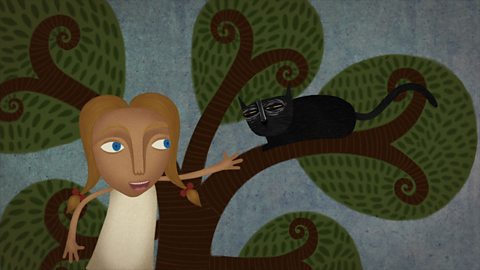
NARRATOR:'This is Dave.'
DAVE:Hi.
NARRATOR:'Dave owns a wooden ship called the Theseus And that's Dave's wife - she doesn't like goodbyes. Dave and his crew…'
DAVE'S CREW:Oh argh!
NARRATOR:'Yes, thank you. Dave and his crew are setting off on a long voyage. It's a tough voyage, with many storms and mishaps. And it gets really quite hard to keep the ship sailing and stop bits of it falling into the water. Every time the ship is damaged, Dave takes the Theseus to George's ship yard. And George replaces the broken'
NARRATOR:'wooden bits with shiny new metal ones.'
DAVE:Bye.
NARRATOR:'But there are many dangers, like Ollie the octopus. Who does like a bit of fish and ships. And so every few months of his journey, Dave heads back to see Georgeand has any broken wooden bits replaced with metal.'
DAVE:Bye, bye.
GEORGE:Bye.
DAVE:HUMMING
NARRATOR:'And each time the ship gets damaged… More metal parts are added and so on and so on. Until, eventually, every part of the Theseus has been replaced. The ship is now entirely metal. Inside and out. When Dave gets home, his wife…'
WIFE:Yay.
NARRATOR:'Who's been really missing Dave a great deal, is surprised. She wants to know why he's got a new ship.'
DAVE:I haven't got a new ship.
NARRATOR:'Says Dave. Dave's wife insists that it can't be the same ship.
NARRATOR:'Dave insists that it is. This goes back and forth for what seems like an eternity. But Dave's wife won't budge.'
WIFE:Your ship was wooden, and this ship is metal. Nothing of the old ship remains.
NARRATOR:'What do you think? Is it the same ship?'
NARRATOR:'And if it isn't, at what point did it become a different ship?'
NARRATOR:'Dave and his wife haven't stopped arguing about whether it's the same ship, when suddenly, over the horizon a familiar shape appears. It's the Theseus, only made of wood. How did this happen? It turns out George always wanted his own ship. So, rather cleverly, he kept all the wooden bits'
NARRATOR:'that fell off the original Theseus and decided to rebuild it. It needed a lot of hard work - and an awful lot of nails. But it looks very good now he's finished. The minute she sees the ship, Dave's wife thinks it's Dave's ship - the Theseus. So what does this mean? They're both called the Theseus.And they both look the same…'
NARRATOR:'well, except that one's made of wood and one's made of metal.
NARRATOR:'It's all getting a bit confusing.'
CHATTER
NARRATOR:'Oh dear.
NARRATOR:'Does this mean there are two Theseus, or just one?'
NARRATOR:'Which ship is the Theseus? Now, this is all very well with ancient ships and what not but what happens if we think about something a little closer to home? Like, I don't know? You! You see, like Dave's ship, our bodies change and grow throughout our lives. We're born. 'We grow up into toddlers.'
NARRATOR:'Then children.'
DAVE:Hey.
NARRATOR:'And we keep growing into teenagers. Then adults. And we continue changing our whole lives. Our hair grows and falls out and more grows without us even noticing. We get a whole new set of teeth. Everything changes. So if every part of us gets replaced too, Like Dave's ship, then that raises a big question.'
NARRATOR:'Am I the same person I was when I was born?
NARRATOR:'And if I am…
NARRATOR:'What makes me, me?'
Video summary
An exploration of the concept of identity using the story of the Ship of Theseus, made famous by British philosopher Thomas Hobbes.
This adaptation of Peter Worley’s 'The If Machine', encourages children to consider the meaning of identity and explores personal memories, experiences and the soul.
This short film is from the BBC series, What Makes Me, Me? And Other Interesting Questions.
Teacher Notes
This short film could be used as a lesson starter for a philosophical discussion on identity.
It could be watched in parts, with pauses for discussion.
Pupils could sit in a circle and start a discussion using the questions provided at the end of each part, or you could work with the children to create your own questions.
Further questions could include:‘What is it that makes the Theseus the Theseus?’ at the end of part 2.And ‘If you could make a clone of yourself, would the clone also possess your thoughts and memories?’ at the end of part 3.
Children could be encouraged to reason in their answers, to explain their opinions and to present alternative viewpoints, in order to stimulate deeper thought and discussion.
Encourage pupils to agree or disagree without judging, and move the discussion forward by asking for new thoughts.
This short film will be relevant for teaching PSHE at KS1 and KS2 in England and Wales, and 1st and 2nd levels in Scotland.
Am I always responsible for my actions? video
An exploration of the concept of personal responsibility using an ancient parable about a scorpion that stings a frog.
What’s fair? video
Looking at whether there is a difference between fairness and equality, and how we consider those that are in some way disadvantaged.
Who owns the sky? video
A story about a community of fisher-people whose livelihoods depend on a river that dries up, which explores the concept of ownership of natural resources.
Why should I be good? video
A boy finds a ring of invisibility and explores ways in which he can use it. How do we know the difference between right and wrong?