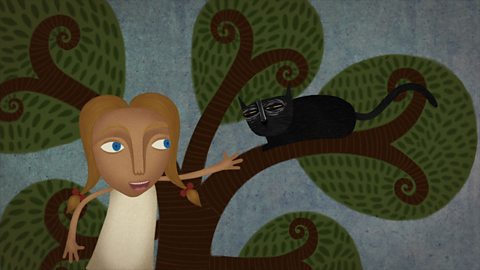
NARRATOR:'On the banks of a river sits a scorpion. This scorpion has got lost and she's separated from her family by a huge river.'
SCORPION'S BABY:Mama!
NARRATOR:'Now, you may not know this but scorpions can't swim. So she can't cross it. She's stuck.'
FROG:Ribbit.
SCORPION:Oh.
NARRATOR:'At that moment a frog passes by.'
FROG:Ribbit, ribbit.
NARRATOR:'Now of course, frogs can swim. So she asks the frog for help.'
FROG:LAUGHS
NARRATOR:'Says the frog.'
FROG:I don't think so. Scorpions and frogs are deadly enemies. Scorpions sting frogs. When we're half way across, you'll sting me.
SCORPION:Why would I do that?
NARRATOR:'Says the scorpion.'
SCORPION:It makes no sense. If I sting you, I won't get across the river to my family
NARRATOR:'But the scorpion can see that the frog's still not sure And so she says,'
SCORPION:I promise I won't sting you.
NARRATOR:'What do you think?
NARRATOR:'Should the frog carry the scorpion across? Eventually, after a lot of pleading from the scorpion the frog agrees to carry her across the river. Now, what looks like a short distance to you, is quite a long journey for a frog - especially when you've got someone your own size on your back. And it's a scorpion.'
SCORPION:Woohoo!
NARRATOR:'Half way across the river the frog feels a sharp pain on his head.'
FROG:Ow!
NARRATOR:'The scorpion has stung him.'
FROG:Why did you do that?!
NARRATOR:'Screams the frog.'
FROG:Now we'll both drown.
SCORPION:I can't help it.
NARRATOR:'Says the scorpion.'
SCORPION:Scorpions sting frogs, it's in my nature.
NARRATOR:'And with that, both the scorpion and the frog sink down into the river.'
FROG:Ribbit.
NARRATOR:'Who was responsible for what happened to the frog and the scorpion?
NARRATOR:'What did the scorpion mean when she said, "It's in her nature"? That's all very well for frogs and scorpions. But what does this have to do with humans? Well let's take Karim as an example, Karim's always been a bit, well, careless with other people's things.'
KARIM:Yeah!
NARRATOR:'Karim's best friend, Sophie, has a telescope that he really wants to borrow.'
KARIM:Hello.
NARRATOR:'The thing is, Sophie's not sure. She knows Karim is careless. But he promises to be careful with it. So eventually she decides to lend him the telescope. Karim heads off, carrying the telescope. Extra carefully.'
KARIM:Phew.
NARRATOR:'He spends the evening looking at the stars. Making sure he's being extra careful. And the next day, on his way to return it to Sophie, he sees a group of little baby scorpions looking cute on the bank of the river. Uh oh. Looks like Karim might not have been extra careful this time.'
KARIM:Hi.
NARRATOR:'And that means he has broken his promise to Sophie.'
KARIM:GASPS
NARRATOR:'She's probably going to be rather upset.'
NARRATOR:'Could Karim have stopped himself from breaking his promise?'
NARRATOR:'How is Karim's promise different to the scorpions promise?'
Video summary
An exploration of the concept of personal responsibility using an ancient parable about a scorpion that stings a frog.
This short film is an animated parable adapted from Peter Worley's 'The If Machine'.
It might encourage children to consider whether we are able to change our nature and if not, whether we are responsible for our actions.
This short film is from the BBC series, What Makes Me, Me? And Other Interesting Questions.
Teacher Notes
This short film could be used as a lesson starter for a philosophical discussion on human nature, free will and whether we are responsible for our actions.
The clip could be watched in parts with a pause for discussion.
Pupils could sit in a circle and use the questions at the end of each part, or you could work with the children to choose their own.
Further questions to ask could include: "If something is in our nature, can we control it?’" at the end of part 2; and "How much control do humans have over our character?" and "If we can control our character, then are we always responsible for what we do?" at the end of part 3.
Children could be encouraged to add reason to their answers, to explain their opinions and to present alternative viewpoints, in order to stimulate deeper thought and discussion.
Encourage pupils to agree or disagree without judging, and move the discussion forward by asking for new thoughts.
This short film will be relevant for teaching PSHE at KS1 and KS2 in England and Wales, and 1st and 2nd levels in Scotland.
What makes me, me? video
An exploration of the concept of identity using the story of the Ship of Theseus, made famous by British philosopher Thomas Hobbes.
What’s fair? video
Looking at whether there is a difference between fairness and equality, and how we consider those that are in some way disadvantaged.
Who owns the sky? video
A story about a community of fisher-people whose livelihoods depend on a river that dries up, which explores the concept of ownership of natural resources.
Why should I be good? video
A boy finds a ring of invisibility and explores ways in which he can use it. How do we know the difference between right and wrong?