NARRATION:Back in the deepest, darkest depths of time, there lived a great mathemagician called Hypatia. Numbers fell under her spell one by one. With them, Hypatia could do anything. Now Hypatia is looking for people to share her powers with. She has forged a mathematical maze. Only true mathemagicians can solve the puzzles and find their way out. Join two young explorers, Oliviaand Hassan, to solve the puzzles, escape the maze and become the greatest mathemagicians of all time.
Dividing using written methods.
ARCHIMEDES:Honking won’t help! Stop honking! I can't concen- Honk, yeah, honk, honk, honk, honk, honk. Yeah, I know, yeah, honk.
Oh, thank goodness our trainee mathemagicians are here. The mathemagicians are here! Yeah, honk, honk. I get it.
HYPATIA:Gridlock! The city is at a standstill. Perhaps we can get things moving by solving this puzzle. Otherwise, we'll be stuck here forever. 432 divided by 12 is equal to what?
OLIVIA:How come they don't just solve the equation? That would lower the bridge and they'd be able to get to the other side.
HYPATIA:They're too impatient! Written division is all about patience. I'm feeling generous, so I'll start you off with a simple equation.
526 divided by three.
ARCHIMEDES:Okay, we'll work from left to right. Three goes into five one time, leaving a remainder of two. We regroup this two to the next column along. Three goes into 22 seven times, with a remainder of one.
OLIVIA:And three goes into 16 five times.
ARCHIMEDES:So our answer becomes…
OLIVIA:175 remainder one.
ARCHIMEDES:If we are dividing the dividend by a two digit number, we use looooong division.
HYPATIA:Let's see how you do with 864 divided by 32.
ARCHIMEDES:In the first column, the hundreds, 32 is too large for us to divide into eight.
HASSAN:So what can we do?
ARCHIMEDES:Move to the next column along, and include this digit. 32 goes into 86 tens twice to make 64. We put two on the top above this column. We then put the 64 made by 32 times two underneath our divisor, so that we can begin working out the remainder. 86 minus 64 is 22, so we put this on the bottom.
OLIVIA:But, we still have four ones…
ARCHIMEDES:So we drop this number down to where our remainder is, resulting in 224.
OLIVIA:32 goes into 224 seven times. So, we put this seven with our answer on our top line. 224 minus 224 is equal to zero, so there's no remainder.
HASSAN:So the answer is 27.
ARCHIMEDES:Exactly. Although it may look slightly complicated, have no fear. This is a neat way of making sure that we always remember our remainders.
HASSAN:I don't know about this long division stuff.
HYPATIA:It's all about taking your time and following through. You've got this.
OLIVIA:Let's do this, Hassan!
HASSAN:Okay, 432 divided by 12.
OLIVIA:12 can't go into four.
HASSAN:So we move to the next column.
OLIVIA:12 goes into 43 three times.
HASSAN:Which equals 36.
OLIVIA:Leaving a remainder of seven.
HASSAN:We can then drop down the two.
OLIVIA:To make 72.
HASSAN:12 goes into 72 exactly six times.
OLIVIA:So we put the six on the top.
HASSAN:So our answer is…
OLIVIA AND HASSAN:36.
HYPATIA:Well done. Your patience has paid off. Congratulations!
OLIVIA:Woo! Yes!
ARCHIMEDES:Ah! I feel better already. No, please no more!
HYPATIA:Now let's see if you mathemagicians can show the same patience as our heroes. Working out whether to round up or round down can be tricky. Let's see how you do. A farmer sells eggs in boxes of 24. How many full boxes can he sell if he has 900 eggs? How many boxes does he need to transport 685 eggs?
Video summary
Olivia and Hassan learn how to perform long division in order to free gridlocked traffic on a bridge.
Our great mathemagician Hypatia challenges them with a division question: 432 ÷ 12, and Archimedes demonstrates how they can use the method of dividing the cars as a springboard to apply long division.
The episode ends with Archimedes performing a long division question, and asking pupils to spot his mistakes.
This short animated film is from the BBC Teach series, Hypatia's Mathematical Maze.
Teacher Notes
Before watching the film:
Prior to this lesson you may wish to introduce pupils to other relevant topics, for example:
- Factors and multiples
- Mental division as the inverse of times tables
- The term ‘difference’ as a means of subtracting
During watching the film:
Depending on the focus of your lesson, you may wish to pause the film at certain points and check for understanding, asking questions such as:
- What is the multiple just below one of the ones on the side of the truck in the video?
- What is the difference between the multiple found and the actual number?
- What resources could we use to find the multiples and the difference?
Final question:A farmer sells eggs in boxes of 24. How many full boxes can he sell if he has 900 eggs? How many boxes does he need to transport all of his 685 eggs?
Answer to the final question:900 divided by 24 = 37.5, so they can sell 37 full boxes.685 divided by 24 = 28.54, so they would need 29 boxes to transport all the eggs.
Following on from the film:
- Explore the difference between rounding up and rounding down problems, as in Hypatia’s final question.
- Look at a number, e.g. 1728. You have three lives. Each time you divide it and you get an answer with a remainder you lose a life. Which divisors will you choose and why? E.g. I’ll choose 3 because 1728 has a digit total of 18 so is a multiple of 3. I’ll choose 2 because it’s even. I’ll choose 4 because 1700 is a multiple of 100 and therefore a multiple of 4, and 28 is a multiple of 4, etc.
This short film is suitable for teaching maths at KS2 in England, Wales and Northern Ireland and 2nd Level in Scotland.
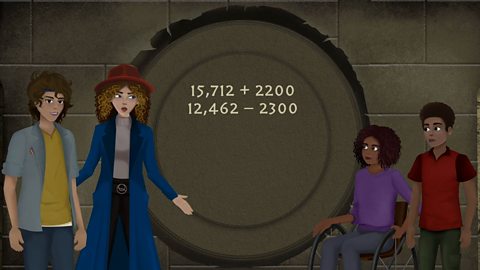
Adding and subtracting using mental methods. video
In a mythical temple full of obstacles, Olivia and Hassan learn simple mental maths and apply it to work out the passcode to open the door.
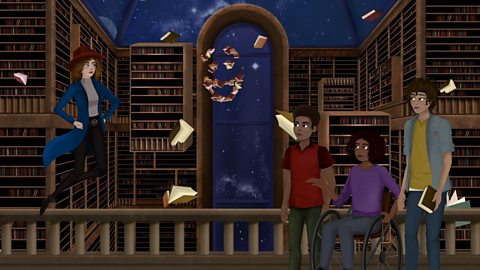
Adding and subtracting using written methods. video
Having been transported to a floating library, Olivia and Hassan's ability to solve large equations using written methods is tested.
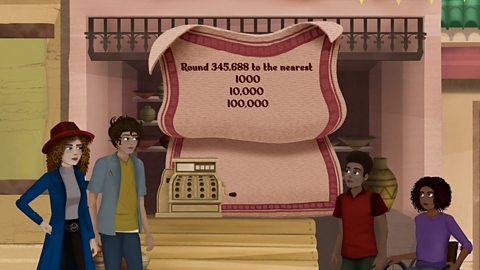
How and why we round numbers. video
Olivia and Hassan are taught how to round to the nearest 1000, 10,000, and 100,000 when a disgruntled magic carpet demands money from them.
Using addition and subtraction in multi-step problems. video
Inside a giant computer created before the age of mathemagicians, Olivia and Hassan are faced with a multi-step problem to reach the labyrinth’s next stage.
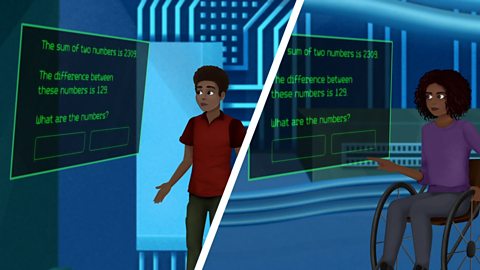
Multiplying by 10, 100 and 1000. video
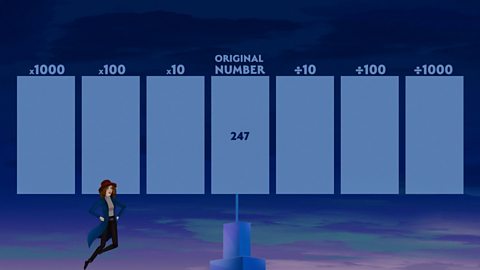
When Olivia and Hassan find themselves on the roof of an enormous skyscraper they learn how to multiply by 10, 100 and 1000 and work out the number of windows on the building.
Mental multiplication. video
While exploring a jungle, Olivia and Hassan learn the true nature of square numbers as being created when two of the same number are multiplied together.
Factors, multiples and primes. video
Trapped in a desert together with Archimedes, Olivia and Hassan learn what common factors, multiples, and prime numbers are.
Multiplying using written methods. video
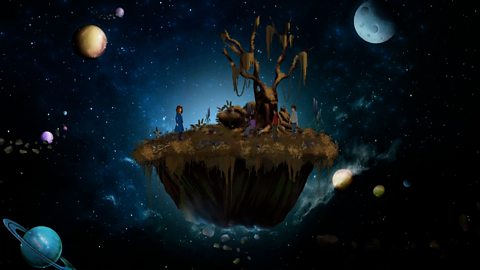
Finding themselves in space, Olivia and Hassan watch mathemagician Hypatia perform long multiplications in the sky by bending the stars.
Recognising and comparing fractions. video
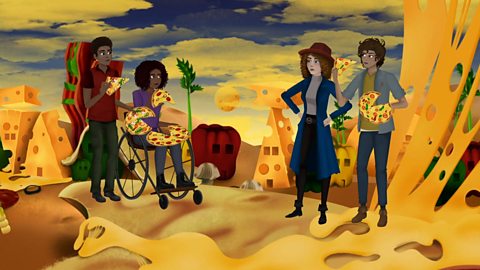
Olivia and Hassan are enjoying themselves in a world made out of pizza and learn how to work with numerators and denominators in fractions.
Adding and subtracting fractions. video
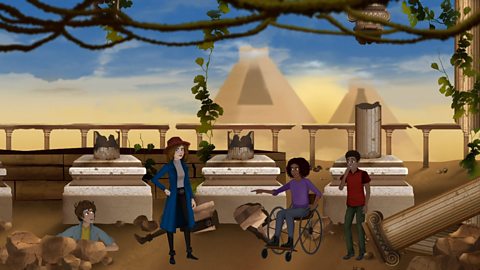
Amongst the ruins of an ancient city, Olivia and Hassan learn how to add and subtract fractions.
Multiplying and dividing fractions. video
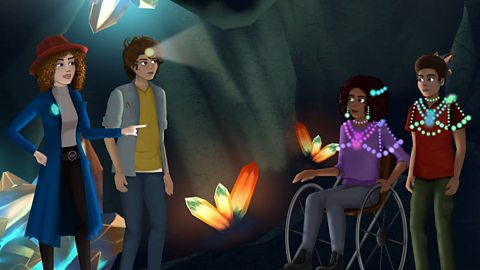
In a mysterious crystal cave, Olivia and Hassan get to work dividing and multiplying fractions in order to find their way out.