NARRATION: Back in the deepest, darkest depths of time, there lived a great mathemagician called Hypatia. Numbers fell under her spell one by one. With them, Hypatia could do anything. Now, Hypatia is looking for people to share her powers with. She has forged a mathematical maze. Only true mathemagicians can solve the puzzles and find their way out. Join two young explorers, Olivia and Hassan, to solve the puzzles, escape the maze and become the greatest mathemagicians of all time.
Adding and subtracting using written methods.
OLIVIA: Wow, what is this place?
HYPATIA: The Cosmic Library is filled with many wonders, but to open its portal you'll have to solve this puzzle… 3356 + 2743.
HASSAN: Uh oh, I'm not sure I can do that in my head.
OLIVA: Oh!
HASSAN: Haha!
ARCHIMEDES: Sheesh, yeah. If you're finding it tricky, you can try writing it down.
OLIVIA: What do you mean?
HASSAN: Dear diary, I love maths so mu-.
ARCHIMEDES: Whoops, wrong one, hehe.
Some equations require a lot of thinking and it can be difficult to keep each part of the solution in our heads. You can write the calculation down to make it easier. Place the numbers to add on top of each other, making sure the ones, tens and hundreds are aligned. We move from right to left, adding the numbers in the same column together. Five and six are in the ones column.
HASSAN: And if we add them together, we get 11.
ARCHIMEDES: That number is larger than nine. It has two digits, 10 and one, and that's okay. We just add this new group of 10 onto the tens column - the next number along, and keep the final one in the ones column. Moving along, we add 40 plus 30 plus a 10 we regrouped into the tens column, so that's eight tens, or 80. Then in the hundreds column, 300 plus 200 is 500, which means the answer is 581.
Subtraction is the same except we take away the boxes instead. So four minus four is zero. We can't do 10 minus 20 because 10 is smaller than 20, so we regroup 100 from the hundreds column. Now we can minus 20 from the 110, leaving us with 90 or nine tens. And 300 minus 200 is 100.
You can try solving Hypatia's puzzle like that, but don't forget to add an extra thousands column.
OLIVIA: Yes, I think I've got it!
HASSAN: Me too, it's 6099.
OLIVIA: 5099. Huh?
ARCHIMEDES: Dear diary, oh no.
OLIVIA: Wait, I know, I forgot to regroup the 1000. The answer is 6099. Woo!
HASSAN: Yeah!
HYPATIA: Not so fast! Let's see how you get on without Archimedes' help.
ARCHIMEDES: Oh, come on.
HASSAN: That's not fair. We don't even have all the numbers.
ARCHIMEDES: Write it down.
OLIVIA: Did you hear something?
We can work out the question marks by working backwards. Two plus what is nine?
HASSAN: Uhh, seven! And three plus what is two?
OLIVIA: Hmm, oh! Maybe there's been a regrouping? Maybe the numbers added up to 12, so the tens column is two, and a 10 was regrouped to the hundreds column.
HASSAN: Oh yeah, that makes sense. So the missing number must be nine. Then 600 plus what equals 500?
OLIVIA: Nine again.
HASSAN: Because 900 plus 600 is 1500.
OLIVIA: And we regroup one of the hundreds.
HASSAN: And then five plus what equals eight?
OLIVIA: Three!
HASSAN: And two plus five is seven for our biggest number.
OLIVIA To make…
HASSAN: 54,937…
OLIVIA: Plus 23,592.
HYPATIA: You did it!
HASSAN: Woo!
OLIVIA: Yes!
ARCHIMEDES: Dear diary, you'll never guess what happened today…
HYPATIA: Olivia and Hassan proved too cunning for my puzzles. Now, I have a question for my young mathemagicians.
I have 37,506 stars. Archimedes has 22,819 stars. How many more stars do I have than Archimedes? How many stars do we have altogether?
Video summary
Having been transported to a floating library, Olivia and Hassan's ability to solve large equations using written methods is tested.
Their mathematical companion Archimedes teaches them how to use written methods to find the solution.
Although they initially stumble at the concept of regrouping, Hassan and Olivia do find the correct answer and are even able to solve Hypatia’s final question to leave the library.
Hypatia and Archimedes leave pupils with a multi-step addition and subtraction problem to solve in the classroom.
This animated short film is from the BBC Teach series, Hypatia's Mathematical Maze.
Teacher Notes
Before watching the film:
Prior to this lesson you may wish to introduce students to other relevant topics, for example:
- Mental addition and subtraction
- Partitioning numbers and talking about each digit in a number in terms of its place value
- Representing numbers with concrete materials and identifying numbers from representations
During watching the film:
Depending on your lesson’s focus, you may wish to pause the video at certain points to check for understanding, asking questions such as:
- Who can spot when regrouping will be necessary in this example?
- When would you use column addition / subtraction as opposed to mental?
- What are the similarities and differences between written addition and subtraction?
- What method do we need to answer Hypatia's final question?
Final Question:
Hypatia has 37,506 stars. Archimedes has 22,819 stars. How many more does Hypatia have than Archimedes? How many stars do they have all together?
Answer to the final question:
37,506 - 22,819 = Hypatia has 14,687 stars more than Archimedes
37,506 + 22,819 = They have 60,325 stars altogether
Following on from the film:
- You could ask pupils to complete written addition and subtraction problems alongside representations of the question using place value counters or dienes blocks.
- You could give your pupils some 'empty box' problems so they need to work backwards in order find the solution.
- You could sort some equations in a table, into problems where there is no regrouping necessary, where there is one exchange or where there is more than one exchange.
This short film is suitable for teaching maths at KS2 in England, Wales and Northern Ireland and 2nd Level in Scotland.
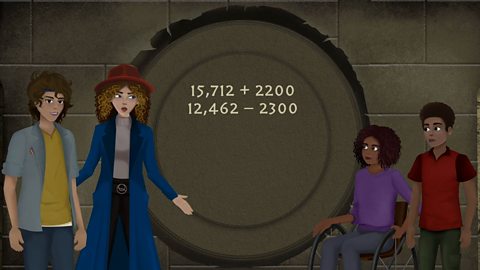
Adding and subtracting using mental methods. video
In a mythical temple full of obstacles, Olivia and Hassan learn simple mental maths and apply it to work out the passcode to open the door.
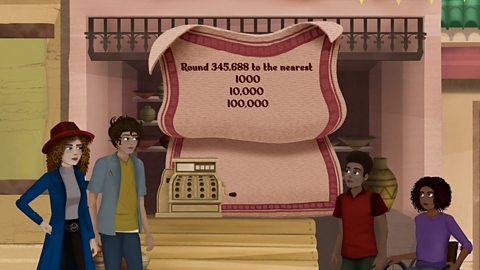
How and why we round numbers. video
Olivia and Hassan are taught how to round to the nearest 1000, 10,000, and 100,000 when a disgruntled magic carpet demands money from them.
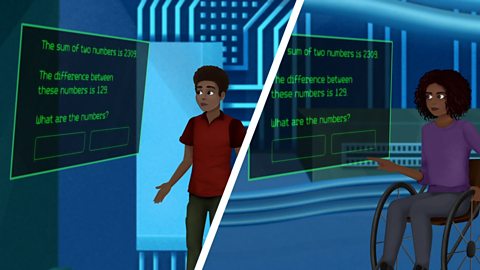
Using addition and subtraction in multi-step problems. video
Inside a giant computer created before the age of mathemagicians, Olivia and Hassan are faced with a multi-step problem to reach the labyrinth’s next stage.
Multiplying by 10, 100 and 1000. video
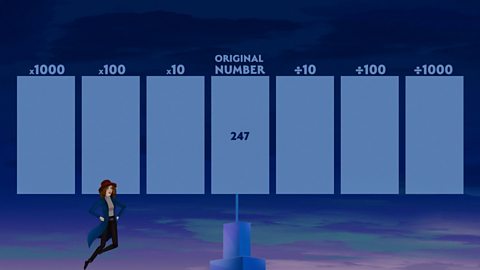
When Olivia and Hassan find themselves on the roof of an enormous skyscraper they learn how to multiply by 10, 100 and 1000 and work out the number of windows on the building.
Mental multiplication. video
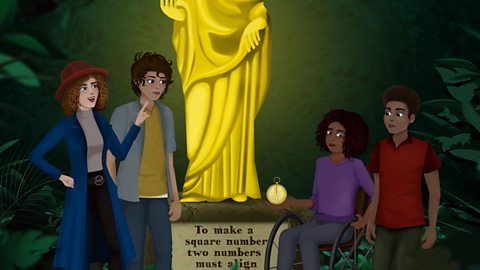
While exploring a jungle, Olivia and Hassan learn the true nature of square numbers as being created when two of the same number are multiplied together.
Factors, multiples and primes. video
Trapped in a desert together with Archimedes, Olivia and Hassan learn what common factors, multiples, and prime numbers are.
Multiplying using written methods. video
Finding themselves in space, Olivia and Hassan watch mathemagician Hypatia perform long multiplications in the sky by bending the stars.
Dividing using written methods. video
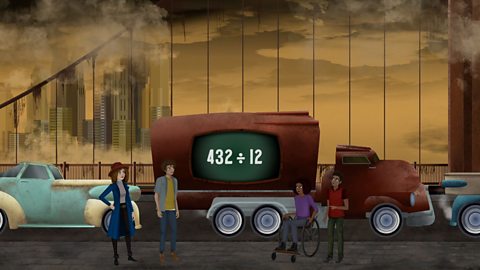
Olivia and Hassan learn how to perform long division in order to free gridlocked traffic on a bridge.
Recognising and comparing fractions. video
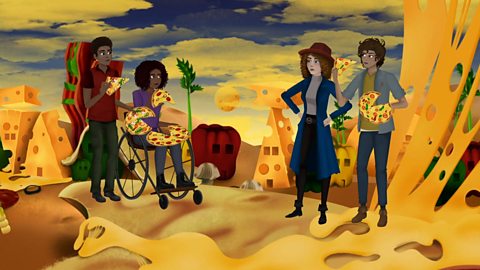
Olivia and Hassan are enjoying themselves in a world made out of pizza and learn how to work with numerators and denominators in fractions.
Adding and subtracting fractions. video
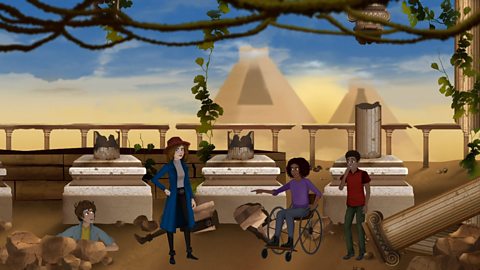
Amongst the ruins of an ancient city, Olivia and Hassan learn how to add and subtract fractions.
Multiplying and dividing fractions. video
In a mysterious crystal cave, Olivia and Hassan get to work dividing and multiplying fractions in order to find their way out.