NARRATION:Back in the deepest, darkest depths of time, there lived a great mathemagician called Hypatia. Numbers fell under her spell one by one. With them, Hypatia could do anything. Now Hypatia is looking for people to share her powers with. She has forged a mathematical maze. Only true mathemagicians can solve the puzzles and find their way out. Join two young explorers, Oliviaand Hassan, to solve the puzzles, escape the maze and become the greatest mathemagicians of all time.
Adding and subtracting fractions.
HASSAN:I bet this was a temple.
OLIVIA:And this was a massive pillar.
HASSAN:Does this go together with this?
OLIVIA:Hmm, not sure.
HYPATIA:Sorry it's a bit of a mess, meant to tidy up before you came.
HASSAN:What is this place?
HYPATIA:These are the ancient ruins of… You know, I'm not too sure. Perhaps you mathemagicians can piece it back together.
OLIVIA:Cool. How do we do that?
ARCHIMEDES:Ooh, we need to look for pieces that are part of the same group.
HASSAN:So we can put parts back together like a puzzle.
OLIVIA:Oh.
ARCHIMEDES:Exactly.
HYPATIA:And if you are ever to find your way out of the city ruins, you will have to solve this puzzle: 2/3 minus 1/2. Can you solve it?
ARCHIMEDES:Let's take a look. Here's how you add and subtract fractions.
When adding or subtracting fractions, we must always make sure the bottom number of both fractions, the denominator, is the same. If we imagine a grid filled with seven out of nine, each square would be a different size to a grid with only two boxes and one filled. We must work out the lowest common multiple of nine and two. The lowest common multiple is from your times table.
HYPATIA:Do you know what it is in this case?
ARCHIMEDES:18. That means we can make the denominator to both fractions in our original sum 18. So for 7/9, we got to 18 by multiplying both numerator, seven, and our denominator, nine, by the same number, two, to make 14/18.
HYPATIA:How about for 1/2? Can you do that too?
ARCHIMEDES:Oh, we can multiply both the digits in 1/2 by nine to make 9/18. Now we're able to add them together, by simply adding our numerators together.
HYPATIA:There is one problem here, can you see it?
ARCHIMEDES:Our numerator is larger than our denominator.
HYPATIA:Yes, we call this an improper fraction.
ARCHIMEDES:18/18 is a whole, with 5/18 remaining, so we express this as one and 5/18.
OLIVIA:Hmm. So for subtraction, we must have to do the same thing, right?
HASSAN:Yeah, make the denominators the same.
OLIVIA:The lowest common multiple of three and two is six.
HASSAN:For 2/3, we multiply by two to make our denominators six, so the fraction is expressed as 4/6.
OLIVIA:And for 1/2, we multiply by three to make our denominator six, so the result is 3/6.
HASSAN:Then we subtract them. Four minus three is one.
OLIVIA:So, our answer is…
OLIVIA AND HASSAN:1/6!
ARCHIMEDES:Correct!
HASSAN:So if fractions can only be joined when from the same whole…
OLIVIA:It must be the same for the ruins!
HASSAN:Finding pieces from the same whole.
ARCHIMEDES:Exactly.
OLIVIA:This plus that plus this bit.
HASSAN:This, that, this and this.
OLIVIA:That, that, this, that.
ARCHIMEDES:Oh.
HYPATIA:Oh wow, thank you so much, but we're a team.
OLIVIA:Yeah!
ARCHIMEDES:I love it!
HYPATIA:Now I have a question for you, my young mathemagicians. A chariot travels from the temple to the outpost. In the morning, it completes 2/3 of the journey. In the afternoon, it completes 1/5 of the journey. What fraction of the journey has been travelled altogether? What fraction of the journey is left to travel?
Video summary
Amongst the ruins of an ancient city, Olivia and Hassan learn how to add and subtract fractions.
Archimedes explains how to perform subtraction using the fractions of the ruins and compiling them together, and with this new knowledge they're able to create a beautiful statue of Hypatia, before moving onto the next part of the mathematical maze.
This short animated film is from the BBC Teach series, Hyaptia's Mathematical Maze.
Teacher Notes
Before watching the film:
Prior to this lesson you may wish to introduce students to other relevant topics, for example:
- Common factors
- Common multiples
- Equivalent fractions and converting
During watching the film:
Depending on your lesson’s focus, you may wish to pause the film at certain points to check for understanding by asking questions such as:
- What are the rules for adding and subtracting fractions?
- Why do we add and subtract the numerators but not the denominators?
Final question:
A chariot travels from the temple to the outpost. In the morning, it completes ²⁄₃ of the journey. In the afternoon, it completes ¹⁄₅ of the journey.
What fraction of the journey has been completed altogether? What fraction of the journey is left to travel?
Answer to the final question:Completed: ¹⁰⁄₁₅ + 3⁄₁₅ = 13⁄₁₅Left to travel: ²⁄₁₅
Following on from the film:
- Add fractions using bar models of the relative size.
- Explore subtraction as difference by giving an open-ended question, e.g. I am thinking of two fractions. They have a difference of ¹⁄₂. What might my fractions be? I.e. ³⁄₈ and ⁷⁄₈. 2⁄₁₀ and ⁷⁄₁₀.
- In these examples, can the denominator ever be an odd number?
This short film is suitable for teaching maths at KS2 in England, Wales and Northern Ireland and 2nd Level in Scotland.
Adding and subtracting using mental methods. video
In a mythical temple full of obstacles, Olivia and Hassan learn simple mental maths and apply it to work out the passcode to open the door.
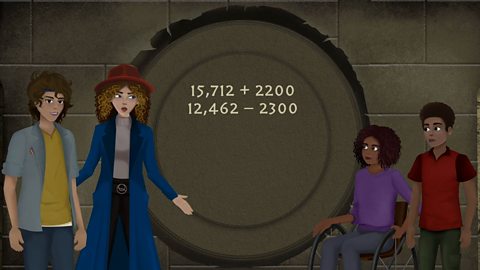
Adding and subtracting using written methods. video
Having been transported to a floating library, Olivia and Hassan's ability to solve large equations using written methods is tested.
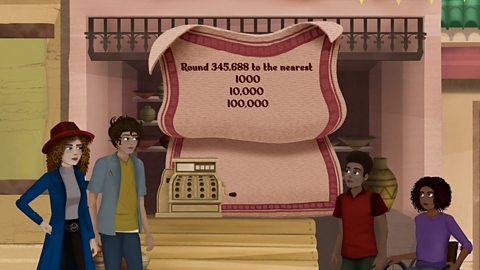
How and why we round numbers. video
Olivia and Hassan are taught how to round to the nearest 1000, 10,000, and 100,000 when a disgruntled magic carpet demands money from them.
Using addition and subtraction in multi-step problems. video
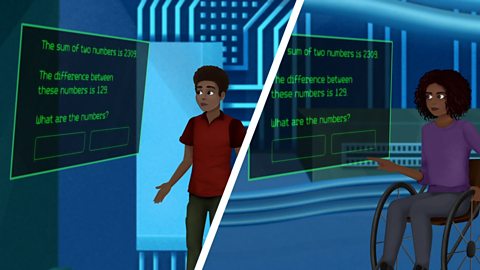
Inside a giant computer created before the age of mathemagicians, Olivia and Hassan are faced with a multi-step problem to reach the labyrinth’s next stage.
Multiplying by 10, 100 and 1000. video
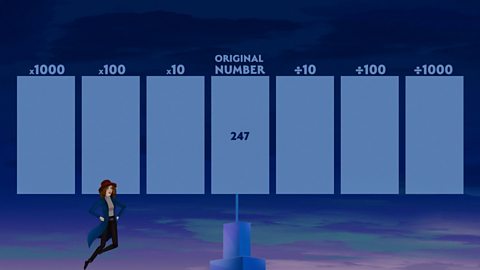
When Olivia and Hassan find themselves on the roof of an enormous skyscraper they learn how to multiply by 10, 100 and 1000 and work out the number of windows on the building.
Mental multiplication. video
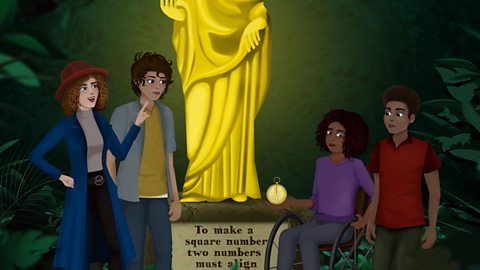
While exploring a jungle, Olivia and Hassan learn the true nature of square numbers as being created when two of the same number are multiplied together.
Factors, multiples and primes. video
Trapped in a desert together with Archimedes, Olivia and Hassan learn what common factors, multiples, and prime numbers are.
Multiplying using written methods. video
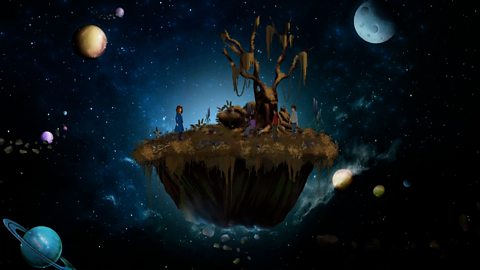
Finding themselves in space, Olivia and Hassan watch mathemagician Hypatia perform long multiplications in the sky by bending the stars.
Dividing using written methods. video
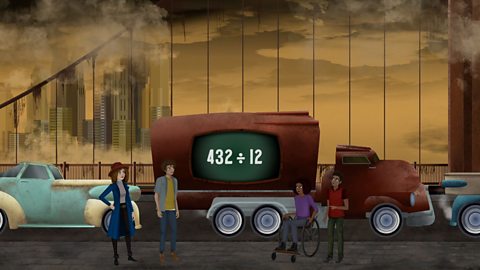
Olivia and Hassan learn how to perform long division in order to free gridlocked traffic on a bridge.
Recognising and comparing fractions. video
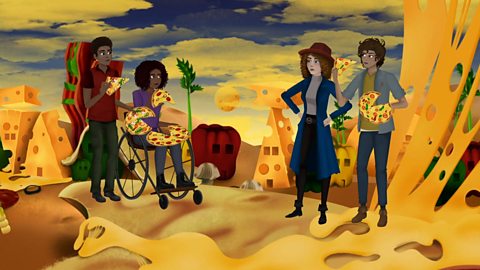
Olivia and Hassan are enjoying themselves in a world made out of pizza and learn how to work with numerators and denominators in fractions.
Multiplying and dividing fractions. video
In a mysterious crystal cave, Olivia and Hassan get to work dividing and multiplying fractions in order to find their way out.