Now forces don't just change the way that things move, they can also change the shape of things.
And a good example of that is Hooke's law. It says that if you apply a force to a spring, then the force stretches spring. And if you don't stretch too much, Hooke's law says that the amount of force you apply is proportional to the stretch.
So, that means that if you apply twice the force, you get twice the stretch. If you applied three times the force, you get three times the stretch.
Now, that works until you stretch the spring too much. Now, you probably know what happens if you overstretch a spring. It won't come back to its original shape, its original length.
Why is that? It's actually quite a nice and deep question with nice and deep answer.
It's because the spring is made up of lots of molecules that are all stuck together with their own little forces between them, and if you overstretch the spring you can break those bonds for good. They don't come back when you let go and so the spring doesn't come back to its original length.
So Hooke's law only applies if you keep all those bonds between the molecules together, that is to say, if you don't overstretch the spring.
In this short video Professor Brian Cox highlights the effect of forces in changing the shape of an object. Hooke’s Law is described using the example of a spring.
The initial linear relationship between force and extension is described, illustrating that the extension is proportional to the force exerted on a spring. It also highlights that the spring returns to its original length when the force is removed.
The video then describes the effect of overstretching a spring and explains that the spring will no longer return to its original length if the bonds within its molecules have been permanently broken by overstretching.
Teacher Notes
Points for discussion:
Investigation of Hooke’s Law is a Required Practical in AQA, Edexcel and OCR GCSE specifications.
This practical develops Apparatus and Techniques Physics 1 & 2 (DfE GCSE subject content guidance, Appendix 4).
At KS3, students need to be aware of Hooke’s Law, particularly the linear relationship between force and extension.
Students may not use a spring at KS3 but may investigate the stretching of, for example, elastic bands or sweet laces.
From previous experience, students will be aware that a force extends a spring and that the spring can be overstretched.
This video provides an explanation for these observations and uses key terminology that students should know, for example ‘proportional’.
Suggested activities:
This video could be used after students have investigated Hooke’s Law as a way of reinforcing the linear and non-linear relationships between force and extension, and to explain their observations in terms of molecular bonds.
Alternatively, it could be used as an opportunity to revisit the practical and the learning from it.
At KS4, students could progress to calculating a spring constant where the relationship is linear, or to calculate the work done in stretching.
At KS3, students may not need to explore the non-linear relationship between force and extension in over-stretching, but experience will have told them that we can overstretch an object and some students may find it helpful to have this explained.
Curriculum Notes
Suitable for Combined Science and Physics GCSE in England, Wales and Northern Ireland and at National 4 and 5 in Scotland, and Cambridge IGCSE Physics
Also may be suitable for KS3. Although a spring may not be the example used at KS3, the idea that forces cause objects to stretch is explored and a linear relationship identified.

Newton’s First Law. video
An explanation of Newton’s First Law of Motion which addresses a common misconception about the effect of a force on an object that is already moving.

An introduction to the speed equation. video
An introduction to the speed equation, illustrating its logic using the example of a journey from home to school.

The importance of checking mathematical answers. video
A reminder to always sense-check mathematical answers in physics, using a speed calculation as an example.

Average speed. video
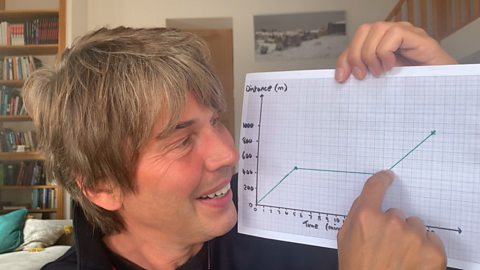
An introduction to average speed and how to use a simple distance-time graph to calculate it.
Relative speed. video
An explanation of the concept of relative speed and how to calculate the relative speeds of two vehicles going in the same direction and in the opposite direction.