It's always worth checking, by the way, in physics, that when you do some sums, do a bit of mathematics, the answer make sense.
If you'd done something wrong in the sum and it's come out with ten thousand metres a minute as a speed, 'cause maybe you did something and you multiplied them rather than divide them, or something like that.
Just think: ten thousand metres per minute. That's ten kilometres in a minute. You can't walk or run ten kilometres in a minute. You can't even do that in a car. You'd have been in a jet aircraft.
And so, you can always check, or you should always check your mathematical answers.
Use your common sense and think 'Is that right'? 'Do I really walk at ten kilometres every minute?'
No, I don't!
In this short video Professor Brian Cox serves a useful reminder to students to always use common sense and check that any mathematical answers seem reasonable.
The context used in the film is to consider that if you calculated that you walk at a speed of 10,000 metres per minute, does that seem reasonable? And if it does not, to go back and check your calculations.
Teachers and examiners know that students often fail to make this essential, final sense check and that they often find such reasoned judgements difficult to make.
This basic message of this video is widely applicable, and not limited to speed or to physics. It is just as valid wherever calculations are made, for example in biology, chemistry, maths or design & technology.
Teacher Notes
Points for discussion:
When carrying out calculations, students often just ‘plug in’ numbers and generate an answer without engaging with the calculation and answer to check that it seems reasonable.
Encouraging students to include this sense check as an essential step in any calculation, will be extremely beneficial in identifying and correcting errors and developing confidence with the calculations.
Suggested activities:
This video follows on well from clip 3 in this collection, which introduces the speed equation.
This video could be used to stimulate discussion about typical speeds for walking, running, cycling, driving, etc, and to support students’ general knowledge around those values.
Students could be given answers to calculations linked to the speed equation and asked to say whether or not they appear reasonable, and if not, to identify the mistake.
Alternatively, students could be given with calculations with missing units and asked to suggest the most appropriate element, for example, metres or kilometres, minutes or seconds.
The principle of sense-checking answers is valid for all sciences where calculations are made.
Curriculum Notes
Suitable for KS3, Combined Science and Separate Sciences GCSE in England, Wales and Northern Ireland and at National 4 and 5 in Scotland (also relevant wherever calculations are carried out), and Cambridge IGCSE Physics

Newton’s First Law. video
An explanation of Newton’s First Law of Motion which addresses a common misconception about the effect of a force on an object that is already moving.

Hooke’s Law. video
An explanation of Hooke’s Law using a spring as an example and showing how overstretching a spring leads to a non-linear relationship between force and extension.

An introduction to the speed equation. video
An introduction to the speed equation, illustrating its logic using the example of a journey from home to school.

Average speed. video
An introduction to average speed and how to use a simple distance-time graph to calculate it.
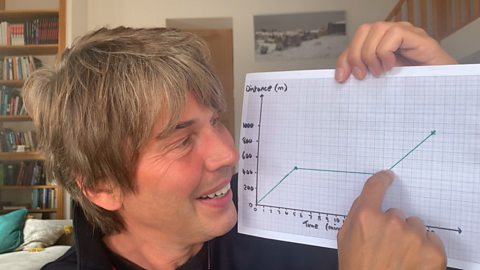
Relative speed. video
An explanation of the concept of relative speed and how to calculate the relative speeds of two vehicles going in the same direction and in the opposite direction.