Let's think now about the concept of motion and in particular, the idea of speed. What is speed?
Well, let's think about an example. Let's say that you're going to go from home to school, and school is one kilometre away from your house, that's a thousand metres.
And you've left yourself ten minutes to make that journey. What speed do you have to walk or run to get to school on time?
Well, speed is distance divided by time. In this case, that means one thousand metres, distance from home to school, divided by ten minutes, the time you've allowed yourself.
You have to travel one thousand metres in ten minutes. Your speed is the distance divided by the time, one thousand divided by ten equals one hundred metres per minute, which is quite a fast walk or even a bit of a jog.
Now, that makes sense, if you think about it, this definition of speed. What does it mean to travel at one hundred metres per minute?
It means literally that in one minute, you've travelled one hundred metres.
So in two minutes, you've travelled two hundred metres.
In three minutes, you've travelled three hundred metres.
In four minutes, you've travelled four hundred metres.
All the way to ten minutes, you've travelled a thousand metres, the distance from home to school.
In this short video Professor Brian Cox gives an introduction to speed. He defines what is meant by speed and how to calculate speed by applying the 'distance divided by time' equation.
The calculation is explained in the context of a familiar journey from home to school and illustrates the logic of the speed equation.
The use of the correct units is clear (metres per minute in this example) and the calculated speed is contextualised in the example of a fast walk or jog, which will be familiar to students and will allow them to sense-check their answers.
Teacher Notes
Points for discussion:
This video provides a simple introduction to the scalar quantity of speed as distance divided by time and so is useful at KS3 in the first instance.
The modelling of logic in this video is also useful more widely as it demonstrates to students that we can often sense-check an equation or a calculated value.
Suggested activities:
This video could be used as part of an introduction to speed at KS3 as it highlights the logic of the speed calculation. Students often fail to apply logic to simple equations and move straight to rote learning.
After watching the video, students could be given other simple calculations to attempt, including using different units. This could highlight the importance of using correct units by comparing, for example, 10m/min to 10m/s. Students could then progress to changing the subject of the equation.
The video could also be used to stimulate discussion about some typical speeds, such as those when running, driving, or cycling, providing an opportunity to apply their knowledge to other real life contexts.
A good follow-on from this could be clip 4 in this series, which focuses on the importance of sense-checking mathematical answers.
At KS4, this video could be used as a simple revision of speed, a scalar quantity, before moving on to learning about velocity, a vector quantity.
Curriculum Notes
Suitable for KS3, Combined Science and Physics GCSE in England, Wales and Northern Ireland and at National 4 and 5 in Scotland, and Cambridge IGCSE Physics

Newton’s First Law. video
An explanation of Newton’s First Law of Motion which addresses a common misconception about the effect of a force on an object that is already moving.

Hooke’s Law. video
An explanation of Hooke’s Law using a spring as an example and showing how overstretching a spring leads to a non-linear relationship between force and extension.

The importance of checking mathematical answers. video
A reminder to always sense-check mathematical answers in physics, using a speed calculation as an example.

Average speed. video
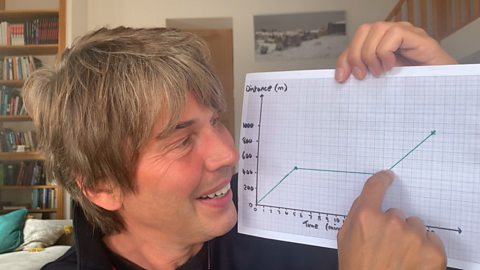
An introduction to average speed and how to use a simple distance-time graph to calculate it.
Relative speed. video
An explanation of the concept of relative speed and how to calculate the relative speeds of two vehicles going in the same direction and in the opposite direction.