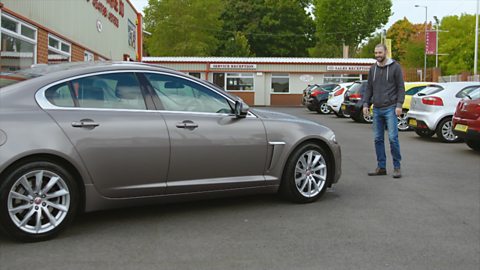
DRESS MAKER:'OK, I've got to make an outfit for the fashion show and I need to use geometric shapes to help create my design.
DRESS MAKER:'So firstly, I need to know what the different lengths of a circle are. The diameter is the length across a circle through the centre.
DRESS MAKER:'Half the length of the diameter is the radius. This is the distance from the centre to any point on the circle edge, and is represented by the letter r in equations.
DRESS MAKER:'And finally, the circumference is the length of the edge around the circle.
DRESS MAKER:'Now, to do any calculations with circles I have to use pi. Pi is the ratio of two different distances on a circle, the circumference over the diameter, and the diameter fits around the circle approximately three point one four times.
DRESS MAKER:'Now to create the skirt for my outfit, I need to calculate the circumference and the area of my circle to see if I have enough material.
DRESS MAKER:'To calculate the circumference of a circle, I need to remember the formula two pi r. As the diameter of my circle is 68cm, the radius will be equal to 34cm.
DRESS MAKER:'So two multiplied by pi multiplied by 34, is equal to213.628cm.
DRESS MAKER:'However, I will be using a semicircle, so I need to divide the circumference by two and add the diameter.
DRESS MAKER:'Therefore, the perimeter of the semicircle is equal to 213.628 divided by two, plus 68, which equals 174.814cm.
DRESS MAKER:'To calculate the area of a circle I need to remember the formula pi r squared.
DRESS MAKER:'However, I need to calculate the area of a sector of a circle, as this will be a different colour to the rest of my skirt. To calculate an arc length, or area of a sector, I use the same formulae.
DRESS MAKER:'But I must also multiply by the angle of the sector over 360, as the angle around the centre of the circle is 360 degrees.
DRESS MAKER:'So using the angle of 60 degrees in my sector, and the radius of 34cm, the area of my sector will equal pi multiplied by 34 squared, multiplied by 60, divided by 360. And in terms of pi, this will equal 192.67 pi.
DRESS MAKER:'Now, in order to create the top for my outfit I need to use a trapezium. A trapezium is a quadrilateral with a pair of parallel sides, and in order to calculate the area of my trapezium I need to use the formula A plus B, multiplied by H, divided by two.
DRESS MAKER:'Where A and B are always the lengths of the parallel sides, and H is always the perpendicular length between the two parallel sides.
DRESS MAKER:'Now with my trapezium, A is equal to 0.52 metres, B is equal to 0.82 metres, and H is equal to 0.62 metres.
DRESS MAKER:'So the area is equal to 0.52 plus 0.82, Which equals 1.34, multiplied by 0.62, which equals 0.831, and divided by two, which equals 0.415 square metres.'
Video summary
This short film demonstrates the practical aspect of dressmaking using geometrical shapes such as a circle and trapezium; forming the top and bottom part of an outfit.
The film guides learners through calculations of the area and perimeter of a circle and trapezium and in the case of a circle, semi-circle, arc and sector.
Geometry is a branch of mathematics concerned with questions of shape, size, relative position of figures, and the properties of space
Geometry arose independently in a number of early cultures as a body of practical knowledge concerning lengths, areas, and volumes.
This is from the series: Real Life Maths
Teacher Notes
The video can be seen as a precursor to a project such as manufacturing of a container that has circles and other shapes; the project could lend itself to investigating wastage of material and potential costs to the company (Teacher to decide on project)._
The video can be used for revision purposes for GCSE exam and can be shared by students to answer exam questions in a carousel type organization.
The learners could use the video as a guide to designing clothes and making the necessary calculations.
Each group of learners present their ideas to the rest of the group.
This clip will be relevant for teaching Maths at KS3/GCSE in England Wales and Northern Ireland. Also at National 4, 5 and Higher in Scotland.
This topic appears in OCR, Edexcel, AQA, WJEC in England and Wales, CCEA GCSE in Northern Ireland and SQA in Scotland.
Ratio and Proportion. video
A cake company demonstrates how ratios and proportions are used to complete an order.
Percentages. video
Clothes shopping and video statistics are used to explain percentages.
Algebra. video
A mobile phone deal and a trip to the cinema are used to explain algebra.

Sequences. video
The purchasing of cupcakes is used to explain linear and quadratic sequences.
Pythagoras. video
Cleaning a window and installing a TV are used to explain the theory of Pythagoras.
Probability. video
Predicting the weather and choosing a chocolate are used to explain probability.

Trigonometry. video
A hiker trying to work out the height and distance he's walked uses trigonometry.
Fractions. video
A group of friends sharing a meal is used to explain fractions.
Finance. video
A man buying a car uses financial planning and investment to work out how much he'll pay.