SHOP OWNER:Hi, what can I get you?
UNKNOWN MALE:Hi, I'm really hoping you can help me. I'm trying to plan my niece's birthday party for tomorrow, and so far the princess-themed decorations I ordered online are yet to arrive.
UNKNOWN MALE:The entertainment has cancelled as they've double-booked. And my attempt at making mini cupcakes, well let's just say that that was a disaster by epic proportions.
SHOP OWNER:You're not having the best of luck, are you?
UNKNOWN MALE:It caught fire.
SHOP OWNER:How is that even possible?
UNKNOWN MALE:I don't know. But I desperately need 25 mini cupcakes, and I need them delivered as I've got tons of other things to do. Please say that you can help.
SHOP OWNER:Yes, as long as you stay out of the kitchen.
SHOP OWNER:Our mini cupcakes are 50p each, with a delivery charge of £4 on any order up to 30 cakes.
UNKNOWN MALE:'So if each cupcake costs 50p, then the linear sequence, with delivery, will be as follows. As the difference between each term is 50, the nth term can be written as 50N plus 400.
UNKNOWN MALE:'I require 25 cakes, so 25 multiplied by 50, plus 400, equals 1,650. So it will cost me £16.50.'
UNKNOWN MALE:So for 30 cupcakes it's free delivery?
SHOP OWNER:That's correct.
UNKNOWN MALE:'Would it be cheaper if I get 30 cupcakes instead?
UNKNOWN MALE:'Well the nth term for 30 cakes or more is 50N. so 30 multiplied by 50 is equal to 1,500. So for 25 cupcakes with delivery, it will cost £16.50, whereas 30 cupcakes will cost me £15. I'll take 30 cupcakes please.
SHOP OWNER:If you're interested, we have a special selection of different cakes, and depending on size, they cost up to £36.
UNKNOWN MALE:How many cakes would you get for the £36?
SHOP OWNER:50.
UNKNOWN MALE:The largest size would probably be wise, and with different cakes, the parents will probably eat them. How much is the next size up?
SHOP OWNER:That's the largest, but I can create one for you.
SHOP OWNER:'I need to calculate what the next term in this pricing sequence will be. I have a sequence of three, 10, 21 and £36. This sequence is not linear, as the first difference between each term differs.
SHOP OWNER:'They are seven, 11 and 15. However, the second difference is constant, it is an increase of four between each term. This means it's a quadratic sequence. If we halve the second difference to find the coefficient of the N squared, so four divided by two equals two, then in the sequence we get 2N squared, two, eight, 18, 32.
SHOP OWNER:'If we subtract 2N squared from the original sequence we get one, two, three and four, which is a linear sequence.
SHOP OWNER:'Therefore, the combined nth term equals 2N squared plus N. So the fifth term of this sequence will equal two multiplied by five squared, plus five,'
SHOP OWNER:which equals £55.
UNKNOWN MALE:You're a life saver.
SHOP OWNER:So how many kids have you got coming round?
UNKNOWN MALE:Oh no, invites!
Video summary
A man is panicking because his plans for his niece's birthday party have so far been a disaster.
He goes to the bakery to buy cupcakes, which he needs delivered to save time.
Using a linear sequence, he calculates the nth term, and then uses it to solve the total cost of the order.
The cakes are then sold in batches; where each one does not increase by the same amount, and hence the nth term of the quadratic sequence is found to solve the price of the larger batch of cakes.
This is from the series: Real Life Maths
Teacher Notes
Students to use the video clip to up-skill their knowledge of how to find the nth term of a linear and quadratic sequence.
Provide students a project around crime figures and which particular house numbers are targeted and learners to spot patterns and predict the burglars next move and how the police can make an arrest.
The burglars then start targeting house numbers that don't go up by same amount presenting a quadratic sequence to solve and then predict the burglar’s next move.
Learners in groups of no more than 3 or 4, investigate: (a) Fibonacci sequence (b) Pascal’s Triangle © Triangular and square numbers (d) The Golden rule (e) Multiplication of bacteria Present their findings in a presentation.
This clip will be relevant for teaching Maths at KS3/GCSE in England Wales and Northern Ireland. Also at National 4, 5 and Higher in Scotland.
This topic appears in OCR, Edexcel, AQA, WJEC in England and Wales, CCEA GCSE in Northern Ireland and SQA in Scotland.
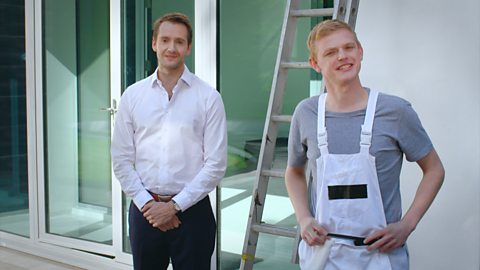
Pythagoras. video
Cleaning a window and installing a TV are used to explain the theory of Pythagoras.
Probability. video
Predicting the weather and choosing a chocolate are used to explain probability.

Ratio and Proportion. video
A cake company demonstrates how ratios and proportions are used to complete an order.
Algebra. video
A mobile phone deal and a trip to the cinema are used to explain algebra.
Percentages. video
Clothes shopping and video statistics are used to explain percentages.
Trigonometry. video
A hiker trying to work out the height and distance he's walked uses trigonometry.

Fractions. video
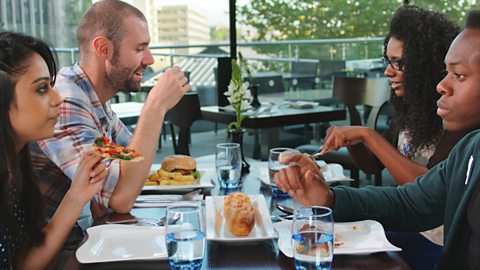
A group of friends sharing a meal is used to explain fractions.
Geometry. video
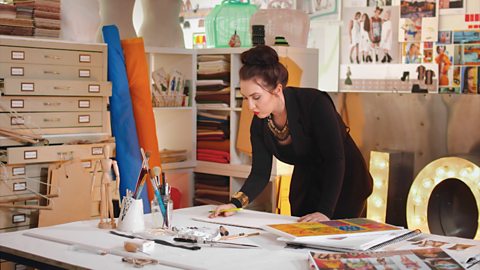
A clothes designer trying to make an outfit uses geometry.
Finance. video
A man buying a car uses financial planning and investment to work out how much he'll pay.