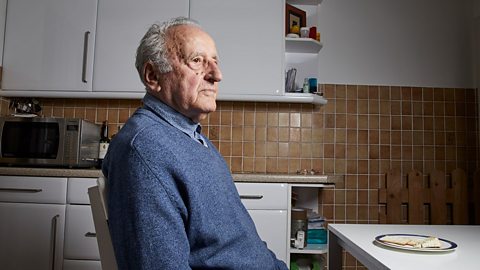
SAM DRESNER:The last year or two, I realise how much traumatised, or hang ups, I have from what happened such a long time ago.
Yes, I was traumatised.
Instead of getting weaker, it seems to be getting stronger, sometimes I have kind of, days where I can’t get it out of my mind. I don’t want to carry it around with me all the time. It just comes, flashes, every day.
From the information I found out my mother and sister they were taken to Treblinka, Treblinka to be gassed. I was 14 when I last saw her and my sister. My sister was three years younger than me.
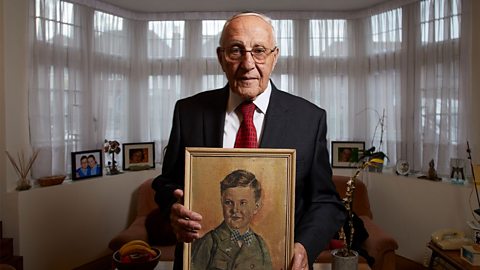
This is a acrylic sketch of my mother from memory but it’s not, it’s not like a photo. I would love to have a photo of my family, I haven’t got any photos. It’s got a bit of a feeling, but I tried my sister too, I can’t get any memory, can’t get anything. I think I remember what kind of eyes she had, what kind of face, but when I come to draw it, it’s no good I had to turn, to burn it all. So the only one that I did was I did a collage and it’s completely abstract. This represents my sister. It might mean anything to you, doesn’t matter what it means to you or to anybody, to me it’s something of my sister.
I would love to have a photo or something, it haunts me, I want…
And that’s another obsession with me is forests, and what I saw. See the Germans used it a lot the forest, the a bigger darker forest the better for small extermination like five hundred people.
I tried again, and again, differently, I call it a hole, it’s a black hole. What kind of god could do it? This god almighty so strong, so merciful, so omnipotent and after you know, I was angry, I still am actually.
Video summary
As a child, Sam Dresner survived several camps during the Holocaust.
He has no photographs of his family, who were all murdered when he was a boy. He uses painting as a way to recreate what they looked like from memory, and to work through his traumatic memories.
It’s only in the last year or two that Sam has come to realise how deeply he has been traumatised by his experiences. Rather than getting weaker, his memories are getting stronger with age.
He found out after the war that his mother and sister were gassed in Treblinka, he was 14 when he last saw them. Whilst looking through his work, Sam recounts the difficulty he has remembering his mother and sister in enough detail to paint their images. He manages something of his mother, but his sister’s image always escapes him. There is only one collage that he’s kept, which represents her.
He describes painting forests as another obsession of his, a result of what he saw. The Nazis used forests to carry out executions, and Sam paints them over and over.
Sam survived several concentration camps, including Buchenwald and Theresienstadt.
This clip is from the BBC series, The Last Survivors.
Due to the sensitive nature of the subject matter, we strongly advise teacher viewing before watching with your students.
Teacher Notes
Why do you think Sam struggles more now with the trauma of his past than he did before?
Use Sam’s film as a discussion around the nature of memory - how it changes through our lives and the importance of being able to remember one’s past. What would it be like not to have any pictures of your family if they were no longer alive?
Sam describes the anger he still feels as a result of what happened in the Holocaust. Should there be forgiveness?
Discuss how those whose families were murdered might have achieved justice after the Holocaust. Is it possible to achieve justice for crimes such as this? Look at how justice was sought after the war, such as through the Nuremberg trials.
Sam queries what sort of god could have allowed the Holocaust. Do you agree? Discuss the impact the Holocaust might have had on people’s faith.
This short film will be relevant for teaching history at GCSE and above in England, Wales and Northern Ireland and National 4/5 and above in Scotland.
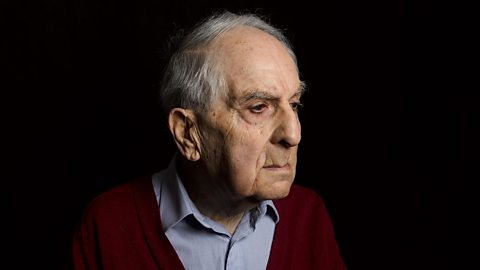
Frank Bright recounts the fate of his former classmates. video
Frank Bright discusses his work researching the fate of his former classmates, using a class photograph taken in 1942 which he calls ‘Red for Dead’.
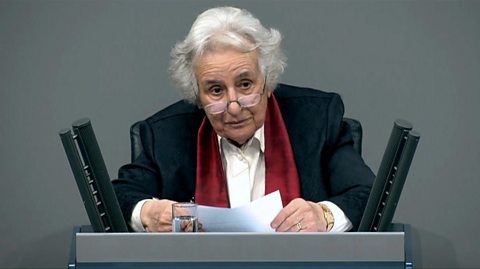
Anita Lasker-Wallfisch addresses German Parliament. video
Anita Lasker-Wallfisch addresses German Parliament to caution against forgetting the past. She contemplates as to what difference speaking out as a survivor can make.
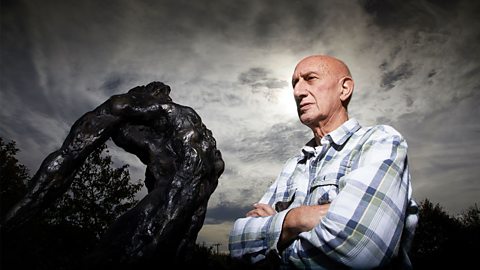
Maurice Blik confronts the impact of his experiences. video
Maurice Blik confronts the impact of his experiences as a child in Bergen-Belsen, recounting the moment his sister died and how sculpture has helped him to process his trauma.
Manfred Goldberg confronts the death of his brother. video
Manfred Goldberg returns to Germany for the first time since he was a child in 1946 to attend a memorial for his family. In doing so, he finally acknowledges the death of his brother.
Ivor Perl returns to Auschwitz with his daughter. video
Auschwitz survivor Ivor Perl returns to the camp with his daughter Judy for the first time. She’s asked Ivor to return in the hope that it will help him, and therefore her, come to terms with the past.