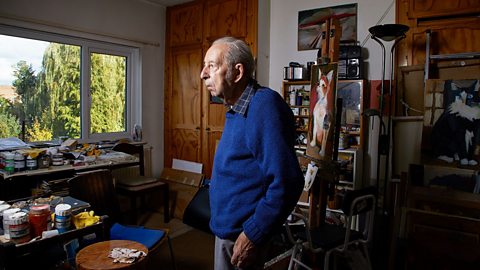
MANFRED GOLDBERG :One hears of miraculous reunions where members of the family find each other after sixty years or more by pure chance, and therefore I have never recited any memorial prayer on his behalf, always making myself believe that maybe he’s still alive. But I certainly think of him when I stand there in front of my parents' grave yes.
INTERVIEWER:What was his name?
MANFRED GOLDBERG:His name was Herman, Herman Goldberg.
Last July I was contacted by an organisation in our home town, with a view to placing some Stolpersteine of our family. This memorial plaque will actually be an acknowledgement that I consider my little brother to have been murdered.
72 years since I was in Gasse. Here you are in Mullergasse, yeah this was our street.
FEMALE SINGER WITH GUITAR
MANFRED GOLDBERG:(IN GERMAN) Dear ladies and gentlemen, a few months ago I wouldn't have dreamed that I would stand here in my birthplace and take part in a memorial ceremony for our family. In particular, one which recognises and honours the murder of my brother, my dear brother. Therefore, it is most appropriate that this small memorial, which will outlive me, is placed here at the very spot where he experienced a few years of life, full of his parents' love. Before he had to live through hell on earth and sadly his young life was cut short. But in all these many years, I never felt able to recite a prayer in his name.
RECITES PRAYER
It certainly touched me, remarkably, because until now we all knew the facts but it has now been sort of publicly and officially, incontrovertibly, indisputably, confirmed.
I wonder whether passers-by ever do stop to glance at these, and whether it does trigger some urge to enquire into the background. I have my doubts. People become immune to these things very fast, very quickly.
Video summary
Aged 13, Manfred Goldberg was transported to Preču concentration camp with his mother and younger brother Herman.
One day, whilst Manfred and his mother worked, Herman disappeared. They never saw him again.
For over 70 years Manfred has held a small hope that somehow, Herman survived and that one day they might be reunited
Manfred has been persuaded to return to Germany for the first time since the war for the installation of memorial ‘stumbling’ stones, or Stolpersteine, outside his family home in Kassel. The stones, laid across Europe, mark the last address of choice of the victims of the Nazi persecution - over 70,000 have been laid to date.
It is the first time that Herman’s death will be publicly acknowledged and means that at last, Manfred will recite El Maleh Rachamim for him - the Jewish prayer traditionally cited in memory of the dead.
Manfred survived several concentration camps including Preču and Stutthof. Unusually, both of his parents also survived the Holocaust.
This clip is from the BBC series, The Last Survivors.
Due to the sensitive nature of the subject matter, we strongly advise teacher viewing before watching with your students.
Teacher Notes
Does it surprise you that Manfred has held on to hope all of these years, that somehow his brother survived?
The aim of the Stolpersteine is to make people stop and think of the many victims of the Nazis. Do you think they are effective? How do we best commemorate the victims of the Holocaust? What should be the aim of a memorial for victims of the Holocaust?
Should there be forgiveness for the crimes of the Holocaust?
How do we make peace with past traumas?
Manfred was interned at a labour camp when his brother disappeared. Use his experience as a way to look at the different ways that the Nazis used concentration camps and slave labour.
This short film will be relevant for teaching history at GCSE and above in England, Wales and Northern Ireland and National 4/5 and above in Scotland.
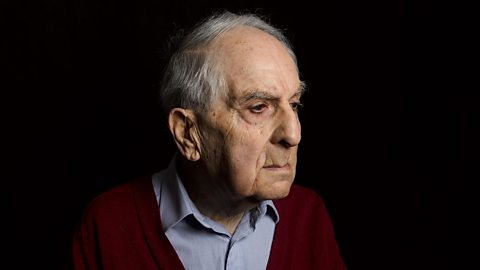
Frank Bright recounts the fate of his former classmates. video
Frank Bright discusses his work researching the fate of his former classmates, using a class photograph taken in 1942 which he calls ‘Red for Dead’.
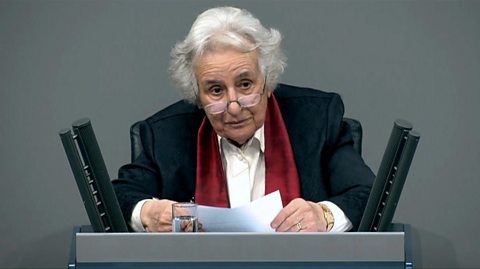
Anita Lasker-Wallfisch addresses German Parliament. video
Anita Lasker-Wallfisch addresses German Parliament to caution against forgetting the past. She contemplates as to what difference speaking out as a survivor can make.
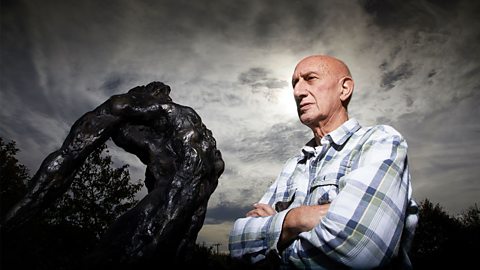
Maurice Blik confronts the impact of his experiences. video
Maurice Blik confronts the impact of his experiences as a child in Bergen-Belsen, recounting the moment his sister died and how sculpture has helped him to process his trauma.
Ivor Perl returns to Auschwitz with his daughter. video
Auschwitz survivor Ivor Perl returns to the camp with his daughter Judy for the first time. She’s asked Ivor to return in the hope that it will help him, and therefore her, come to terms with the past.
Sam Dresner grapples with his memories of the Holocaust. video
Sam Dresner has no photos of his family, who were murdered when he was a boy. He uses art to recreate what they looked like from memory, and to try and process what he saw.