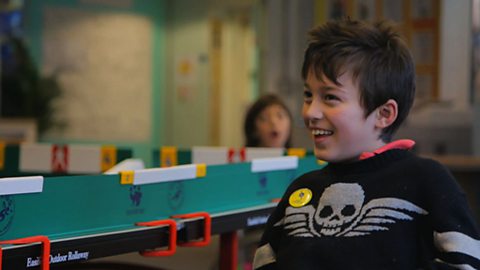
Video summary
Phoebe is seven-years-old and lives with diabetes but she still loves trick or treating at Halloween - even if she has to be careful around sweets.
In her own words she describes managing her condition daily with the help of her mum, teachers and friends, while still enjoying her favourite activities.
"Type 1 diabetes is that I have a pancreas that doesn't work. It means my blood sugar goes low and high so I have to have injections to help."
"At Halloween other people give me sweets, but I say 'no' because I have to control it. I couldn't just sneak and eat one because I didn't bring the diabetes kit."
My name is Phoebe, I'm seven years old and I have type 1 diabetes.
[Group of children] "TRICK OR TREAT!"
Type 1 diabetes is that I have a pancreas what doesn't work. It means that my blood sugar goes low and high so I have to have injections to help it. Other people give me sweets and I say no because I have to control it properly the way I should.
Phoebe's friend:
"Do you want these?"
I couldn't just sneak and eat one because I didn't bring the diabetes kit.
Phoebe's friend:
I feel sorry for Phoebe because we can eat as much as we like rather than Phoebe. Every time she picks up a sweet, she has to ask her mum and then take a test. And also has to take, erm… a jab.
Phoebe:
I test and I inject myself 4 times a day. I do the insulin before I eat my dinner… “Six point eight."
Phoebe's mum:
"Six point eight… that's excellent!"
Phoebe:
I have to fill the insulin in my pancreas to make it work.
Phoebe's mum:
"Put in 55 grams of carbohydrate that should do it."
Phoebe:
In the morning, when we're doing our breakfast, what we do is we have all of these little strips and we put one in and then what we do is we get a fingerpick ready and then we prick my finger, blood comes out, I tell my mum the reading and then after that she tells me how many carbs to put into the monitor, I put them in and then it tells me how many units I should give to inject myself.
Phoebe's mum:
“Tested……four units… four units.”
Phoebe:
When I had my injection the first ever time it did hurt. Now I've gotten used to having the injection it is…it's actually getting better and better every time.
Phoebe's mum:
“There you go,”
“Thank you, mummy, ”
“No worries.”
[Singing times tables]
At school, I have to break times and lunchtime I have to do it again.
Phoebe's teacher:
"Phoebe, could you go and take yourself down to Mrs Bourne please, good girl, thank you."
And if I don't do that, um my blood sugar will go really really high.
The signs are when I've got a bad tummy, maybe the headache and when I'm really teary and I'm really shaky as well.
School nurse:
"Make sure that you eat all your apple up, ok,"
"There you go,"
"Thank you."
Phoebe:
I do have to be kind of careful because even though the… I have had the jab and I can run around I can't run around too much mad.
You see the, the pancreas it goes a bit, woah, and like that's when I start to feel a bit low.
My friends at home, they always say are you okay when they just noticed when I'm running a bit weird…or shaky they just run and knock on the door, then my mum knows and they bring me in.
Whenever you see a diabetic a bit, a bit shaky or anything wrong with them just go and look after them and tell somebody, straight away.
My hobby is singing, acting and dancing.
[Singing]
Whenever it's the snack time, I have to do my blood test… and my injection whenever I'm eating.
“No!..”
"I'm not gonna eat my lunch"
School Nurse:
"Yeah you are"
“It's fine, have that"
"…then we'll do it again, in a bit"
Phoebe:
When I have a low reading, I have to have a sugary drink or anything what's got sugar in it…and then I have to wait for 10 minutes and it'll bring back up the sugar levels.
[Sighs]
“6.9… 2 units…"
It makes me feel like that I'm really left out on food… because loads of people get to eat straight away… and I have to have the blood test and the injections to have before I eat… it's not really that fair, if you know what I mean.
But some of my friends what are really kind - they don't eat their sweets. They eat it when I eat it and they be really kind to me, and I really enjoy that because it means that they're being a really kind, thoughtful friend.
[Phoebe singing]
I, erm, have my own little book where I write my own songs… from singing as well.
Phoebe singing:"I want to be a normal girl…that's all I want. If only I could have this…"
Diabetics can still be normal children and normal people, but all that's wrong with them…they just have to have blood tests, it doesn't mean they can stop doing what they need to do.
When I grow up I would like to be a nurse, a vet or mostly I would love to be a singer!
I do singing lessons with Polly and erm, we do harmonies together and then she brings me new songs what I should learn and then I sing the songs to her and she helps me.
[Phoebe singing Adele's 'Someone like you'].
It doesn't matter I've got diabetes, even though you're diabetic whatever happens to you, you can just still go anywhere.
My routine at home:
"I test and inject myself four times a day. I do the insulin before I have dinner. I might have to put insulin in to make my pancreas work."
"In the morning, at breakfast, we have these little strips and we put one in (the insulin monitor) and we prick my finger, blood comes out and I tell my mum the reading, and then she tells me how many carbs to put into the monitor."
"I put them in, then it tells me how many I units I should inject."
"My injection did hurt every time but now I've got used to it, it's getting better."
My routine at school:
"At school, at break time, and lunch time, I have to do it again. If I don't, my blood sugar will go high."
"The signs are when I've got a bad tummy, maybe a headache and when I'm teary and shaky as well."
"I have to be careful. Even if I've had a jab, I can't run around too much."
"My friends at home always say, 'are you OK?' if they notice I'm running a bit weird or shaky. They run and knock on my door and my mum knows and they bring me in."
"Whenever you see a diabetic a bit shaky or anything wrong, just go and look after them and tell somebody straight away."
I love to sing and dance!
"My hobby is singing, acting and dancing. Whenever it's snack time, I have to do my blood test and injection."
"When I have a low reading, I have a sugary drink or something with sugar, then I wait 10 minutes and it will bring back up the sugar levels."
"It makes me feel that I'm really left out on food because loads of people get to eat straight away but I have to have the blood test and injections before I eat. It's not that fair."
"Some of my friends are really kind. They don't eat their sweets, they eat when I eat. I really enjoy that because it means they are being a really kind, thoughtful friend."
"When I grow up I would like to be a nurse, or vet, but mostly I would love to be a singer!"
Discussion ideas for parents, carers and teachers:
- Talk to your children or class about how some medical conditions can affect our lives although we cannot see them.
- Discuss resistance skills, such as the challenge of saying no to temptation.
- Discuss the important role of friends offering support by being kind and thoughtful.
- Talk about other kinds of medicines that children may have to take.
This clip will be relevant for teaching PSHE, health and wellbeing in primary schools at KS2 in England, Wales and Northern Ireland and 2nd Level in Scotland.
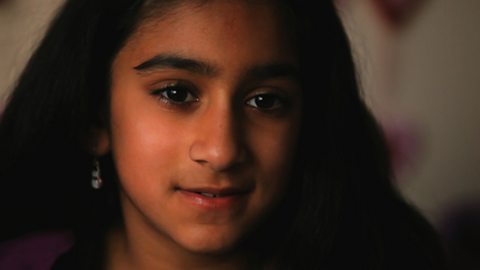
Dealing with asthma - Alesha's Story. video
Alisha is a nine-year-old girl who suffers from asthma. She talks about how it affects her life and the things she finds difficult.
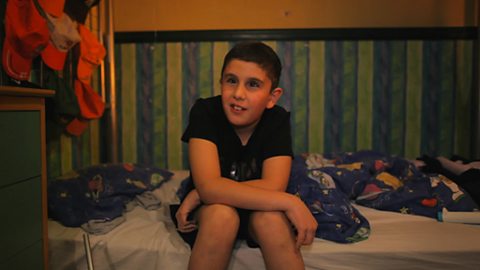
Coping with visual impairment - Theo's Story. video
Theo is a ten-year-old boy with a visual impairment. He does not want to be treated differently because of his disability and doesn't like it when people are being too nice to him.
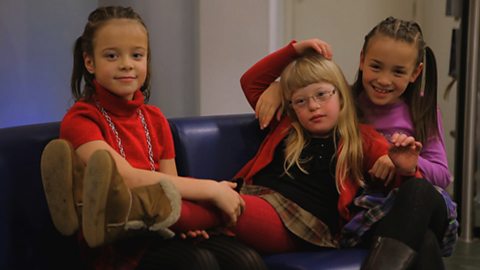
Down's Syndrome - Alexandra's Story. video
We meet triplet Alexandra who unlike her other two sisters, has Down's syndrome.
Coping with Dyslexia - Sophie's Story. video
Sophie is a nine year old girl who suffers from dyslexia and struggles with reading and spelling.
Coping with epilepsy - Robbie's Story. video
Robbie is an 11-year-old boy who has epilepsy. Robbie suffers from absences where he does not know where he is.

Cerebral Palsy - Archie's Story. video
In this short film for primary schools we meet Archie, a ten year old boy who has cerebral palsy.