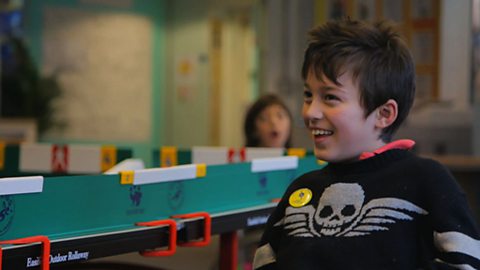
My name is Robbie, I'm eleven years old, and I live in Edinburgh.
Some people might have really bad epilepsy where they have like…like big seizures… but I just have absences which is just like my err eyelids fluttering and I just stop what I'm doing for ten seconds.
Of my friends, the people who've seen me had an absence would be Cameron, but I spend a lot of time with him.
Cameron:
It's almost like he goes to sleep and he just for a couple of seconds, maybe about 10 seconds he just sort of goes to sleep and like… he'll just sort of sit there and like you can be talking to him, he doesn't have a clue you're talking to him. And then when he wakes up and he doesn't really know where he is and he sometimes feels a bit dizzy and doesn't feel too well.
He just has a bit of a sore head for a wee while and then he just gets better pretty quickly.
Robbie:
I've had an absence at skiing, at Hill End.
Cameron:
He was just going up the tow, just over there, and he, I think he just went into it and he fell off the tow…and didn't really know where he was and kind of just got a bit dizzy and stuff like that.
Robbie:
And then in the British Championships training run, I had an absence just when I was about to turn so I just carried on going straight…
And when I woke up from there I just stopped, but I didn't know where I was and people shouting at me 'Go on, go on' and I was just like 'Woah'.
It might not be as safe as like if I didn't have epilepsy but I just think if I wanna do skiing then I should be able to do it.
I also like rugby, mountain biking and judo.
Doing rugby and judo sometimes it can be quite dangerous sports to have epilepsy with.
We practice strangles, hold-ons, hip throws and just normal throws.
There’s something called an armlock, where, where you get somebodies arm in like a certain position and if you carry on moving it like, then you can break their arm so if I had an absence when that was happening I could break my arm because I wouldn't be able to tap and tell them to stop, but… sort of a risk which I would have to take.
I enjoy quite a lot of playtimes, I get to just be with my friends and just do what we want…
All my friends know about my epilepsy, 'cos I thought which it's nothing to be embarrassed about. I felt which my friends should know, just in case I had an absence and they thought which maybe I was ignoring them or something.
Cameron:
I don't think epilepsy really does anything to anyone's friendship with Robbie but it's just when he has an absence, everyone just gets a bit worried.
Robbie:
It's not really something you can be scared of when you see somebody having an absence because it's basically just them getting on with their normal life 'cos I'll just carry on what we're doing afterwards.
Cameron:
When he has an absence, you've just got to like be a bit more supportive 'cos he doesn't really know where he is and he's like a little bit dizzy and sometimes gets headaches so you just need to support him and say 'Come on Robbie, it's okay' and stuff like that.
Robbie:
What stops me having absences would be eye medication. What makes me have absences is being tired…
I'll have to take my medicine for two years… and then I'll slowly stop taking it. Then if it… if I do grow out of it, then it'll be good…but if I don't, I'll just have to carry on taking it.
Well I just swallowed my tablets and it like, hurts my throat…Well I've got to take two… two in the morning and two in the evening. It's not very nice, like having to take it all the time…I'm always last at the table, 'cos I'm a slow eater and then I've got to take tablets. But then again, it does do its job.
Well, the bad thing, would be having to take the medication all the time and the good thing would be getting a free bus pass and getting to meet other people with epilepsy, and sharing and just having fun [giggles].
I go to Epilepsy Scotland, which is a group of a lot of people who have epilepsy…
Even some of the helpers have epilepsy.
We do bowling, laser quest… go to the cinema…just go out on general trips out. The main point is to bring together our people with epilepsy so then we can sort of talk about it and when I was away on a trip, I saw everyone else taking my medication and I just thought I'm just one of them so it's basically the same.
Having epilepsy doesn't really stop me doing anything 'cos I just think I'm the same as anybody else.
Cameron and friend 2:
I don't really see his epilepsy that much like, I only really see it when he has an absence. He's just like any other friend, so…Yeah, we don't really care… Yeah.
Robbie:
Epilepsy doesn't really make me that different because I'm just the same as everybody else… I'm just a normal person.
Video summary
Robbie is an 11-year-old boy who has epilepsy.
Robbie suffers from absences where he does not know where he is.
Although they don't last very long, they have the potential to be very dangerous in certain circumstances.
Robbie is very aware of this but takes a risk when doing physical activities that he enjoys like judo, rugby and skiing.
Robbie is very active with his friends who all know about the absences and know what to do to get help.
Robbie's friends believe that the absences do not stop the friendship and don't change Robbie as a person because he is just like any other friend.
Robbie has to take regular medication to prevent them and also attends a group where people with epilepsy come together to talk about their condition.
This clip is from the series Same but Different.
Teacher Notes
After watching the clip, the class could have a discussion about epilepsy and how it can impact on one's life.
As well as to consider how we may view people with disability.
Children could explore the role of friends in offering support and being there in an emergency, as well as consider the good and bad points in one's life and how we can make more of the positive.
Pupils could explore the concept of risk in our lives and what we can do to minimise it.
This short film will be relevant for teaching PSHE at KS2 in England, Wales and Northern Ireland and 2nd Level in Scotland.
Dealing with asthma - Alesha's Story. video
Alisha is a nine-year-old girl who suffers from asthma. She talks about how it affects her life and the things she finds difficult.
Coping with visual impairment - Theo's Story. video
Theo is a ten-year-old boy with a visual impairment. He does not want to be treated differently because of his disability and doesn't like it when people are being too nice to him.
Living with diabetes - Phoebe's Story. video
Phoebe is a seven-year-old girl who suffers from type 1 diabetes. Hear how she manages her medication and still enjoys Trick or Treat on Halloween.
Down's Syndrome - Alexandra's Story. video
We meet triplet Alexandra who unlike her other two sisters, has Down's syndrome.
Coping with Dyslexia - Sophie's Story. video
Sophie is a nine year old girl who suffers from dyslexia and struggles with reading and spelling.
Cerebral Palsy - Archie's Story. video
In this short film for primary schools we meet Archie, a ten year old boy who has cerebral palsy.