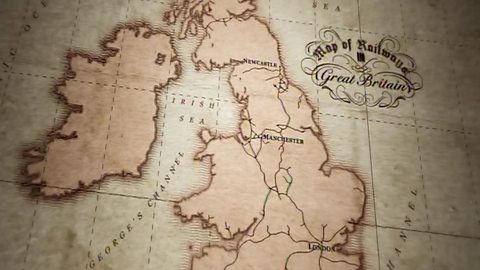
Railways are everywhere—so much a part of our daily lives that it's easy to forget just what incredible pieces of engineering they are. But how on earth do you actually go about building a railway? Who builds it? And how would you go about doing it nearly two centuries ago, without many of the tools that we rely on today?
The answer is through a remarkable combination of engineering genius, a determined and skilled workforce, and sheer strength. Take the London to Birmingham line, one of the most extraordinary achievements in our history. It was 112 miles long and required eight tunnels, 150 bridges, five viaducts, and ten stations.
The Victorians viewed the London to Birmingham line as an achievement on par with the building of the pyramids. At the time, it was one of the greatest civil engineering projects in human history. It was designed by Robert Stephenson, son of the celebrated engineer George Stephenson. The project would make Robert one of the most famous men of the railway age, and it was truly a remarkable feat.
It was incredibly challenging. Take the ridge near the village of Kilsby in Northamptonshire. Stephenson needed to drill a tunnel through it, but the ridge was composed mainly of quicksand, and he had terrible problems with flooding. It took him two years to get the tunnel built. After pumping out all the water, he faced another problem—one no engineer had ever encountered before.
Stephenson’s final act of genius at Kilsby is still visible today. What looks like a castle is actually the top of a ventilation shaft—just one of several used to allow smoke from locomotives to escape. When Stephenson proposed the idea of a tunnel over a mile long, people were appalled. They feared suffocation. But Stephenson believed the ventilation shafts would make the tunnel safe. After it was built, he marched through the tunnel at the head of a brass band.
For me, these show just how far nature was being tamed by the railways. Hills were mined and blasted, valleys were bridged—nothing could stand in their way. Across the country, the story was the same: embankments, cuttings, hundreds of tunnels, thousands of bridges. Stephenson and his fellow engineers found ways to overcome the giant problems posed by railway building.
But despite the genius of these engineers, it was another breed of men who were responsible for the actual building of the railway network. These men were skilled builders with staggering levels of strength and endurance. They were called navvies—the unsung heroes of the railways.
How did you become a navvy? Was it a sought-after job? A man would size you up quickly to see if you'd done labouring work, maybe check your boots for muck to see if you'd been working recently. They said it took a year to turn a farm labourer into a navvy, but once you were good at it, you were at the cutting edge of the Industrial Revolution’s labour force.
It was said that a navvy could shift 20 tonnes of muck a day. That meant a single man could fill all the skips every day, for weeks on end. But what was life like for a navvy? Where did they live, and under what conditions?
Away from towns, up on the moors, if you were lucky, there might be shacks knocked up by the contractor. If not, you'd dig out topsoil, build up sod walls, and throw a roof on it—that would be your home. As for wages, you paid them what you could get away with.
This is Woodhead in the Cheshire Pennines. Nowhere is there a better example of the horrendous conditions navvies endured. Digging the tunnel here took six years and cost more navvy lives than any other dig in Britain. At the parish church of St James, something like 26 navvies were buried—not in the graveyard, but in a field next to it.
Over 30 navvies were killed during the building of this tunnel. Many more were wounded, lacerated, or crippled for life. The parish register records John Young, killed on the railway at age 59; John Thorpe, age 24; and four days later, another John Thorpe—likely his infant son. They now lie in unmarked graves beneath the field. It’s not much of a monument to the men who made modern Britain.
This story is just one of many. Britain's railway history is littered with tales of navvies working in brutal conditions. Hundreds died from accidents, overwork, disease, or alcoholism. Yet despite such horrendous conditions, by the end of the 19th century, millions of navvies had gouged and blasted 20,000 miles of railways—the equivalent of going to Australia and back.
Today, much of our railway system is the same as it was when the engineers and navvies built it well over a century ago. We use the same bridges, the same tunnels, even the same lines. So next time you take a train, think about the incredible levels of effort required to build this system—and about the men who made it happen.
Dan Snow describes the brilliance, ingenuity and determination of the people who build the country’s railway lines, bridges, tunnels and viaducts that we still use today.
Railways are everywhere, so much a part of our daily lives it’s easy to forget just what incredible pieces of engineering they are.
At the time, the London to Birmingham line was the greatest civil engineering achievement in human history and the Victorians saw it as a feat on par with the building of the pyramids.
This clip is from the series Locomotion: Dan Snow's History of Railways.
Teacher Notes
Students could imagine they have been asked by Network Rail to contribute to a special booklet celebrating the railways.
Network Rail have asked them to write a short article about a piece of railway engineering (for example a bridge or a tunnel) which people use every day but do not realise is of enormous historical significance.
Curriculum Notes
This clip is suitable for teaching History at KS3 and GCSE/KS4 in England, Wales and Northern Ireland and National 4 and in Scotland.
More from Locomotion: Dan Snow's History of Railways
Life before railways. video
Dan Snow explains the important role played by the railways in the Industrial Revolution in transporting supplies of cheap coal to homes and factories.
Liverpool to Manchester - the world’s first modern railway. video
Dan Snow explains the significance of the Liverpool to Manchester Railway; the world’s first inter-city railway.
The Stockton and Darlington Railway. video
Dan Snow explains why the Stockton and Darlington Railway was a landmark in British history. He explains how the line was efficient, profitable and exciting at the time.
The world that railways made. video
The railways changed our way of living, allowing fresh food to be transported around the country and making holidays a possibility for ordinary people.