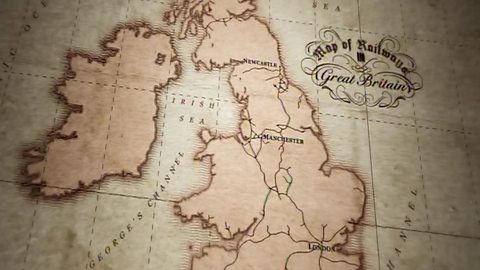
By the early 1800s, parts of industrial Britain had developed an ingenious way of moving coal around. Known as a wagon way, it involved a horse pulling a cart along railway lines. It was groundbreaking for its time, but this was the Industrial Revolution, and times were changing fast.
Nowhere was this more obvious than at one huge coalfield in County Durham. It had massive moneymaking potential, but wagon ways were not enough to unlock it. The only thing that could was a railway. Step forward George Stephenson, a local engineer, and his colleague, Nicholas Wood. It was agreed that they would build this railway—the first of its kind.
The Stockton and Darlington Railway opened on the 27th September 1825, watched by crowds of thousands of astonished onlookers. This was something totally new. Unlike anything that had come before, the rails were made of iron instead of wood, and the power came not from horses but from locomotive engines driven by steam. It was a success! People on board could now travel faster than a man could run.
The trains were built to take coal from Darlington to the port of Stockton on the River Tees, but this railway provoked a reaction that no one was expecting. Even though I have travelled on faster trains, riding on this replica still gives you a sense of just how magical it must have been for those first passengers at the dawn of the railway age. It was that magic that made it a success.
While some critics, including writers and artists, were warning against the arrival of machines, the people fell in love with them. It seems amazing now, but no one had really expected the excitement it would cause. Tens of thousands of people wanted to travel between Stockton and Darlington, whereas a fraction of that had gone by stagecoach.
The Stockton and Darlington became world famous, and people travelled from across Europe just to see it. This has been seen as a huge turning point in the history of railways. In a way it was, but not because of all the minor incremental improvements Stephenson made to the locomotive and the rails. It was because, partly driven by this huge demand from people, from passengers, it made money. It was profitable.
Of course, the line wasn't without its problems. The engine broke down all the time, so horses still had to be used. There were accidents, and it was far too busy. But, make no mistake, this was a massive event. For a while, the eyes of the world were on Stockton and Darlington, and the line was more popular than anyone could ever imagine.
Put simply, it proved that railways were the future.
In the early 1800s, there was a massive demand for coal as Britain was undergoing an industrial revolution.
Coal was needed to fuel the new factories springing up across the country making textiles, metal goods and countless other items.
There was plenty of coal, but it was hard to shift from the mines to where it was needed, and demand was exceeding supply.
Wagon ways made it easier for a horse to pull bigger loads by cart, but something larger was needed.
The great engineer George Stephenson was commissioned to build a truly modern railway, with tracks that were iron and not wood, and cars that were pulled by a locomotive steam engine not horses.
Thousands turned out to see the opening of the railway and people seemed to understand that they were witnessing something very important.
The line was efficient, it was profitable, and it was new and exciting - this was the future.
This clip is from the series Locomotion: Dan Snow's History of Railways.
Teacher Notes
Activities for the class could include:
1. Write a newspaper report describing the opening of the line in 1825.Before you write it, study some present day newspapers and look at how they report a sensational new event.See if you can hype up this railway the same way because it was a huge event!
2. Think of recent developments in technology which have caused a stir (eg the iPad)._ Do you think the Stockton-Darlington would have been as big an event to people at that time?_
Curriculum Notes
This clip is suitable for teaching History at KS3 and GCSE/KS4 in England, Wales and Northern Ireland and National 4 and in Scotland.
More from Locomotion: Dan Snow's History of Railways
How to build a railway. video
Dan Snow describes how building a railway network that still serves Britain today was an immense achievement.

Life before railways. video
Dan Snow explains the important role played by the railways in the Industrial Revolution in transporting supplies of cheap coal to homes and factories.
Liverpool to Manchester - the world’s first modern railway. video
Dan Snow explains the significance of the Liverpool to Manchester Railway; the world’s first inter-city railway.
The world that railways made. video
The railways changed our way of living, allowing fresh food to be transported around the country and making holidays a possibility for ordinary people.