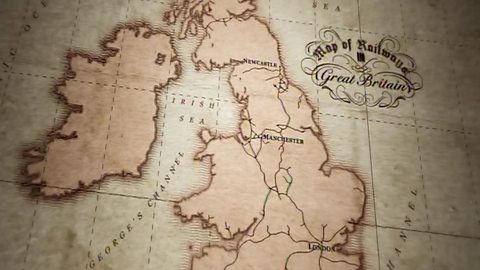
We can trace the origins of railways right back to the late 17th and early 18th centuries. At this time, Britain was on the brink of a period of massive change – the Industrial Revolution.
The story starts here, in the north-east of England, where the revolution was being powered by something known as black gold. If you were a lucky landowner, you might find a lot of this – coal. It has a strange beauty and, in fact, is just a huge lump of energy. In the 18th century, Britain was producing more coal than any other country in the world. County Durham alone was exporting 600,000 tonnes a year, mainly to London. This was powering the Industrial Revolution and would drive the development of our railways.
The mining companies needed to get the coal from the hills around Newcastle down to the River Tyne, where it would be shipped to London. Not an easy job across the hills and valleys of the region. What they came up with was a system based on rails, powered by horses. But it was not a railway as we know it today. It would be some time before steam trains ran on tracks.
We should not underestimate the impressive achievements of these pioneers. The Causey Arch, built in 1725, had a bigger span than any bridge on the Thames or the Severn. In fact, when it was built, it had the widest span of any bridge in Britain. On top, horse-drawn wagons carried coal from the mine down to Newcastle. Every day, around 2,000 wagons crossed this bridge—about one every 20 seconds. Despite its limitations, it was still a very efficient way of taking coals to Newcastle.
Once wagons running on tracks were established as a good idea, all the mine owners wanted them. The more coal you could transport, the more money you could make. So, you needed a top-notch transport system to help you out.
Unfortunately, Britain’s transport system wasn’t up to scratch. It was a confusing muddle of dirt tracks, trails, and basic roads. The demands of newly developing industries and the money to be made from them called for a transport revolution across the country. Horses just weren’t keeping pace. You could only travel at around eight miles an hour, and horses had to be changed every ten miles. The roads were often terrible, crashes were common, and traffic jams were legendary. Then there was the lurking threat of the highwayman.
But the big problem with transport wasn’t people—it was stuff. If you wanted to move cargo, you needed a canal boat. This could carry about 25 tonnes of cargo, but in winter, canals could freeze. Barges would be stuck, and their cargoes pilfered. In summer, droughts meant not enough water in the canals, and boats could be grounded.
Britain was changing at shocking speed, but its transport system remained slow, unreliable, and expensive. The winners of the Industrial Revolution would be those who could transport the most goods the most quickly. There had to be a better way than relying on horses.
This is an underground wagon way—a tunnel two miles long used to carry coal under the city to Newcastle’s docks. Here, wagons weren’t pulled by horses but by ropes attached to an extraordinary innovation: the steam engine. Machines developed from the early 1700s burned coal to create steam. The one for this tunnel had the pulling power of 40 horses. For the first time, engineers were combining rails with steam engines.
But the biggest drawback was that they didn’t move. Building static steam engines to pull wagons on ropes and pulleys was one thing. But what if steam engines could run by themselves, unattached? What if they could roam free across the countryside, across the world?
In the spirit of the new industrial age, brilliant inventors tried out clever devices. Yet these first moving steam engines—or locomotives—could only lumber along slowly. They could explode, or were too heavy for their tracks. They were still experiments.
If anyone could crack the whole thing—build a powerful, efficient locomotive, tracks to support it, bridges, tunnels, and make the whole system profitable—that man would be a genius. He would have turned the humble wagon way into a railway.
It wouldn’t be long before that man stepped forward: a mining engineer from the north-east called George Stephenson. He would go on to change the world.
Dan Snow explains how the roots of modern railways can be traced back to the late 17th and early 18th centuries.
Coal was central to the story, it was extremely valuable, but only if it could be transported from the inaccessible hills and valleys where it was mined to the cities and factories where it was needed.
Dan shows how early engineers built railroads for horse drawn wagons, but these were still not enough to satisfy the demand for coal.
Canals also carried coal, but these would freeze over in winter and dry out in summer.
There was a need for a system of transport which could overcome the weather, the terrain and nature itself.
This clip is from the series Locomotion: Dan Snow's History of Railways.
Teacher Notes
The teacher could provide flat templates of spirals, available on the internet, for pupils to fill in with notes and illustrations, showing how the initial demand for coal led to changes in transport, with each stage being linked to the next.
When cut out, these could be displayed by hanging from the ceiling.
Half the class could make similar spirals looking at the development of steam power from the first simple engines to steam locomotives.
Curriculum Notes
This clip is suitable for teaching History at KS3 and GCSE/KS4 in England, Wales and Northern Ireland and National 4 and in Scotland.
More from Locomotion: Dan Snow's History of Railways
How to build a railway. video
Dan Snow describes how building a railway network that still serves Britain today was an immense achievement.

Liverpool to Manchester - the world’s first modern railway. video
Dan Snow explains the significance of the Liverpool to Manchester Railway; the world’s first inter-city railway.
The Stockton and Darlington Railway. video
Dan Snow explains why the Stockton and Darlington Railway was a landmark in British history. He explains how the line was efficient, profitable and exciting at the time.
The world that railways made. video
The railways changed our way of living, allowing fresh food to be transported around the country and making holidays a possibility for ordinary people.