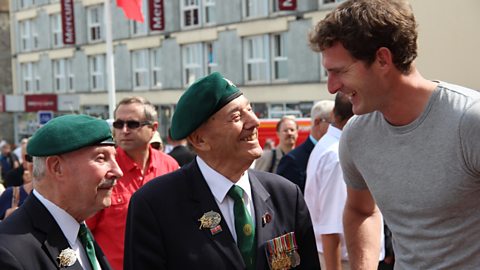
Dan Snow:
December 1941 the Americans have joined the war bringing money and man power.
Churchill and Roosevelt were agreed the time had come to reverse the humiliating retreat of Dunkirk, a full scale invasion would be launched to free occupied Europe and defeat Adolph Hitler.
The area where the invasion would eventually take place was never seriously in doubt, it would be the coastline of North West Europe but it was heavily defended, the Nazi’s dominated the area and they were turning Europe into a fortress.
Fearing an allied assault, the Germans had built a defensive network of bunkers, minefields and heavy guns, stretching along the coastline from Spain to Norway it was known as the Atlantic wall. The allies knew from experience that punching a hole through it would be a high risk strategy.
In August 1942 a raid had been mounted on the French town of Dieppe. It was here that the allies made their first major attempt at a landing on French soil and the result was a disaster.
The aim was to test the German defences and briefly seize the port but apache intelligence and poor planning led to a deadly miscalculation of the enemy’s strength. And lapses in security meant the Germans were expecting the attack.
As they landed on the beach the allied troops were mowed down by machine guns hidden in the cliffs. In less than 8 hours over half of the 6,000 strong invasion force were killed, wounded or captured.
Dieppe was a defining moment in the second World War, it taught the allies a bitter but a timely lesson and that was if they wanted to invade Nazi occupied western Europe, if they wanted to punch through these massive fortifications they would have to get the preparation right, the intelligence right and execute it far better, and if they didn’t do those things then as that corpse covered beach down there showed the consequences would be unthinkable.
For D Day to succeed the allies needed precise intelligence on the German defences, they needed eyes on the enemy. They turned to a trusted friend, the Spitfire. But this was a Spitfire with a difference, instead of guns it was armed with high tech cameras to photograph every inch of the European coastline from heights of 30,000 feet.
The aerial photos were bought here to RAF Medmenham just west of London, this was home to the photo interpreters, PI’s. Here the highly trained analysts worked night and day to unlock the secrets of each photograph. Using 3D glasses known as stereoscopes they analysed thousands of images each week, scrutinising the defences in astonishing detail and probing the Atlantic wall for weakness which the allies could exploit.
GEOFFREY STONE:
We covered the whole of the channel coast with as much information as possible about all the defences.
The most obvious invasion route would be straight to Calais barely 20 miles but aerial photos revealed this would be suicidal, the Germans had anticipated an allied attack and the coastline was heavily defended with vast guns.
So the photo interpreters focused the search on less well defended beaches further west.
WILLIAM LUCKEY:
There’s only a very few beaches that could be used for a landing and that was the key to the whole thing, to pick out a spotwhere we were going to land and no-one including me knew where this was but we had the pictures.
DAN SNOW:
Eventually the allies found what they thought might be a chink in the Nazi armour, a 60 mile stretch of the Normandy coastline where they hoped to take the enemy by surprise. The advantage of that stretch of coast was that there were less of these, German defences and there were no major ports so no huge concentrations of German military power as there had been at Dieppe.
After months of careful reconnaissance a plan for the D Day invasion could finally begin to take shape. Five beaches would be attacked by 145,000 men, British and Canadian forces would seize three beaches in the east code named sword, juno and gold, the Americans would take two western beaches, Omaha and Utah.
The photo interpreters at RAF Medmenham had provided the allied leadership with a crucial piece in a vast jigsaw but even with precise intelligence such a grand plan carried high risks.
To avoid another blood bath like Dieppe allied troops must be trained to execute the plan with expert precision. The British commandoes and the American rangers underwent some of the toughest training, specialising in amphibious assaults and stealth raids, these elite new units would spearhead some of D Day’s toughest missions.
JOHN C RAAEN JR:
By the time we got into England we finally developed a feeling that our mission would be landing on hostile shore, everybody knew that. First though we were taught to transition from boats to the attacking of fortresses or beach defences.
GEORGE ‘JIMMY’ GREEN:
You exercised day and night until we got it absolutely right and the rangers were very good troops, trained by our commandoes.
ROBERT L. SALES:
The British commando in my opinion were the best troops in the world.
FRED WALKER & ROY CADMAN:
In those days we would, we were ready for anything really, whatever they slung at us we’d do and that was it.
That’s right, that’s right.
DAN SNOW:
June 1944 with the intelligence gathered and training complete the allies were ready to launch the greatest invasion in history but the D Day plan must not be leaked or the allies risked a blood bath on a scale far greater than Dieppe. Troops were locked down in secure camps as details of the invasion were unveiled. Aerial photos, models and maps revealed in minute detail the defences the men would face from the position of the mind fields to the location of each gun.
ROBERT L. SALES:
They began to show us maps and photographs of what was gonna take place and that’s when we see those cliffs with those machine guns and where we were landing it was gonna be two machine guns and you know, it scared everybody pretty good.
DAN SNOW:
After months of physical training the men prepared themselves mentally for what lay ahead.
FRED & ROY:
I couldn’t sleep on the last night in the camp. No, no. We were all sitting talking about it and smoking and.
All anxious, yeah. Oh yeah sure. Even the Germans get like that, don’t worry, yeah.
BOB STOODLEY:
There was a lot of punching and pushing about, throwing knifes at pictures of Hitler,it’s the sort of thing soldiers get up to and I think it’s a bravado because we knew that we were going on something quite big.
DAN SNOW:
On the evening of June the 5th 1944 6,000 vessels left harbours and ports along the British coast line, the next 48 hours would be decisive.
It would be the last time many of the soldiers would see British shores again.
FRED & ROY:
hat a sight, what a sight. It was erm, it was like playing for England and all the crowd cheering like mad. We stood up there and watched all this and tears were running down our faces.
JOHN C RAAEN JR:
We recognised that we would probably have about 50% casualties and that er, of those 1 in 5 would be killed and er, ever the optimist the American soldier goes into battle no matter what expecting that he will be the one to survive.
Video summary
Historian Dan Snow and numerous British and American survivors tell the story of how the D-Day landings were planned.
Following the disastrous attempt to attack Dieppe in 1942, the Allies realised only meticulous planning would allow them to get through the Nazi Atlantic Wall defences of mainland Europe.
Aerial photos taken from Spitfires of the entire coast of France allowed analysts at RAF Medmenham to find a weak point in the defences on the beaches of Normandy.
British Commandos and US Rangers took part in stringent training in stealth raids and amphibious attacks, so that they could lead the invasion of 156,000 men.
Former Commandos recall their emotions the night before the attack on 6th June 1944, knowing it would would mean death and injury to thousands.
This short film is from the BBC series, D-Day: The Last Heroes.
PLEASE NOTE: This short film contains scenes which some viewers may find upsetting. Teacher review is recommended prior to use in class.
Teacher Notes
This short film is a useful introduction to the detailed planning of the D-Day landings.
Students could watch this short film and then discuss the advantages and disadvantages of the landing sites chosen by the analysts at RAF Medmenham.
Students could also use the knowledge they gain from this short film to predict whether they think the D-Day landings were ‘successful’, deciding first what they think ‘success’ would look like.
This short film will be relevant for teaching history at GCSE and above in England, Wales and Northern Ireland and National 4/5 and above in Scotland.
The Battle for Omaha. video
Veterans of the Omaha Beach landings in Normandy recall their memories just before the attack began, and the carnage that followed before the beach was secured.
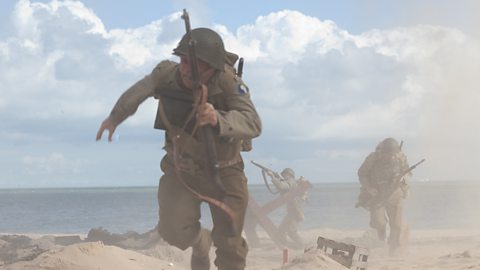
Winning D-Day - The Sword Beach landings. video
Veterans recall what it was like to be part of the D-Day landings on Sword Beach, and the move inland to take control of German positions.