DAN SNOW:
7 miles off the coast of Normandy France, 6,000 ships wait for the signal, 145,000 troops prepare to storm five beaches. Four years after a humiliating retreat at Dunkirk the allies are poised to unleash a daring bid to free occupied Europe from Hitler’s tyranny.
FRED WALKER & ROY CADMAN:
I think there was a general feeling amongst the lads for Christ sake let’s get this over with. Now we’ve got them on the run, let’s get in, get stuck in and sod ‘em.
DAN SNOW:
There aren’t many days that can be said to have changed the course of history, there aren’t many days like the 6th of June 1944. I think D-Day was the single greatest military operation the world had ever seen and at stake was nothing less than the freedom of the western world.
To gain a foot hold in France the allies would attack five beaches along a 60 mile stretch of the Normandy coast. The British would take three in the East sword, juno and gold. The Americans would assault two beaches in the West code named Omaha and Utah. But the beaches were just the beginning.
If D Day was to succeed the allies had to smash through the coastal defences and advance in land, if they failed to do this it would make it easier for the Germans to counter attack and drive them back into the sea. As a result the troops landing on the D Day beaches had a series of objectives and one of them, the most ambitious of those was for the British landing at sword beach. Lying 7 miles inland and protected by a network of bunkers, their target for D Day was the city of Caen
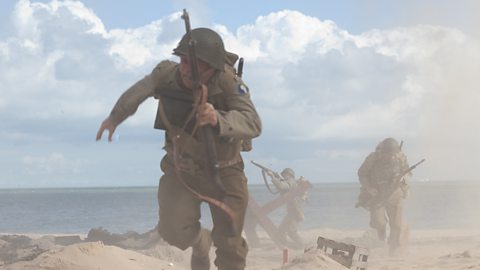
As the landing craft powered into sword beach troops were heartened by the smoking shoreline ahead.
FRED WALKER & ROY CADMAN:
These battleships they were firing on the beach 18 inch guns you know. As they went over like an express train. I looked from the front of my manning craft it was a mass of flame and smoke and I thoughtnobody could survive in that, nobody.
DAN SNOW:
But as the ramps went down the German guns opened up, the allied bombardment had left the defences damaged but not destroyed.
It would have been a living hell in this place, snipers, shells, mines, obstacles and yet their only hope was to surge up it, get through the German defensive line and out into the countryside beyond.
FRED WALKER & ROY CADMAN:
I run so fast, I would have beat Jessie Owens that day, I suppose I was frightened out of me life a little bit, you just keep going, you’ve gotta get off that beach else you was brown bread ain’t ya.
I’d started to rush up the beach and there was a young, a young soldier, he was trying to dig a hole and the waves were crashing down and filling his thing up with water and I grabbed him by the scruff of his neck and I dragged him all the way up.
And I shouldn’t have done that, I should have left him and got off the beach because that’s what they tell you, you’ve gotta get off that beach as fast as you can but I couldn’t, I couldn’t leave him there.
DAN SNOW:
Taking sword beach wasn’t easy, the Germans put up a stiff resistance and the British suffered heavy casualties, but although the fighting was fierce it was also short, the Germans were overwhelmed by British naval ships bombarding the coast and the tanks that pushed up the beach. By 9am the troops were a mile inland.
It was a critical moment for the invasion. Thousands of soldiers were ashore and many more were landing, the element of surprise was long gone, with bases just beyond Caen, deadly German tank divisions could strike back at any time. It was vital for the troops to move inland and establish a firm foothold as quickly as possible. Using the aerial photographs the allied planners had identified key targets. One was a German bunker complex code named Hillman.
Now that’s sword beach down there, you can see that line of fog, these aerial photos are absolutely fascinating, they show the Germans up here constructing hugely significant positions, you can see the trenches here, observation posts, machine gun posts and so in order for the troops to get off this beach and push inland, this would have to be neutralised.
So this is the main entrance all facing North towards the coast. It was clearly a battle field command centre, you can see the wiring here, the communications, the maps on the wall, this is a place where all the information is gathered from the battle fields and then action is taken, artillery is called down, air support is called for, this is where the German commanders would win or lose the battle for Normandy. Taking Hillman fell to the Suffolk regiment and they came up against fierce resistance.
RON ROGERS:
They tried to attack us I suppose but it wasn’t successful to begin with. All sorts of erm, armour was bought up, anti-tank guns erm, a royal artillery came.
DAN SNOW:
But protected by a heavy metal dome or copular the German gunners were able to fire on the attackers at will.
RON ROGERS:
Everything that came up here and shot at the copulas bounced off.
DAN SNOW:It was the action of one man, Titch Hunter that finally changed the course of the battle.
RON ROGERS:
And it was only erm, after Titch Hunter had gone forward with his brain gun firing from the head that they capitulated.
DAN SNOW:
By firing straight into the copular one man succeeded where tanks had failed, the Germans began to retreat, the Suffolk’s had finally won the upper hand.
RON ROGERS:
Out came the commandant and erm, and 70 men under guard who had given themselves up.
DAN SNOW:
As the day wore on, progress in land had slowed, the German resistance had been fierce and positions like Hillman hard to take. The city of Caen remained under Nazi control but the devastating counter attack the allies feared never came. A foot hold in France had been won.
As the sun set over Normandy on the 6th of June 1944, the allies took stock, not all the objectives had been met and they knew they faced heavy fighting in the weeks ahead, as it was they did not liberate Paris until August of that year. D Day wasn’t the end of the war but it was perhaps the beginning of the end for the Nazi’s.
GEORGE ‘JIMMY’ GREEN:
They occupied France, they occupied most of Europe. You couldn’t allow those people to go on controlling the world.
DAN SNOW:
More than 4,000 men were killed on D Day and for the survivors memories are still vivid.
RAY TOLLEFSON:
I don’t know if the words I’d describe it er, when you think of er, of all the friends you lost.
FRED:
Well you think about some mates, that’s all yeah. Yeah get a bit emotional like I am at the moment.
FRED WALKER & ROY CADMAN:
The dead ones, they’re the real heroes. Real heroes. You can’t give more than your life can you?
ROBERT L. SALES:
All soldiers never die they just fade away, well I’ll be fading away soon. So I’ll maybe catch up with some of the boys.
DAN SNOW:
For me the greatest privilege and the greatest insight of all is meeting the people that witnessed these events nearly 70 years ago. Today they still have the power to recall it as if it were yesterday, they have the ability to tell stories that will stay with you for the rest of your life, they have the ability in one sentence to make your blood run cold and to make you laugh. It is an enormous privilege to meet them and although they’re nearing the end of their lives I know that their names and their stories will be talked about forever.
Video summary
British veterans give their account of the D-Day landings on Sword Beach; the first step towards defeating Nazi Germany.
They recall the huge naval bombardment that preceded the landing, and weakened the Nazi guns.
We hear what is was like to run across the beach under heavy fire, avoiding snipers, shells and mines.
Historian Dan Snow uses aerial photographs and maps to explain the ambitious objective of taking the city of Caen, seven miles inland, and the interim objective of taking the heavily defended Hillman Bunker.
He visits the bunker, now a museum, and we hear how one soldier's heroism led to the Nazis there surrendering.
The veterans reflect on the 4000 men who died on D-Day, and the friends that they lost.
This short film is from the BBC series, D-Day: The Last Heroes.
PLEASE NOTE: This short film contains scenes which some viewers may find upsetting. Teacher review is recommended prior to use in class.
Teacher Notes
This short film provides a useful detailed account of the British landings on Sword, using reconstructions and veteran accounts of what happened on that day.
Students could watch this short film and discuss why this victory was so important and why it marked the beginning of the end for the Nazi occupation of Europe.
They could also use it as a base upon which to research the logistics of the attack (e…g. the use of Mulberry harbours and the Pluto fuel line).
This short film will be relevant for teaching history at GCSE and above in England, Wales and Northern Ireland and National 4/5 and above in Scotland.
Planning D-Day. video
Historian Dan Snow and numerous British and American survivors tell the story of how the D-Day landings were planned.
The Battle for Omaha. video
Veterans of the Omaha Beach landings in Normandy recall their memories just before the attack began, and the carnage that followed before the beach was secured.