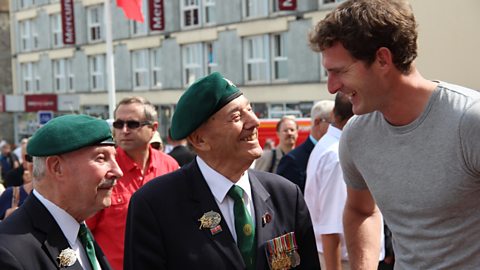
DAN SNOW:
June the 6th 1944 D Day. As dawn broke the largest armada in history stood waiting off the Normandy coast.
JOHN C. RAAEN JR:
It was an impressive sight, as far as the eye could see nothing by ships.
DAN SNOW:
Allied ships and aircraft pounded the Nazi defences in preparation for the greatest invasion of all time.
ROBERT L. SALES:
All that fire, all the ships around us firing, planes going overhead, I began to get nervous.
RAY TOLLEESON:
It was spectacular. Maybe we forgot what we were doing otherwise because we were in awe of the that with the sight that we were seeing.
DAN SNOW:
If German positions could be damaged before the assault began the troops might stand a fighting chance as they landed on the beach.
FRED WALKER & ROY CADMAN :It was a mass of flame and smoke and I thought nobody could survive in that, nobody.
DAN SNOW:
The stakes were high, the next 24 hours would determine the outcome of the war, if the invasion was a success the allies could surge in land and liberate Nazi dominated Europe, but if it failed thousands of men would lose their lives and any hope of victory would be crushed for years to come.
The plan was audacious, 145,000 men would assault the Normandy coast, in the East British troops would attack 3 beaches code named gold, juno and sword. In the West the Americans would take Omaha and Utah. Of the 5 beaches one promised a particularly bloody fight.
Omaha where the Germans enjoyed lots of natural advantages, just look at these aerial photographs they show the line of bluffs, steep cliffs almost which made it very difficult to get off the beach, the only way up to the countryside beyond were these exits here which were of course carefully defended. There were also a line of German machine guns on the top of these bluffs which were able to cover the entire beach with deadly accurate machine gun fire for the attackers there would be no where to hide.
JOHN C. RAAEN JR:
We recognised that we would probably have about 50% casualties and that ah, of those 1 in 5 would be killed.
ROBERT L. SALES:
Where we were laying there was 2 machine guns and you know, it scared everybody pretty good.
DAN SNOW:
But the machine guns on the bluffs were just one element of the elaborate Nazi defences. Allied reconnaissance plains had identified an even greater threat on the cliffs to the west of the beach, a massive gun battery on the Ponte Boch It was feared that the heavy guns could annihilate American landing craft on route to the beaches, they had to be destroyed.
JAMES ‘IKE’ EIKNER:
It absolutely had to be neutralised or the whole operation would be in danger and jeopardy.
DAN SNOW:
In the weeks leading up to the invasion allied aircraft dropped 380 tonnes of bombs on Ponte Boch and you can see from this aerial photograph the devastating damage that’s been done to the area. What remains unclear from this is just what’s happened to the guns themselves.
Dramatisation With thousands of lives at stack no chances could be taken. An elite unit of American rangers had been given the unenviable task of silencing the guns, in the early hours of the 6th of June they must land and scale the 1,000 foot cliffs under fire, it was one of the most dangerous missions of D Day.
JAMES ‘IKE’ EIKNER:
You would fire on them while coming in. this was not a surprise the enemy had had about 30 minutes to get up out of this underground bunkers, he was up there throwing hand grenades down by the bush or basket fall and firing right down on us.
JOHN C. RAAEN JR:
There were Germans on top throwing potato mashers down at us, ah, there were riflemen shooting at them but the worst of it was that there was two machine guns nests they were shooting right into backs
JAMES ‘IKE’ EIKNER:
The enemy damn it, cut some of the ropes, that was not kosher you know.
JOHN C. RAAEN JR:
And yet the first man to the top of the cliffs was there in 50 seconds from the time they grounded down. And I don’t know how he did it.
DAN SNOW:
But for the rangers who had fought their way to the top there was a nasty surprise, the big guns had been moved and they didn’t know where, the threat remained. Unaware of the drama at the Ponte Boch Coxon Jimmy Green was taken from the first wave of American infantry into Omaha beach.
GEORGE ‘JIMMY’ GREEN:
The troops we took in were from Bedford Virginia and they hadn’t seen action before, they were quiet country lads and I was trying to reassure them.
DAN SNOW:
Today so many people think that they can get a sense of what the war must have been like by playing these realistic computer games but there’s nothing realistic about those games, they can’t replicate the, the gut wrenching terror, they can’t replicate the overwhelming desire to be somewhere else, to be anywhere but here and they can’t replicate the stench of diesel and the stink of vomit that swilled around men’s boots.
As the boats came into land the dramatic events below were recorded by reconnaissance planes.
JOHN C. RAAEN JR:
There was oil, there was smoke, there were explosions, there were troops blown apart, anything you wanted, unpleasant was there.
GEORGE ‘JIMMY’ GREEN:
That cost 300 yards of open beach with no cover and we were mowed down. Every man in my boat was killed, awful waste. It was em, a very sad occasion.
DAN SNOW:
A second wave powered Omaha beach they could see the devastation ahead.
ROBERT L. SALES:
I could see what looked like dead man, the a company had landed 10 minutes ahead of us,there was fire and smoke, a real chaos and I jumped back in and I said captain look like dead bodies all over the place to me. He said something wrong.
When that ramp went down the machine guns opened up on us. And it was like bullet of bees swarming around.
The captain of course took off first and right behind him was my friend Sergeant Wright and when I got out on the raft I fell.
RAY TOLLEESON:
It was right around that time that I got hit, I, I thought my arm was gonna fall off, the blood was pouring out of there that looked like it wouldn’t be long I’d have no more blood. It’s amazing but one of the things I thought of was that you know in the United Statesnow people are going to work and they’re getting up and that there and here we are.
DAN SNOW:
In these shallows hundreds of Americans were drowned, hundreds more were cut to pieces by sniper gun, machine gun fire, heavy artillery shrapnel, high explosives. This water ran red and the beach in front was covered in corpses.
ROBERT L. SALES:
I crawled up on the sand there was Dick Wright, my sergeant and my friend, he was hollering I’m hit, I’m hit and he raised up on his elbows, that was his mistake because in that machine gun nest was a rifleman, a sniper with a telescope and he picked him up and he hit him right in the head and his face just dropped to the sand. I often wonder if er, if I could have done something for Dick Wrightbut what do you do when someone’s full of bullet holes and the bloods coming up. You’ve got to think of your own life.
DAN SNOW:
The soldiers landing on Omaha stood little chance, their tanks had sunk off shore in heavy seas and allied aircraft had missed the German defences. With the troops caught in a deadly storm of machine gun fire, the battle had stalled.
JOHN C. RAAEN JR:
We saw fear and panic there, they never would have gotten off the beach if it hadn’t been for the 5th rangers.
DAN SNOW:
John Raaen and the troops of the 2nd and 5th rangers arrived at Omaha at a critical point. Diverted from his original mission at the Ponte Boch John Raaen landed on a less heavily defended part of the beach.
JOHN C. RAAEN JR:
Now all that time at the sand tables and the maps paid off, I knew exactly where I was. I landed probably right there and went up the bluffs, here’s the path I went up and there’s the little shack. Those bluffs were covered with smoke when we got there, the smoke blinded the infantry above us and they couldn’t shoot at us.
DAN SNOW:
By challenging the machine gun nests on the bluffs the rangers helped slow down the slaughter on the beach below. The rangers at the Ponte Boch had also seen success, the heavy guns had been found and silenced and the threat to troops at Omaha had finally lifted. With thousands of men ashore and many more landing the battle for Omaha had been won, the allies could push inland and consolidate their foot hold in France. But success came at great cost, over 1,700 men had been killed and many more wounded.
By the end of the day all five beaches had been captured and a little corner of Normandy had been secured, it’s been seen by history as a great victory, the beginning of the end of the Nazi menace but for those who had survived the carnage on Omaha, victory must have seemed like a distant prospect, for the men who’d watched their friends die, there was little chance to recover or reflect with months of hard fighting ahead of them before Germany was finally defeated the battle for Europe had only just begun.
Video summary
D-Day veterans recall the bloody attack on Omaha Beach on 6th June 1944 that lead to 1700 American lives being lost.
They recount the experience of being part of the largest armada in history, and the awareness before the attack that there would be heavy casualties.
Historian Dan Snow narrates reconstructions of the attack, and how the failed attempts to take out the Nazi guns meant carnage for the troops landing on the beach.
We hear about the bravery of the elite team of US Rangers who had to climb a 30 foot cliff under heavy fire in an attempt to take out the biggest German guns, only to discover they had been moved.
Veterans recall getting injured, and seeing friends killed, and the panic of being under heavy fire.
A Ranger recalls how the intensive planning and studying of maps beforehand enabled his men to attack the machine guns on the cliffs, turning the tide of the battle and allowing the Americans to progress inland.
The battle was a victory that would eventually lead to the defeat of Hitler, though at a heavy human cost.
This short film is from the BBC series, D-Day: The Last Heroes.
PLEASE NOTE: This short film contains scenes which some viewers may find upsetting. Teacher review is recommended prior to use in class.
Teacher Notes
This short film provides a useful detailed account of the US landings on Omaha, using reconstructions and veteran’s own accounts of what happened on that day.
Students could watch this short film and debate whether military leaders were right to send the US troops to attack such a well-defended beach.
This short film will be relevant for teaching history at GCSE and above in England, Wales and Northern Ireland and National 4/5 and above in Scotland.
Planning D-Day. video
Historian Dan Snow and numerous British and American survivors tell the story of how the D-Day landings were planned.
Winning D-Day - The Sword Beach landings. video
Veterans recall what it was like to be part of the D-Day landings on Sword Beach, and the move inland to take control of German positions.