Hello, children, what are you doing?
We're cleaning our paintbrushes.
Good thing you have a sinkin your classroom.Do you know what happens when yousend dirty water down the plughole?
Does it go down the drainand underground?
Yes! That's right.All your dirty water from the sink,bath and toilet all go down pipesand end up in the same place -underground, into the sewer.Would you like to see where thedirty water goes?
BOTH: Yes, please!
My friend Stewart is waitingto show you round.Off you go,down the drain.
Hello. Hello. I'm going to takeyou down to my sewers.Would you like to come with me?
BOTH: OK.
We'll open the door first. Wow!Rather deep, isn't it?
Yes. How deep is it?
It's as deep as twodouble-decker buses.
BOTH: Wow!
That's quite deep.What's down there?
Dirty water, sewage.Ugh! It comes from your toiletwhen you flush.
Can we go down there?
Of course you can.
Do you want to go down therewith me?
BOTH: Yes. OK, then.
What we need is a helmet and gloves.Put this on your head for me.I'm going to takeyou down into the sewers.
Stewart is takingthe children into the dark sewer.We should nevergo into an underground sewerwithout the adults who work there,because it would be very dangerous.
Watch your step!Right, let's goand look at some sewerage. Come on.Are you ready for an adventure?
Yes!
Let's go. Keep with me.
Yes, sir!
You may not realise it,but under our feet,there are hundreds of miles oftunnels and they are very important.
What is sewage?
If you think of all the houses,everybody lives in a house,all the water goes downand collects in a big sewer system.So from every house, all their taps,all the toilets, the baths,the showers, it all comes downinto the sewer system,and even from the roads. When itrains, it comes down the drainsand then it comes into thisgreat big sewer system.This is what takes your sewageaway from the towns and your houses.From your toilets,these go into the drains.A pipe like this.This is a four-inch pipe,but they can get bigger.Six, nine inches, 12 inches,18 inches, 24 inches,until you get a big eight-footbarrel, like this. A big sewer.The sewers work on a reallyimportant thing called gravity.Gravity makes water flow downhill.
How does it travel?
To make the sewer system work,all the pipes, they are not flat.They have a small gradient.They are slanted like that,to make the water run.If you have it flat like so,when we put the water in,nothing comes out the end.To make the water go,they tilt the pipe.That's how it flows down the drain,like that.That's howwe take all your waste water away.
Can we go along the tunnel now?
Of course.Are you ready? Have you gotyour torches on?
BOTH: Yes.
OK, then, if you want to follow me.What we do is walk up here.There's a bit of poo there.This is a sewage tunnel.All our dirty watertravels from your homesinto these underground tunnels.This is real sewage.This is when you go to the toilet,you flush your chainand it comes downinto the sewer system.
Eugh! There's some toilet paper!
That's all toilet paper, yes.
That is so disgusting!
What do you think of that?
Er, poo. Yuck.
It smells quite yuck.
You have to clean the sewerevery day or every week?
No, we clean this sewerevery eight weeks.We have to get a lorryand special pipesand we go in thereand suck up all the grit and dirtand take it away.
That sounds quite yucky.
It is quite yucky.OK, children, now thatyou've seen how a sewer works,it's time to go back to the surfaceto see what happens next.
Now it's time to visitthe sewage treatment plant,where Ben will show you round.
Morning, children.
BOTH: Morning.
This is a treatment works,where sewage comes afterit's been through the tunnels.Do you want to see how we cleanand recycle it?
BOTH: Yes.
Excellent. Follow me.This is the waste-watertreatment works where all the sewageand waste water,comes to be treated.It looks like a big water monster!
A big water monster!
Does it have wee in it?
It has got wee in it.
Poo?
Yes.Anything from the house is collectedthrough the pipes,comes to the treatment worksto be treatedand this is what itlooks like to start with.What we'll do is take samplesas we go roundand show you how it getscleaner and cleaner.Now, we'll go and seethe next stage.
Yeah.
Yes.
OK? Follow me.
All the dirty water we sawin the sewerscomes to a sewage-treatment plant,like this one,where they make it all clean again.The first process is like a sieve,to get rid of all the big bitsof rubbish in the water.
In this machine here,there is one of these screensfor things like cotton buds.Anything flushed down the toiletthat's too big to treat,this is where we take it out.
Where do the big bits go?
All the bits we take out here we cantake to burn, to produce energy,or we can take to landfill sites.This way.
Here we have the next stageof the cleaning process.This is whatwe call a settlement tank.Leaving the dirty waterto settle in these tankslet's all the big bitssink to the bottomso they can be taken away.So, here, we have taken anothersample from these tanks.Can you see in this one, can you seethe sludge settling to the bottom?
BOTH: Mm-hm.
That's sludge we drawout of the bottom of the tankand this cleaner waterwe take off the top.
What is sludge?
Sludge is the poo thatwe've allowed to settleto the bottom of the tank.We then suck that out and take itaway and use it to help feed plants.The water looks clean,but there's still tiny germs in it,so we need to take those out.I'll show you how we do that.Follow me.
Here, this is the next stageof the treatment,or the cleaning, process.Although we've taken the solids out,there are still tiny germsthat are in the waste water.
What are germs?
Germs are tiny, tiny bugsyou can't see with your eyes.They are not good for us sometimes,so we need to take those germs out.We do that in these filter beds.The water is passed over the stonesand the nice germsthat live on these stoneseat the bad germs, so thatwe get cleaner water off the bottom.
Why do we need to clean sewage?
We need to clean sewageto make sure it's safe.Because we don't wantthe nasty bugsgetting into rivers,streams or the sea.We take out the bad germs,so we don't get ill.
These germs here are called bacteriaand they are really tiny.But not all germs are bad.Here, they use good germs,which attach themselvesto these stones,to eat up the bad germsliving in the dirty water.These special stoneshave lots of holes,so the good germs have somewhereto live and grow.
So this is the very last thing we doand that is to check to make sureit's OK to put back into the stream.And this is what it looks likewhen it goes into the stream. Whoa!
That's really…wow.
Wow! That is so clear.
See the difference?
It's like you've just putthe water in from the tap.
Yes, that's not tap water,it's come from here.
Now you know how sewageis cleaned and treated.
Hello, children, you're back.What did you find out aboutwhere our sewage goes?
All the dirty watergoes down the pipes in our homesand then through big pipesunderground, called sewers.We went down a manhole into a sewer.It was a big, dark tunnelwhere the sewage went.The sewage goes all the wayto the sewage-treatment plant,where it's cleaned.
First, all the bits of rubbish,like toilet paper, get taken out.The sewage is then sent to a tank,where the big bitssink to the bottom.These bits are called sludge.The sludge can be driedand used to make plants grow.
Next, they have to cleanthe tiny bits you cannot seeby using special stones.Then, the water is clean enoughto go into the river.
That's brilliant. Well done.Now we know what happens to ourwaste once it leaves our homes.Great work. Bye-bye.
BOTH: Bye-bye, Curious Cat.
Goodbye, children.
Video summary
The children meet an expert who takes them underground to see a sewer.
They see the raw sewage travelling through the sewer tunnel and explore them.
Next, the children visit a sewage treatment plant where they meet a second expert who takes them on a tour showing them how the raw sewage comes into the treatment plant and how it is cleaned and sent back into the river.
They see how the solid waste in the sewage is taken out, and how the microscopic bits of sewage still remaining are eaten by a variety of microorganisms using a filter bed made of special rocks.
Throughout the tour, the expert takes water samples so the children can compare the dirty sewage that comes in with the clean water that goes out at the end of the process.
This is from the series: Curious Cat Steel, Electricity, Sewage
Teacher Notes
The clip would provide an opportunity for children to consider the implications for areas of the world who have no sewage system.
They could think of the dangers faced by the people and maybe suggest ways to overcome the problems.
Alternatively the clip could provide a way in to looking at filtering and children could design a simple water filtration system by experimenting with different media such as sand, gravel and fabrics, to see which combinations can clean a sample of dirty water the best.
This clip will be relevant for teaching Science at KS1 and KS2 in England
Also Foundation and KS1 in Northern Ireland. and Early/1st/2nd levels in Scotland.
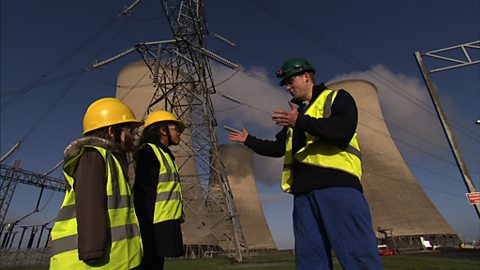
How is electricity made? video
Two children meet Curious Cat, an animated cat who asks them if they would like to find out how electricity is generated.
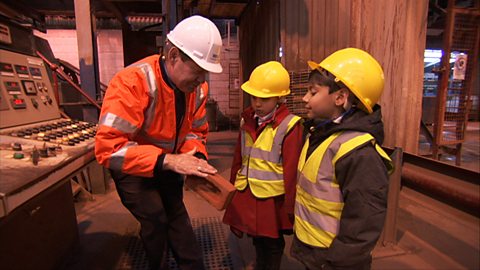
How are bricks made? video
With the help of Curious Cat, two children visit a brick factory to find out they bricks are made.
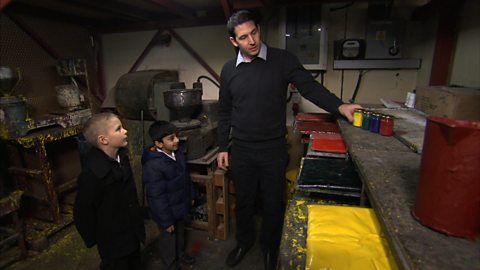
How are crayons made? video
With the help of Curious Cat, two children visit a crayon factory to find out how they are made.
How is glass made? video
With the help of Curious Cat, two children find out how flat glass for windows is made.
How are TV programmes made? video
Two children find out how TV programmes are made and how they reach your TV at home.
How is paper made? video
Two children meet animated character Curious Cat, who asks them if they would like to find out how paper is made.
How is wool made? video
Curious Cat, an animated character, helps two children find out more about how wool is made.
How is steel made? video
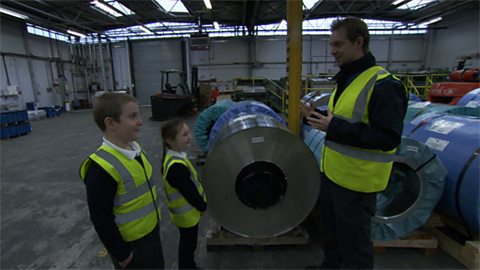
Curious Cat, an animated cat, asks two children if they’d like to find out how biscuit tins are made.