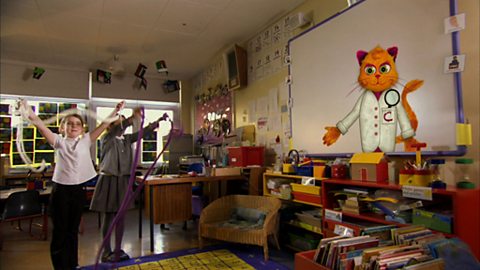
CURIOUS CAT:Hello, children. What are you doing with those biscuit tins?
BOY:Oh, hello, Curious Cat.
GIRL:We're sorting our biscuit tins for our school project.
CURIOUS CAT:It looks like you have plenty of tins there. But do you know how biscuit tins are made?
BOY:No.
CURIOUS CAT:Let's find out how it all begins.
CURIOUS CAT:'The tins are made of steel, and steel is made from special rocks underground called iron ore. Iron is a metal, and it's found in rocks deep underground. To get to these rocks, we have to use explosives 'and big machines to dig deep and take away the loose earth. The iron ore rocks are then loaded onto a truck and transported to the steel factory. To make steel, you need iron ore, coal, and limestone, which all come from the earth.'
CURIOUS CAT:Are you curious to find out what happens next?
BOY:Yes.
GIRL:Yeah, that'd be great.
CURIOUS CAT:Then off you go.
CURIOUS CAT:'To find out what happens next, you'll have to visit the steel plant, which is a huge factory where all the ingredients are brought together to make steel. My friend, Chris, is waiting to show you around.
GIRL:Hello.
CHRIS:Hi, my name's Chris, and I'm here today to teach you all about our steel-making factory. All around you can see the raw materials for making steel, iron ore, coal, and limestone. I'm glad you've already got your safety gear on. Now we're gonna head to the blast furnace to see what we do next.
CURIOUS CAT:'Look at all the raw material. There is heaps here, and it all comes from the earth.'
CHRIS:So the first thing that we need to do is to mix all the raw ingredients together, the iron ore, the coke, and the limestone, and to melt them together in the blast furnace.
BOY:What is a blast furnace?
CHRIS:A blast furnace is like a huge hot oven that's used to melt the raw ingredients for steel-making. What's really interesting is that we can never really turn the furnace off, because once it cools down, it takes so long to heat back up again. So it's actually on all year round.
GIRL:How does a blast furnace work?
CHRIS:I tell you what, we'll go outside and I'll show you, okay?
CURIOUS CAT:'So this is one of the enormous blast furnaces that melts the iron ore, coal, and limestone, the ingredients that make steel.'
CHRIS:So what happens is we put all of the raw ingredients into the top of the furnace until all the iron is melted down into a white-hot pool of liquid iron at the bottom.
CURIOUS CAT:'The furnace is so hot, we're not allowed anywhere near it.'
GIRL:How hot is the furnace?
CHRIS:Do you know how hot the water in a kettle is? ell, a blast furnace is 20 times hotter than that, so it's very, very hot.
BOY:How would you get it all out of the furnace?
CHRIS:Once the metal is collected in the bottom, we have to drill a hole into the bottom of the furnace.
CURIOUS CAT:'The red-hot liquid drains into special containers on trains called torpedoes, which will take the liquid to the next part of the process, to turn it into steel. The liquid metal at this stage is full of impurities, so, the next process is to clean it.'
GIRL:How does cleaning work?
CHRIS:Well, a special lance is lowered down to the surface of the liquid, and really, really fast gas is blown onto the top of the liquid. This makes all the impurities and everything else that's in the steel that we don't want float to the surface so we can scoop it away. Then we're just left with the steel that we need.
CURIOUS CAT:'Once the steel is cleaned, the next stage is to turn it from a liquid into a solid.'
GIRL:When does it start looking like steel?
CHRIS:Well, first we have to cool the red-hot liquid into a solid, and then we can roll it thinner. Shall we go and see what we do next?
CURIOUS CAT:'The red-hot liquid steel is moulded into giant slabs, and then the next process is to roll it to make thin sheets of steel.'
CHRIS:The slabs from the steel plant are still too thick to be made into biscuit tins, so this is where we bring it to make it even thinner and roll the slabs into steel sheets.
BOY:How do you turn those slabs into thinner sheets?
CHRIS:Well first, you have to reheat them.
CURIOUS CAT:'The steel slabs need to be reheated in a very hot oven, so they're soft enough to go through the rollers, which make them thinner and longer.'
CHRIS:'Then we can cut them, trim them, and roll them into big coils, which look like giant toilet rolls, which can sometimes be up to a kilometre long.'
CURIOUS CAT:'That does look like a giant toilet roll. It also looks very, very hot.'
GIRL:It doesn't look like anything like biscuit tins.
CHRIS:No, you're right. First, we need to send them to another process to make them even thinner again. And then we can take it to the factory to make it into biscuit tins.
CURIOUS CAT:'So, at the end of this process, the red-hot steel is cooled and then rolled even thinner. And it is then ready to be made into biscuit tins. Chris is taking the children to see how this is done.'
CHRIS:So, here we are at the factory where we take the steel and make it into biscuit tins. As you can see, the steel has already been rolled really, really thin by the steel factory. The first thing that we have to do is to cut it up into smaller sections so that we can put it through the machines.
CURIOUS CAT:'The thin sheets of steel are loaded onto the machine that cuts them into different sizes. This way, you can make different-sized biscuit tins.'
CURIOUS CAT:'Once the sheets have been cut into the right sizes, the biscuit tin designs are printed on them.'
CHRIS:So these ones have just come back from the printers, and as you can see, they've got the same design all over them. This one will actually make about 15 biscuit tins. Do you think it's starting to look a bit more like biscuit tin now?
GIRL:Yeah.
BOY:Yes.
CURIOUS CAT:'Next, the printed sheets are cut even smaller, and then pressed to make the biscuit tin shapes.'
CHRIS:Here, the cylinders are just about to go into this machine. This is where the bottoms get put onto them.
CURIOUS CAT:'And after one last check, the biscuit tins are finished. They're now ready to be filled with biscuits.'
CHRIS:So now, our lids, and our cylinders make a finished biscuit tin.
GIRL:Thank you.
CHRIS:One for you.
CHRIS:And one for you.
BOY:Whoa.
CURIOUS CAT:Hello, children. what did you find out?
GIRL:First, we went to see the ingredients, coal, iron ore, and limestone. They were mixed together and melted in huge furnaces that look like big ovens.
BOY:'The liquid was poured into a transporter called a torpedo.'
BOY:'This then cooled into big slabs. The slabs get flattened and stretched. They are then rolled, and look like massive toilet rolls.'
GIRL:'The steel rolls are made even thinner and sent to the biscuit tin factory. That's where the rolls get shaped into tins. It was brilliant.'
CURIOUS CAT:Well done, children. Now you know how steel is made, and how a biscuit tin is made. Excellent work. See you next time. Bye for now.
GIRL:Goodbye, Curious Cat.
BOY:Goodbye, Curious Cat.
CURIOUS CAT:Goodbye, children.
Video summary
This short film, first published in 2012, is for teachers and review is recommended before use in class.
Curious Cat shows the children footage of iron ore being mined, before sending them off to a steel works.
An expert shows them piles of rock in the raw materials yard and explains how a blast furnace works.
The children observe the iron being turned into steel in a B.O.S. plant.
Next, they watch the solid steel being rolled and shaped into coils.
The guide then takes the children to a biscuit tin factory where they see the steel cut, printed and shaped into biscuit tins.
The children take their own biscuit tins back to the classroom and tell Curious Cat everything that they've learned.
This is from the series: Curious Cat Steel, Electricity, Sewage
Teacher Notes
Students could be asked to recap the raw materials required to make steel.
They could explore how the characteristics of each of the raw materials – iron ore, coal and limestone – change when they turn into steel.
Where possible students could look at and handle some examples of each material and describe its properties. Students could then draw a flow diagram of the steel-making process as described in this clip.
This clip could be used to explore how metal is used in everyday life.
Challenge students to draw up tables for a study in their classroom or home, describing an object which contains metal, the kind of metal it contains, the property of that metal (conducts heat, is light, is waterproof and so on) and the related use.
Alternatively, the students could imagine that they are founding a metal factory to build robots.
Using the processes of steel production shown in this clip, students could take this as a starting point to explain the process involved in building the bodies for their robot.
What metal would they choose? Would the body be thick, thin or incorporate parts which are both?
This clip will be relevant for teaching Science at KS1 and KS2 in England and Foundation Phase in Wales.
Also Foundation and KS1 in Northern Ireland and Early/1st/2nd levels in Scotland.
How is electricity made? video
Two children meet Curious Cat, an animated cat who asks them if they would like to find out how electricity is generated.
What happens to our sewage? video
Two children meet Curious Cat, an animated cat who asks them if they would like to find out what happens to our sewage once it leaves our homes.
How are bricks made? video
With the help of Curious Cat, two children visit a brick factory to find out they bricks are made.
How are crayons made? video
With the help of Curious Cat, two children visit a crayon factory to find out how they are made.
How are TV programmes made? video
Two children find out how TV programmes are made and how they reach your TV at home.
How is glass made? video
With the help of Curious Cat, two children find out how flat glass for windows is made.
How is paper made? video
Two children meet animated character Curious Cat, who asks them if they would like to find out how paper is made.
How is wool made? video
Curious Cat, an animated character, helps two children find out more about how wool is made.