Curious Cat:
Hello children, what are you doing?
Female Child:
We're sticking our pictures up on the wall.
Curious Cat:
That's great, but have you ever thought about how important walls are? That wall doesn't just hold your pictures up, it's holding up the roof above our heads and the whole school. It has to be very strong to do that. Do you know what it's made of?
Male Child:
Is it made out of bricks?
Curious Cat:
That's right, but what are bricks made from?
Female Child:
Hmm, I don't know.
Curious Cat:
Bricks start their journey in the ground as clay. Clay is a type of rock, in fact, clay is made up of tiny bits of rock, smaller than a grain of sand. The clay is dug up by big diggers in quarries. Clay is special, because when it is mixed with water, it becomes very sticky and it can be made into lots of different shapes. This is why it can be used to make lots of things like plates, cupsand bricks. Clay is the main ingredient to make a brick but a lot has to be done to the clay before it can hold up a building. Would you like to find out more?
Female & Male Child:
Yes please.
Curious Cat:
Off you go to the brick factory to find out more from my friend Graham.
Graham:
Hello children, my name's Graham, I run this brick factory and would you like us to show you how we make our bricks?
Female & Male Child:
Yeah!
Graham:
Come on then, let's see what we can find.
Curious Cat:
All the clay comes to the factory from local quarries ready to be made into bricks. The first thing to do is to move the clay from the yard into the factory.
Male Child:
Wow.
Curious Cat:
It travels on a conveyor way up in the air. You can follow it to see what happens next.
Graham:
There's the conveyor belt, so the clay goes up and goes all the way up into the factory.
Male ChildWow.
Curious Cat:
The next stage is to get rid of all the lumps. The conveyor takes the clay to a big machine that crushes it. To see inside the crusher, you need to climb up all these stairs. Be careful now.
Graham:
There you go, if you look in, those big rollers are crushing up the clay. Can you see?
Female & Male Child:
Yeah.
Graham:
Each one of those weighs about 10 tonnes.
Female Child:
Wow.
Curious Cat:
Now the clay is smoother, water is added.
Graham:
The big mixer we saw up there crushing the clay and we also start to add some water to the clay.
Male Child:
Why do you add water?
Graham:
We have to make sure the clay is nice and soft so we can mould it into bricks.
Curious Cat:
To see how soft the clay needs to be, Keith can show you how he makes bricks by hand.
Keith:
Hello kids, my name's Keith and I'm gonna show you now how to make a handmade brick ok?
Female & Male Child:
Yeah!
Keith:
What we do, we get the clay, which is the same as the clay we used down in the factories, we get enough clay to make the brick and then we roll it in the sand.
Female Child:
Why do you roll it in the sand?
Keith:
I roll it in the sand so when we make the brick, it doesn't stick in the mould. So if I didn't do that, we wouldn't be able to get the bricks out and they wouldn't be no good.
Keith:
Ok, then we pick it up, place it in there, this is the noisy bit.
Keith:
Ok and cut that off, we use that to make another brick and we turn it over give it a little tap like that then we put it on here look, lift it up and that's the brick.
Female Child:
It's amazing.
Keith:
Who wants to make a brick?
Female Child:
Me, me, me.
Keith:
Brick onto the top of there, that's it. Pat it down.
Keith:
That's it.
Keith:
That's it, pat it on top.
Keith:
Pull it towards you.
Keith:
Bring it over here. There we are, there we go.
Keith:
This is how bricks have been made for thousands of years but now the majority of them are made in the factories. We can't make enough for all the houses that are being built nowadays.
Male ChildWhat happens next?
Keith:
Well, Graham will show you what happens next. Shall we go and see him?
Female & Male Child:
Yeah!
Keith:
Come on then.
Curious Cat:
In order to make lots of bricks in the factory, a massive machine is used. Just like Keith, the machine squeezes the clay into moulds. Each rectangle shape makes a brick.
Graham:
So, this is actually bricks being made by the soft, sticky clay coming down through the machine and press to up there is just squeezing the right amount of clay into the mould, a very, very soft, sticky clay, lovely to play with.
Curious Cat:
The bricks are pushed out of the mould using sand. This is exactly the same as Keith and his handmade bricks but the sand has another really important job.
Graham:
We use different types of sand to give us different colours of bricks, so we can make purple bricks, black bricks, red bricks and in fact the bricks we're making today, you've seen all the clay coming into the factory will actually come out yellow. So, a nice buff clay, yellow sand in stain will make a yellow brick. Red sand with a red clay and then we can even put colourant on thebrick, so lots and lots of different sands, coloured stains will make lots of pretty different coloured bricks ok?
Curious Cat:
Now the bricks have to be made hard and the first part of this is to dry them.
Graham:
Once we've made our bricks we then have to dry them so we put them into dryers, they're in the dryers for about 24 hours. The temperature of the dryer is up to 100 degrees Celsius so very, very hot, that's why there's sometimes steam coming out of the dryer because that's the water coming out of the brick.
Female Child:
Why do you remove the water?
Graham:
If we didn't remove the water before they go into the kiln, they would actually explode, the water would get trapped in the middle of the brick and they would shatter and we don't like shattered bricks, we like perfect bricks. Ok, shall we go and see the next stage and the kiln.
Female & Male Child:
Yes please.
Curious Cat:
Once the bricks are nice and dry, they go to the kiln to be fired.
Graham:
So, these have just come through the kiln, the kiln is a really, really hot oven, it's a hot temperature of a 1080 degrees centigrade so in a minute, the doors will automatically open and we will see all the red hot bricks inside.
Male Child:
Oh yeah. Wow. It looks very hot.
Curious Cat:
That's right children, those flames are firing the bricks, hardening them so they're strong enough to hold up a house.
Graham:
That's the end of our day, this is where the bricks are finally selected. We package them up and send them off all over the UK for people to build houses, hospitals and schools. So, you now know exactly how to make bricks so you can go off now and tell Curious Cat: all about it can't you?
Female & Male Child:
Yeah!
Curious Cat:
So children, how was your journey?
Female Child:
It was great.
Male Child:
We made our own bricks, see.
Curious Cat:
That's fantastic, what did you learn?
Female Child:
Bricks are made of clay and water. The water makes the clay easy to mould.
Male Child:
The mix is squished and squashed so it is all the same.
Female Child:
It's put into a mould to make a brick shape.
Male Child:
It is dried to get rid of all the water so it wouldn't explode.
Female Child:
It gets really hot in the kiln and this makes the brick really strong.
Male Child:
The bricks are packed up to go to building sites.
Curious Cat:
Well done children. Now you know how clay becomes strong enough to hold up the school and your houses. It's time to say goodbye.
Female & Male Child:
Bye bye Curious Cat.
Curious Cat:
Goodbye children.
Video summary
At the brick factory the children see diggers extracting clay from a quarry and the kinds of things which can be made from clay.
They meet an expert who shows them the process of making bricks, including getting rid of all the lumps in the clay; adding water to make it softer so that it can be squeezed into a mould; the importance of sand to help the clay out of the mould and the drying and firing of the bricks in a kiln.
The children also make their own bricks by hand.
This is from the series: Curious Cat TV, Bricks, Crayons
Teacher Notes
This clip could be used as part of a topic about houses and homes.
Pupils could discuss how they think bricks are made and what processes they go through.
The clip could be shown at this point and paused at each stage of the process, so pupils can take notes and create a class diagram of the process.
A discussion could follow about all the different types of buildings that are built with bricks.
You could introduce practical activities using clay by getting your pupils to create various clay objects.
They could design their own brick houses in Design and Technology and calculate how many bricks would be needed.
A bricklayer could be invited in to school to demonstrate how to build a wall.
This clip will be relevant for teaching Science at KS1 and KS2 in England and Foundation Phase in Wales.
Also Foundation and KS1 in Northern Ireland and Early/1st/2nd levels in Scotland.
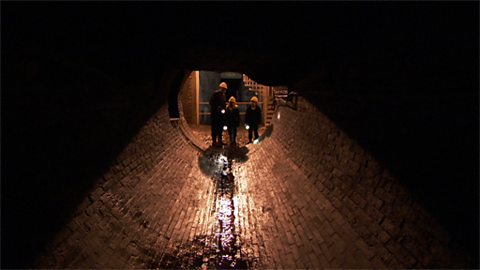
What happens to our sewage? video
Two children meet Curious Cat, an animated cat who asks them if they would like to find out what happens to our sewage once it leaves our homes.
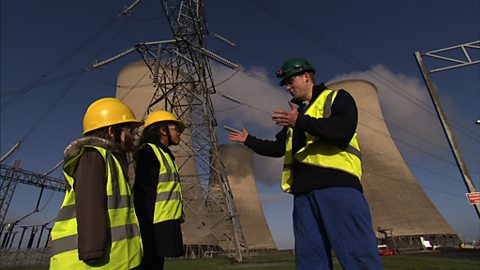
How is electricity made? video
Two children meet Curious Cat, an animated cat who asks them if they would like to find out how electricity is generated.
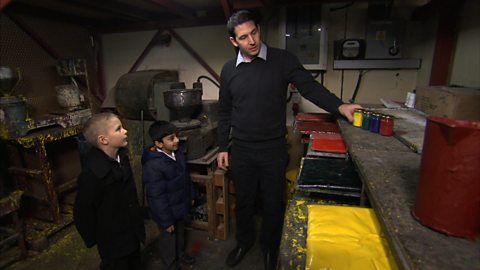
How are crayons made? video
With the help of Curious Cat, two children visit a crayon factory to find out how they are made.
How are TV programmes made? video
Two children find out how TV programmes are made and how they reach your TV at home.
How is glass made? video
With the help of Curious Cat, two children find out how flat glass for windows is made.
How is paper made? video
Two children meet animated character Curious Cat, who asks them if they would like to find out how paper is made.
How is wool made? video
Curious Cat, an animated character, helps two children find out more about how wool is made.
How is steel made? video
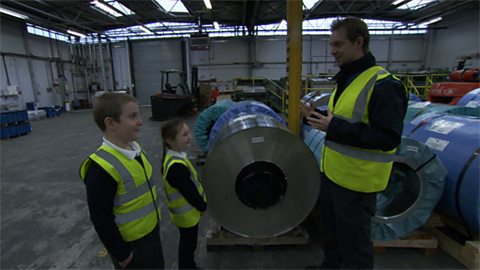
Curious Cat, an animated cat, asks two children if they’d like to find out how biscuit tins are made.