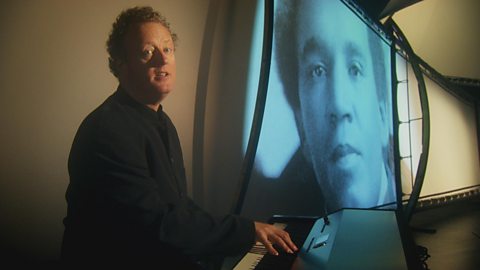
In this short film Howard Goodall looks at how musicians such as Dmitri Shostakovich and Richard Strauss adapted to survive Hitler's Germany and Stalin's Soviet Union.
Goodall examines the era, looking at some of the 20th century's greatest composers - Béla Bartók, Carl Orff, Richard Strauss and Dmitri Shostakovich - who each learnt to survive with their own unique strategy.
He tells the extraordinary story of Shostakovich's 7th Symphony, performed and broadcast as a symbol of hope in the midst of the horrifying siege of Leningrad during World War Two.
Features extracts from Béla Bartók - Music for Strings, Percussion and Celesta (1936), Carl Orff - Carmina Burana, Dmitri Shostakovich - 7th symphony.
This short film is from the BBC series, Howard Goodall's Story of Music.
Teacher Notes
This short film would be good for illustrating how the historical and cultural environment that composers work in can have a massive influence on their music.
Using this clip as a springboard, students could select another piece of music and research the cultural and musical context in which it was written, and how this may have affected the work.
This clip sets the context for an exploration of the Leningrad Symphony. For example, the second movement can be used for a listening or analysis activity, where the successive instruments playing variations on the violin's initial theme are identified and the nature of their variations discussed.
Curriculum Notes
This short film will be useful for teaching music, particularly in the areas of music history, notation, composition, music theory and understanding styles.
More from Howard Goodall's Story of Music:
Notation and melodic movement. video
How do you write down a melody? In this short film Howard Goodall gives an introduction to early notation and how music was first written down.

Harmony, intervals, triads and cadences. video
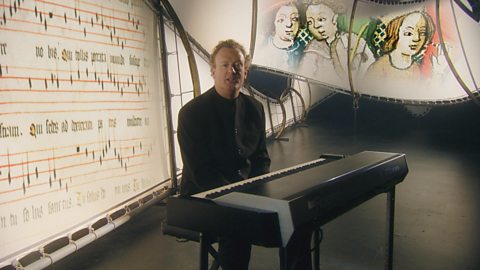
In this short film Howard Goodall looks at the late medieval period and the development of harmony by composers such as John Dunstaple.
Harmony, dissonance and an introduction to opera. video
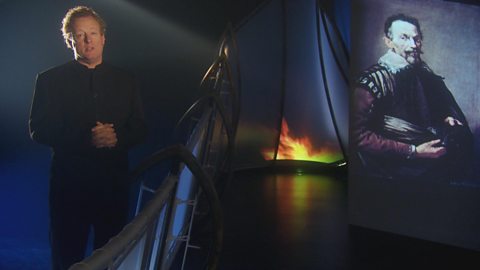
In this short film Howard Goodall looks at the importance of Claudio Monteverdi, the 16th century composer who introduced more emotive, dissonant harmonies.
Key signatures, equal temperament and the 12-tone tuning system. video
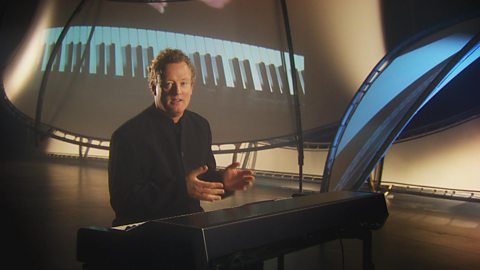
In this short film Howard Goodall explains the origin of the 12-tone tuning system that has become the foundation of classical and popular western music.
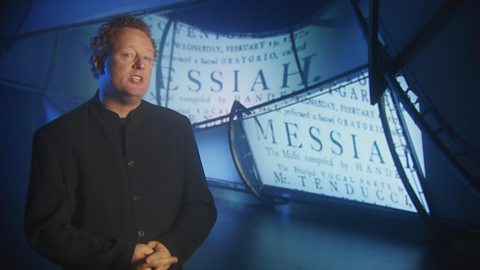
Handel, the pianoforte and oratorio. video
In this short film Howard Goodall explores 18th century music, the invention of the piano and the establishment of opera as a major art form.
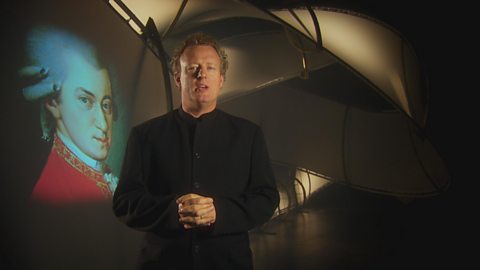
Mozart, melodic writing and the symphony. video
In this short film Howard Goodall analyses Wolfgang Amadeus Mozart's importance in musical history, exploring his symphonies and operas, and his relationship to his contemporaries, Haydn and Beethoven.
Haydn, symphonies and melodic writing. video
In this short film Howard Goodall analyses 18th century music, Joseph Haydn' impact on composition, and the rise of the symphony and opera as prominent musical forms.
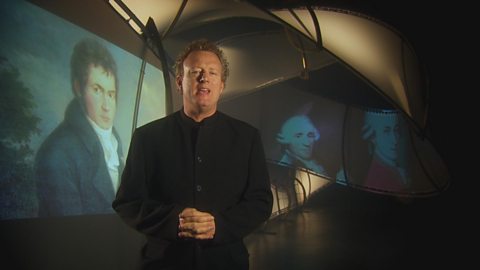
A profile of Beethoven. video
In this short film Howard Goodall offers a profile of Beethoven and his development from classical composer to romanticism.
Franz Liszt, symphonic poems and orchestral music. video
In this short film Howard Goodall profiles Franz Liszt and developments in 19th century music, including his innovations with themes of death and destiny.
Saint-Saëns and developments in French composition. video
In this short film Howard Goodall asks how French composers changed the direction of music in the 19th century. Includes a focus on Erik Satie and Gabriel Fauré.
Debussy, world music and impressionism. video
In this short film Howard Goodall examines Claude Debussy and the transition away from traditional composition methods.
Minimalism and the advance of music technology. video
In this short film Howard Goodall explores the rise of modern popular music such as hip hop and looks at music technology and sampling.
Stravinsky, Russian music and modernism. video
In this short film Howard Goodall finds out how Igor Stravinksy's spiky, aggressive, complicated music took the musical establishment by storm in the early 20th century.
Blues and ragtime. video
In this short film Howard Goodall explores the origins of blues music and ragtime and looks at how the invention of recorded music popularised folk and spiritual African American music.