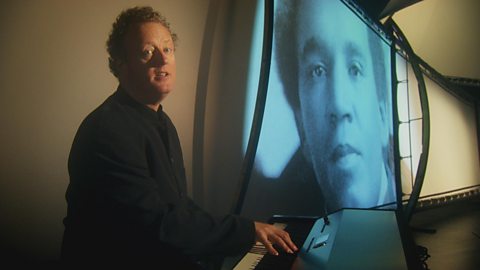
Howard Goodall:By 1600 after centuries of painstaking experiment, on the part of often anonymous musicians, the musical toolbox, we still use today, was taking shape. Music had become a rich mix of sacred and secular, instrumental and vocal.
Howard Goodall:But one thing music rarely did was express complex, let alone conflicting, emotions.
Howard Goodall:The next stage on music's journey was for a composer who could use dissonance, deliberate clashes of notes and chords, to conjure up subtle emotions.
Howard Goodall:What's more, almost anything you'd hear around 1600 was on a relatively small scale.
Howard Goodall:'The time was ripe for someone, somewhere, 'to start creating long substantial forms 'that would last a whole evening and leave audiences cheering for more. 'Which is exactly what happened.
Howard Goodall:'Opera was born.
Howard Goodall:'The man of the moment, 'one of the ten most influential composers of all time, 'was Claudio Monteverdi.
Howard Goodall:'In his hands, opera went from zero to hero.
Howard Goodall:'In opera, music is at the service of the drama 'and so it needs to be able to express complex, 'even conflicting, emotions.
Howard Goodall:'Luckily Monteverdi had already spent years trying to do exactly that, 'with his sophisticated, passion-filled madrigals.
Howard Goodall:'To do so he had begun to recalibrate harmony.'
Howard Goodall:Let's look at just one of his madrigals, which put cats among pigeons, even in his own time. It's from the fifth book of madrigals of 1605, and it's called O Mirtillo, Mirtillo Anima Mia. Oh Myrtle, Myrtle, My Soul. Listen to this bit.
MUSIC: O Mirtillo, Mirtillo Anima Mia by Claudio Monteverdi
Howard Goodall:It's obvious Monteverdi is dipping in and out of all kinds of chords that don't seem comfortably related to each other. He wants you to feel surprised or intrigued, especially if it enhances the words of the poem.
Howard Goodall:So on these words "Che chiami crudelissima Amarilli", "The one you call cruellest, Amarillis" He creates a series of deliberate clashes of chord called a dissonance, or suspension.
Howard Goodall:'Instead of sticking to chords that had close affinities with each other, 'he deliberately mixed up unrelated chords 'and exploited the strange disorientating sounds this produced.
Howard Goodall:'It was music that could manipulate our emotions 'that Monteverdi brought into opera.
Howard Goodall:'He also introduced another ingredient, 'a dramatic oral effect that had been invented in Venice. 'Then one of the world's richest and most powerful city states.
Howard Goodall:'It's huge, cavernous basilica, St. Mark's, 'employed some of the best musicians in Europe 'including for a time Monteverdi himself.
Howard Goodall:'On top of all this, 'the building served as a kind of musical and acoustical laboratory.
Howard Goodall:'An uncle and nephew team called Gabrieli, 'had developed a kind of precursor of surround sound at St. Marks. 'Achieved by placing groups of singers and instrumentalists 'in different parts of the building, 'and having them sing or play alternately.
Howard Goodall:'The technical term for the technique is polychoral, 'many choirs.
Howard Goodall:'Monteverdi knew and admired this polychoral style, 'and thought it would work alongside his intimate, 'emotionally-charged madrigal style when he came to writing opera.'
Howard Goodall:Monteverdi didn’t invent opera, a Florentine composer called Peri did, in 1597.
Howard Goodall:But Monteverdi did write the first good opera, L'Orfeo, which premiered in Mantua in 1607.
Howard Goodall:He was aiming for maximum emotional effect, maximum narrative clarity, maximum impact, even shock, and wasn't going to obey anyone's rules about what he could or could not do.
Howard Goodall:'What's more, Monteverdi invented a new combination of instruments 'never before gathered together. 'He borrowed old and new styles, he used choral music, 'he told the stories through characters 'directly expressing themselves to the audience.
Howard Goodall:'Almost everything about L'Orfeo was then a novelty. 'It was loud, it was long and it was modern.'
Howard Goodall:And let's not forget how liberating it all must have been, because as musical techniques have been developing, century by century, so too had the ability to express more complex, subtle and unexpected emotions along the way.
Howard Goodall:Monteverdi was using music plus.
In this short film Howard Goodall looks at the importance of Claudio Monteverdi, the 16th century composer who introduced more emotive, dissonant harmonies.
Monteverdi’s madrigals and the opera 'L’Orfeo' are used to demonstrate unrelated chords and dissonance.
L'Orfeo was one of the first major operas. Monteverdi is seen as one of the key composers who founded the Baroque period in music.
This short film is from the BBC series, Howard Goodall's Story of Music.
Teacher Notes
Encourage your students to try transposing simple tunes into difference keys. What difference does it make?
Look at different instruments and the different keys they play in (e.g. violin in C, trumpet in Bb).
Set students the task of transposing a small piece of music from C to Bb.
Reflect on different playing techniques and the capabilities of each instrument.
Curriculum Notes
This short film will be useful for teaching music, particularly in the areas of music history, notation, composition, music theory and understanding styles.
More from Howard Goodall's Story of Music:
Notation and melodic movement. video
How do you write down a melody? In this short film Howard Goodall gives an introduction to early notation and how music was first written down.
Harmony, intervals, triads and cadences. video
In this short film Howard Goodall looks at the late medieval period and the development of harmony by composers such as John Dunstaple.
Key signatures, equal temperament and the 12-tone tuning system. video
In this short film Howard Goodall explains the origin of the 12-tone tuning system that has become the foundation of classical and popular western music.
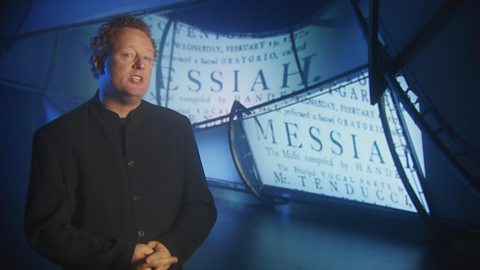
Handel, the pianoforte and oratorio. video
In this short film Howard Goodall explores 18th century music, the invention of the piano and the establishment of opera as a major art form.
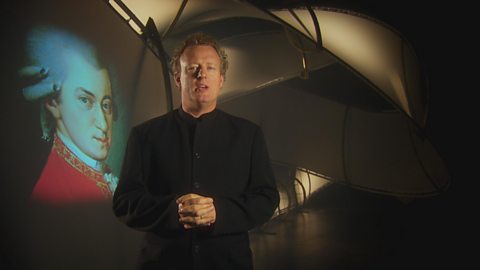
Mozart, melodic writing and the symphony. video
In this short film Howard Goodall analyses Wolfgang Amadeus Mozart's importance in musical history, exploring his symphonies and operas, and his relationship to his contemporaries, Haydn and Beethoven.
Haydn, symphonies and melodic writing. video
In this short film Howard Goodall analyses 18th century music, Joseph Haydn' impact on composition, and the rise of the symphony and opera as prominent musical forms.
A profile of Beethoven. video
In this short film Howard Goodall offers a profile of Beethoven and his development from classical composer to romanticism.
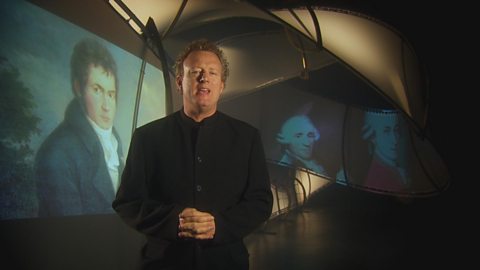
Franz Liszt, symphonic poems and orchestral music. video
In this short film Howard Goodall profiles Franz Liszt and developments in 19th century music, including his innovations with themes of death and destiny.
Saint-Saëns and developments in French composition. video
In this short film Howard Goodall asks how French composers changed the direction of music in the 19th century. Includes a focus on Erik Satie and Gabriel Fauré.
Debussy, world music and impressionism. video
In this short film Howard Goodall examines Claude Debussy and the transition away from traditional composition methods.
Shostakovich and the effects of Nazi rule on composers. video
In this short film Howard Goodall looks at how musicians such as Dmitri Shostakovich and Richard Strauss adapted to survive Hitler's Germany and Stalin's Soviet Union.

Minimalism and the advance of music technology. video
In this short film Howard Goodall explores the rise of modern popular music such as hip hop and looks at music technology and sampling.
Stravinsky, Russian music and modernism. video
In this short film Howard Goodall finds out how Igor Stravinksy's spiky, aggressive, complicated music took the musical establishment by storm in the early 20th century.
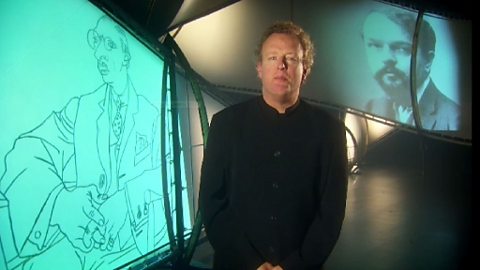
Blues and ragtime. video
In this short film Howard Goodall explores the origins of blues music and ragtime and looks at how the invention of recorded music popularised folk and spiritual African American music.