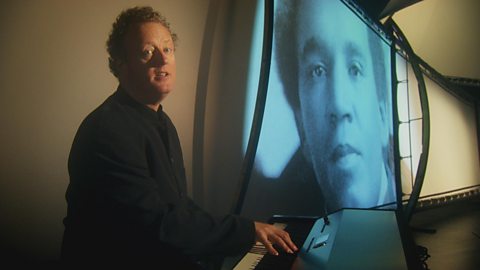
Howard Goodall:In the last half of the 19th Century the sleeping musical giant of Russia woke up with a bang.
Howard Goodall:While the spectacularly successful Tchaikovsky became a friend to the Tsars and famous throughout the world, it was the music of the almost self-taught, Modest Mussorgsky that profoundly influenced other composers.
Howard Goodall:Using as it did, Russian ingredients and sounds that didn't originate in Germany, Austria or Italy.
Howard Goodall:When this music was first heard in Western Europe, It galvanised the composers who heard it, not least Claude Debussy.
Howard Goodall:Russian music had arrived. And in the early 1900s it was to go into overdrive, thanks to the startling music of a young prince among composers, Igor Stravinsky.
Howard Goodall:In a series of startling ballet scores, Stravinksy took the rule book as handed down by Haydn, Mozart and Beethoven, the slowly evolving development of tunes, and threw it away. Modernism had arrived.
Howard Goodall:Stravinsky, like Mussorgsky and Debussy before him, wanted to find a way of assembling a musical structure without using constantly developing nuggets of tune.
Howard Goodall:Stravinksy in particular wanted to tell his ballet stories a different way. He created a montage, an aural jigsaw. One tune followed by a different tune, followed by a different tune in tumbling succession.
Howard Goodall:For this reason, ballet with its short restless kaleidoscopic episodes, was the form for which Stravinsky was born to compose.
Howard Goodall:'We find the idea of musical collage, the mix, the remix, the iPod shuffle 'and the mash-up completely normal. 'But we shouldn't forget how bewilderingly unfamiliar an idea 'this was to the musical establishment of the early 1900s.
Howard Goodall:'When the ballet roost took Stravinsky's second ballet, 'Petrushka, to Vienna in 1913, 'the scandalised musicians refused to play it, 'describing it as dirty music.
Howard Goodall:'All of the radicals, Mahler, Debussy and Stravinsky, 'were dismantling the old system, 'whereby musical ideas carefully unfolded one thing after another 'They wanted everything at once.'
Howard Goodall:Stravinsky, like all Russian composers, was turned on by the rhythmic urgency of dance. But he did something very unusual with that rhythm.
Howard Goodall:Whilst Mahler had layered melody on melody, tangled together like a twisted knot, and Debussy had manipulated blocks of adjacent sound overlapping one another, Stravinsky went one step further, superimposing simultaneous rhythms on top of each other.
Howard Goodall:'Polyrhythm as it has since been dubbed, 'had long existed in African tribal drumming. 'Improvised on the spot by highly intuitive, skilful players.
Howard Goodall:'But polyrhythm, conceived from scratch by a composer, 'written down on a page, 'imposed on the western symphony orchestra player by player. 'This was utterly, breathtakingly novel a concept.
Howard Goodall:'It was as if Stravinsky wanted the past and the present 'to co-exist in one dimension. 'The prehistoric ritual of his dancers, 'and the modern cacophony of the industrial world. 'And the only way that he could conceive it was to make parallel, 'competing rhythmic patterns fight for the same space.
Howard Goodall:'It's complicated, but it's magnificent.'
In this short film Howard Goodall finds out how Igor Stravinksy's spiky, aggressive, complicated music took the musical establishment by storm in the early 20th century.
Includes extracts from Stravinsky's Petrushka and The Rite of Spring.
This short film is from the BBC series, Howard Goodall's Story of Music.
Teacher Notes
This short film presents Debussy, Mahler and Stravinsky as radicals of their day.
Discuss with the students who they consider to be today's radical musicians. What would they have to do today to be radical?
This could lead to a short composition task where the students aim to create a radical composition.
What instruments could be used to reinterpret these composers' work for a contemporary audience?
Curriculum Notes
This short film will be useful for teaching music, particularly in the areas of music history, notation, composition, music theory and understanding styles.
Notation and melodic movement. video
How do you write down a melody? In this short film Howard Goodall gives an introduction to early notation and how music was first written down.
Harmony, intervals, triads and cadences. video
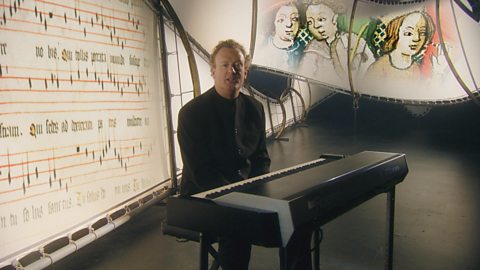
In this short film Howard Goodall looks at the late medieval period and the development of harmony by composers such as John Dunstaple.
Harmony, dissonance and an introduction to opera. video
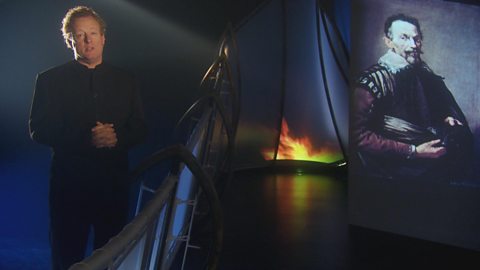
In this short film Howard Goodall looks at the importance of Claudio Monteverdi, the 16th century composer who introduced more emotive, dissonant harmonies.
Key signatures, equal temperament and the 12-tone tuning system. video
In this short film Howard Goodall explains the origin of the 12-tone tuning system that has become the foundation of classical and popular western music.
Handel, the pianoforte and oratorio. video
In this short film Howard Goodall explores 18th century music, the invention of the piano and the establishment of opera as a major art form.
Mozart, melodic writing and the symphony. video
In this short film Howard Goodall analyses Wolfgang Amadeus Mozart's importance in musical history, exploring his symphonies and operas, and his relationship to his contemporaries, Haydn and Beethoven.
Haydn, symphonies and melodic writing. video
In this short film Howard Goodall analyses 18th century music, Joseph Haydn' impact on composition, and the rise of the symphony and opera as prominent musical forms.
A profile of Beethoven. video
In this short film Howard Goodall offers a profile of Beethoven and his development from classical composer to romanticism.
Franz Liszt, symphonic poems and orchestral music. video
In this short film Howard Goodall profiles Franz Liszt and developments in 19th century music, including his innovations with themes of death and destiny.
Saint-Saëns and developments in French composition. video
In this short film Howard Goodall asks how French composers changed the direction of music in the 19th century. Includes a focus on Erik Satie and Gabriel Fauré.
Debussy, world music and impressionism. video
In this short film Howard Goodall examines Claude Debussy and the transition away from traditional composition methods.
Shostakovich and the effects of Nazi rule on composers. video
In this short film Howard Goodall looks at how musicians such as Dmitri Shostakovich and Richard Strauss adapted to survive Hitler's Germany and Stalin's Soviet Union.

Minimalism and the advance of music technology. video
In this short film Howard Goodall explores the rise of modern popular music such as hip hop and looks at music technology and sampling.
Blues and ragtime. video
In this short film Howard Goodall explores the origins of blues music and ragtime and looks at how the invention of recorded music popularised folk and spiritual African American music.