Liz Bonnin introduces a video clip examining how physical processes, including ice and glaciers, have shaped the landscape of the Yorkshire Dales.
The video
LIZ BONNIN: Hi, I’m Liz Bonnin. I’m looking into physical geography, but whereas a geologist might dig around some rock formations, I’ve been digging into the BBC’s vast archives to uncover programmes packed with inspiring information.
And this one has got almost everything. Spectacular views of the British countryside, locations that featured in the Harry Potter series, strange rock formations, rare plants, a place loads of you will recognise from school trips, fascinating facts and on top of that, they’ve thrown in comedian, Hugh Dennis, and wildlife presenter, Julia Bradbury, who get things started with a stroll atop a vast limestone patio in the Yorkshire Dales…
JULIA BRADBURY: Set foot on it, and it’s one weird place. Almost otherworldly.
Ooh, did you hear that?
I feel as though I’m walking along the spine of a dinosaur.
This spot is so weird, they filmed a scene from Harry Potter here. So how has such a mysterious place come to be?
This concoction of weirdly-shaped slabs and cracks would once have been a flat expanse of rock. But over the years, surface water has nibbled away at the limestone, leaving this incredible pattern.
The pieces of this limestone pavement, as it’s called, have old Yorkshire names.
The blocks are called clints. And the gaps are known as grikes.
But the most curious thing is what’s hidden down in the grikes. Meet Professor Cynthia Burek, a geo-conservationist, who’s fascinated by this unusual rocky habitat.
Limestone pavements are pretty mysterious places, aren’t they?
CYNTHIA BUREK: Yes, they are full of surprises and mysteries.
JULIA BRADBURY: Remarkably these cracks are teeming with plant life that’s extremely rare in Britain.
CYNTHIA BUREK: Down in the grikes we have a very shady, a very humid sort of environment. Microclimate, if you will. And we have shade-tolerant plants down there. Ferns…
JULIA BRADBURY: You’re making it sound quite nice.
CYNTHIA BUREK: It’s a bit narrow to get down there! It’s a real surprise for people when visitors come up here. They say, ‘Oh my goodness, look. Look at all these ferns. These hart’s tongue fern and the maidenhair spleenwort.
JULIA BRADBURY: Just lovely, lovely names!
CYNTHIA BUREK: Yes.
JULIA BRADBURY: But there’s a puzzle. These are plants you’d expect to see in shady woodland. Not here. How did they get here then? Well they’re a clue that not so long ago this all would have looked completely different. It was a thick forest.
CYNTHIA BUREK: So this would originally have been ancient woodland. The whole thing, but the only place we find the woodland now is down the grikes. This relic woodland flora which used to be everywhere. That’s what makes this landscape, this feature, so special.
JULIA BRADBURY: The woodland that once covered the uplands of Yorkshire were stripped back to bare limestone by our ancient ancestors and their grazing animals. It took thousands of years.
LIZ BONNIN: The limestone is the remains of tiny creatures and plants that died and sank to the bottom of a tropical sea, that covered the Yorkshire Dales, 330 million years ago. Now over millions of years, vast amounts of sea life got compressed into stone, creating a staggeringly thick bed of rock.
Later in the last ice age, glaciers swept right across Yorkshire, scouring the rock surface to leave those huge flat areas, and below that limestone pavement lies a place with its own dramatic story. A place that Hugh Dennis is particularly fond of, Malham Cove…
HUGH DENNIS: It’s a fantastic cliff. It’s about 200 feet I should think, top to bottom. It’s absolutely sheer. I think I must be feeling exactly what a spider feels like when it’s trapped at the bottom of a bath. They haven’t looked after it very well though, it could do with some limescale removing. Look at the staining on that.
Essentially you’re looking at one massive pile of dead coral and shellfish. And there’s the same amount again below ground. But wait and see what else happened here.
The sea bed that would turn into limestone began experiencing earthquakes. Over millions of years, a fault deep under the sea floor made part of it drop.
Eventually the sea dried up and there was desert. But the place was under constant change. In fact 300 million years of drama later, it was even covered in ice, which melted sending trillions of tons of water cascading over the drop in the ground.
It would have been like Yorkshire’s own Niagara Falls, sculpting and eroding Malham Cove into the place I love today.
LIZ BONNIN: Now that’s what I call an epic clip! Sometimes geography rocks!
Download/print a transcript of the video.
Julia Bradbury visits Malham Cove in the Yorkshire Dales to explain how the landscape has changed: the area was once ancient woodland but is now characterised by limestone paving.
The clip explains how the limestone pavement is formed, including the significance of ice and glaciers. It includes an animation of how the area was once underwater and how the seabed was impacted by tectonic movement, becoming desert, then being covered in ice, and eventually - million of years later - becoming the landscape that is seen today.
Teacher Notes
As many classes study this area and this formation, this short film can be used to apply the study of limestone and glacial erosion to the classroom.
Students could watch this clip either before or after they study and see just how spectacular the landscape is.
Curriculum Notes
This topic appears in Geography at KS3 (Hydrology) and KS4 / GCSE (Rivers and water) in England, Wales and Northern Ireland and National 4/5 in Scotland.
More geography clips with Liz Bonnin:
What is the water cycle? video
Iain Stewart describes the water cycle including evaporation, condensation and precipitation.
How does a river change as it travels downstream? video
An archive clip of Sir David Attenborough as he follows the course of the Amazon River as it travels downstream.
The erosion of the Grand Canyon. video
Liz Bonnin introduces the Grand Canyon - its ancient geology and what can be learned from the erosion of the rocks.
What coastal management techniques are being used on Hayling Island? video
Introduces the coastal management techniques used on Hayling Island in Hampshire to control drift and flooding.
What is a ‘spit’ and how does it form through longshore drift? video
Katie Knapman explains how a spit forms through longshore drift and is a dynamic physical process, constantly changing the coastline.
The geology of the Jurassic Coast. video
Exploring the Jurassic coastline and its geological significance with rocks spanning the Cretaceous, Jurassic and Triassic periods.
Glaciation and the UK coastline. video
Alice Roberts explains how Britain was once connected to Europe, but changed due to rising sea-levels following the Ice Age.
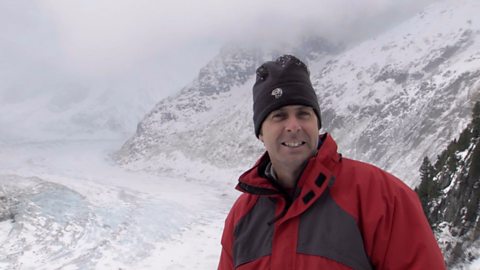
How has glaciation shaped the landforms of the Northern Hemisphere? video
Iain Stewart explains the glaciation of the Northern Hemisphere, focusing on the Yosemite Valley in California.
What evidence is there for climate change in the UK? video
Tom Heap considers the evidence that the UK climate might be changing - with more droughts, higher summer temperatures, but wetter winters.
How can plate tectonics impact oceans? video
Exploring how the plate tectonics impacts the coastline, focusing on California through study of the San Andreas fault.
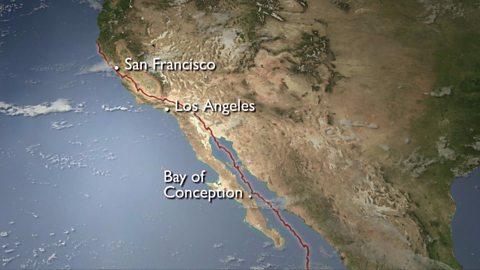
Plate tectonics in the UK - Anglesey. video
Nick Crane explores the geology and seismology of Anglesey - earthquake hot spot of the UK.
Deforestation and the growth of soya in Paraguay. video
Simon Reeves visits Paraguay to consider the deforestation that has occurred there to grow soy and the challenge of conservation vs development.