Liz Bonnin introduces a clip in which Simon Reeve finds out about severe deforestation in Paraguay.
The video
LIZ BONNIN: Hi, I’m Liz Bonnin. We all should know by now what climate change is and you may be aware that the Earth’s forests are considered key to preventing its effects: removing carbon dioxide and releasing oxygen back into the atmosphere.
Famously the Brazilian rainforests in South America play an important role in this, and there was a time when its neighbour, the landlocked Republic of Paraguay, was also covered in trees, so the same could be said for its forests.
Now though, huge forest areas have been chopped down, mainly so that people can grow these. These are soya beans, used mostly to feed cattle and humans and the oil from the beans can even be used as a fuel for engines, or to make candles, crayons, carpets or cleaning products. Basically you can do a lot with them. But does that make it alright to chop down the forests? Well, in this clip, we find Simon Reeve in Paraguay trying to find out…
SIMON REEVE: In the last 50 years, nearly all of Paraguay’s forest has been destroyed. We were heading towards the Mbaracayú Reserve, one of the last pockets of forest in Paraguay. The once mighty Atlantic Forest used to cover almost all of eastern Paraguay. In its place now were endless fields of cash crops, especially soy.
Wow, there was a sheep on the runway. We just missed it. That was close.
WOMAN IN PLANE: It was a quick runner!
SIMON REEVE: Lucky for us as well.
Like a cork from a bottle.
So this is almost the entrance then to the forest. The last bit.
I met up with René Palacios, the head ranger at the Mbaracayú Reserve, who showed me this unique habitat.
So here we’re entering…
RENÉ PALACIOS: The Atlantic Forest, yeah.
SIMON REEVE: The Atlantic Forest. It used to extend over an area much larger than just Paraguay didn’t it?
RENÉ PALACIOS: Oh yes, it came all the way from the Brazilian coast, the Atlantic coast, down to Paraguay and north Argentina.
SIMON REEVE: Tell us what the Atlantic Forest actually is, because not many people have heard of it.
RENÉ PALACIOS: Well, we have many, many species of plants, more than 2,000. Lot of birds. You can find here the big mammals, like… You know, have you heard about jaguars?
SIMON REEVE: I have heard about jaguars, yes.
RENÉ PALACIOS: Yeah.
SIMON REEVE: You have them here?
RENÉ PALACIOS: You can find here, jaguars, yeah.
SIMON REEVE: What other animals have you got?
RENÉ PALACIOS: We have pumas too.
SIMON REEVE: Pumas as well?
RENÉ PALACIOS: Yeah. And do you know about the tapirs?
SIMON REEVE: It’s almost a bit like a pig.
RENÉ PALACIOS: Yeah but big, 300 kilos of mammal.
SIMON REEVE: A giant pig.
RENÉ PALACIOS: Oh, yeah.
SIMON REEVE: Back at his headquarters, René explained that the forest has been cut down to make way for crops like soy.
RENÉ PALACIOS: We had a huge deforestation in Paraguay, in Atlantic Forest. Most of the deforestation was made for agriculture. The land in Paraguay used to be very low price so many, many people came, especially from Brazil, bought land and planted soy. Because the soil here is very good. They have very good production, the productivity is very high.
SIMON REEVE: Soy now accounts for nearly half of Paraguay’s exports. In one of the poorest countries in South America, many people see this cash crop as Paraguay’s economic salvation. But there’s a growing campaign against soy.
Wow it really is just a sea of soya.
Activist Diego Segovia took me to soy fields on the edge of the reserve.
When you see these huge fields of soy where there used to be great forests, what do you feel? I mean the forests here have been lost really in your lifetime, haven’t they?
DIEGO SEGOVIA: We say they’ve become a green desert, because there’s no other form of life that isn’t soy. Nothing but soy. And the herbicides they use kill everything else. They kill the soil, the kill the water, they kill the rural communities.
SIMON REEVE: Soy is high in protein, and most of Paraguay’s harvest goes to China and Europe to feed our pigs and cattle. But it’s also now being used to make biofuel, a replacement for fossil fuels like petrol.
But surely, biofuel, it’s seen as something that might save us from climate change.Isn’t it a good thing?
DIEGO SEGOVIA: We think this is a myth. It’s a lie, because to produce biofuels you need to cut down the forest. You have to get rid of the trees, and the trees are the living things that absorb the most carbon. I think this is madness, converting our fields into fuel for cars.
LIZ BONNIN: And to get a better sense of how much the Atlantic Forest has disappeared, between 2001 and 2014, land the size of 250,000 football pitches has been cleared of trees every single year. So much in fact, that some politicians are saying that instead of getting young people in Paraguay to join the army for the national service, it would be better for them to become tree planters.
Download/print a transcript of the video.
Liz Bonnin introduces a video clip in which Simon Reeve explores deforestation in Paraguay to create arable farmland.
Simon Reeves examines the extent of deforestation in Paraguay over the last 50 years and the reasons for it - primarily the change of land use to arable farming and the planting of a single crop: soy. He is shown the unique ecosystem of the Atlantic Forest before explaining how important soy has become to the economy of Paraguay. The film highlights the tension between conserving natural resources and developing the economy.
Teacher Notes
Key Stage 3
Students could watch this short film before completing a piece of work about the debate between conservation and exploitation.
Students could research further the arguments on each side and present their opinion - should Paraguay continue to grow soy to develop their economy or should the forests be replanted?
Key Stage 4
Students could compare the data of Paraguay’s deforestation to the data about the growth of the economy and spot patterns.
Students could focus on the use of soy for bio-fuels and the irony of deforestation to provide a ‘green’ economy source.
Curriculum Notes
This topic appears in Geography at KS3 (Hydrology) and KS4 / GCSE (Rivers and water) in England, Wales and Northern Ireland and National 4/5 in Scotland.
More geography clips with Liz Bonnin:
What is the water cycle? video
Iain Stewart describes the water cycle including evaporation, condensation and precipitation.
How does a river change as it travels downstream? video
An archive clip of Sir David Attenborough as he follows the course of the Amazon River as it travels downstream.
The erosion of the Grand Canyon. video
Liz Bonnin introduces the Grand Canyon - its ancient geology and what can be learned from the erosion of the rocks.
What coastal management techniques are being used on Hayling Island? video
Introduces the coastal management techniques used on Hayling Island in Hampshire to control drift and flooding.
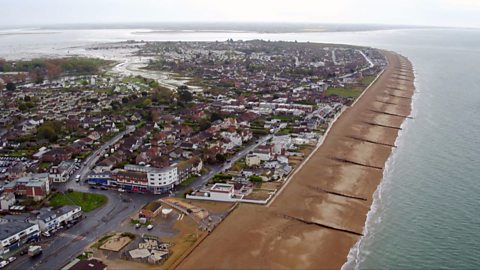
What is a ‘spit’ and how does it form through longshore drift? video
Katie Knapman explains how a spit forms through longshore drift and is a dynamic physical process, constantly changing the coastline.
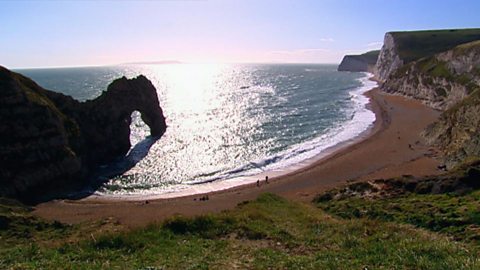
The geology of the Jurassic Coast. video
Exploring the Jurassic coastline and its geological significance with rocks spanning the Cretaceous, Jurassic and Triassic periods.
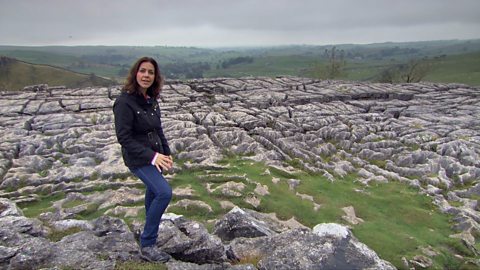
How have physical processes impacted the landscape of Yorkshire? video
Julia Bradbury explains the formation of Malham Cove including limestone pavement, highlighting the impact of glaciers on the landscape.
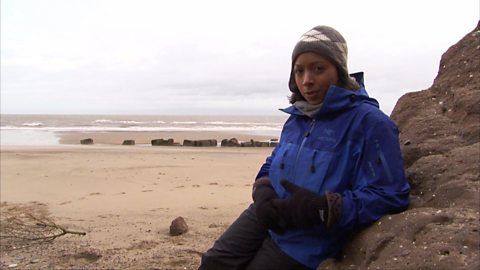
Glaciation and the UK coastline. video
Alice Roberts explains how Britain was once connected to Europe, but changed due to rising sea-levels following the Ice Age.
How has glaciation shaped the landforms of the Northern Hemisphere? video
Iain Stewart explains the glaciation of the Northern Hemisphere, focusing on the Yosemite Valley in California.
What evidence is there for climate change in the UK? video
Tom Heap considers the evidence that the UK climate might be changing - with more droughts, higher summer temperatures, but wetter winters.
How can plate tectonics impact oceans? video
Exploring how the plate tectonics impacts the coastline, focusing on California through study of the San Andreas fault.
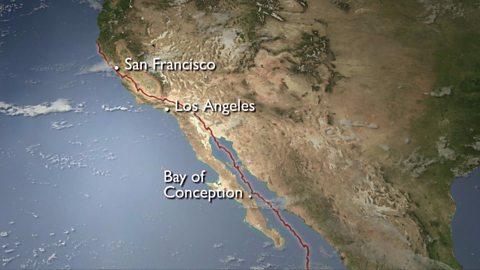
Plate tectonics in the UK - Anglesey. video
Nick Crane explores the geology and seismology of Anglesey - earthquake hot spot of the UK.