Liz Bonnin introduces a clip explaining the water cycle.
The video
LIZ BONNIN: Hi, Liz Bonnin here. I'm a science, wildlife and natural history presenter and I'm passionate about conservation and the natural world, and today, we're here on the south coast by the stunning Seven Sisters cliffs, to talk to you about physical geography.
Now physical might make you think that the subject only covers solid things, like rocks and landscapes, but actually it also requires an understanding of the things that have an impact on our surroundings, and that is why we're now going to look at water.
Water is everywhere around us, as vapour, rain or clouds in the air, or in rivers and seas, and it's essential for all life, both plants and animals, to survive.
And it's constantly moving around in a process called the water cycle.
Now that's got nothing to do with floating bicycles, which is a shame, but in this clip Professor Ian Stewart does get to go on very impressive ride in a para-glider.
PROFESSOR STEWART: The fresh water that we depend on begins its life in the oceans. As the sun's rays beat down on the surface of the sea they heat the water molecules until some evaporate. It's the start of an extraordinary journey.
You know, when water evaporates it feels like it vanishes into thin air, but although we barely notice it, water molecules are suspended around us all the time. Just that we're only aware of it when they clump together as cloud.
At any one time, less than a thousandth of the world's fresh water is up here in the atmosphere. It may not seem much, but this is what spreads water from the seas to the land.
A water molecule doesn't hang around up here for very long. In fact it spends less time up here in the atmosphere than in any other time in its journey. A mere nine days until a typical water molecule crashes to earth as rain.
For most of us, rain is perhaps the most familiar stage of the water cycle. But, notoriously, the least reliable.
When the water falls as rain, it joins a bigger system cascading and carving its way across the land surface as streams and rivers. Look at that! Water absolutely everywhere!
Rivers and rain are the part of the water cycle that we depend on. Whoa! And yet they're only a tiny proportion of the world's fresh water. A measly 2% of all fresh water on the planet.
The rest of the Earth's fresh water is locked away down there, on the ground. (As the para-glider lands) Wahey! Oh, what a landing. The vast majority of it is stored as ice.
Most of the rest seeps deep into the earth, where it's known as ground water. Hidden away down here is the planet's second largest store of fresh water. But in the end, all water arrives back in the oceans, and the cycle begins again.
LIZ BONNIN: So there you go. Most of the Earth's fresh water supplies, over 65%, are frozen in the ice caps and glaciers. There's a huge amount, over 30%, trickling around in the ground and rocks beneath us, and rivers and streams only account for tiny amount. A drop in the ocean!
Download/print a transcript of the video.
Liz Bonnin introduces the water cycle - part of Hydrology at KS3 and Rivers and water at KS4 - and explains that water is constantly moving around Earth.
Professor Iain Stewart examines the constant process of evaporation, condensation and precipitation. Water evaporates and forms clouds in the atmosphere; it condenses and returns to the Earth as rain or snow; it forms rivers that eventually lead to the sea or lakes; the water evaporates and the cycle begins again.
Professor Stewart explains that only 2% of the world’s freshwater is held in rivers and rain: most is locked away as ice or stored deep in the earth as groundwater.
Teacher Notes
This short film could be used to introduce the water cycle and how water moves around a never-ending system.
Students could consider the various stages of the water cycle that are mentioned and how water moves between each stage.
Students could also consider how small a percentage of the global water supply is available as fresh water and the implications of this.
Curriculum Notes
This topic appears in Geography at KS3 (Hydrology) and KS4 / GCSE (Rivers and water) in England, Wales and Northern Ireland and National 4/5 in Scotland.
More geography clips with Liz Bonnin:
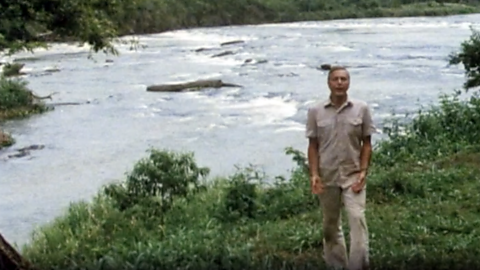
How does a river change as it travels downstream? video
An archive clip of Sir David Attenborough as he follows the course of the Amazon River as it travels downstream.
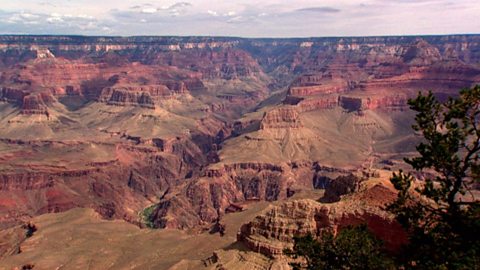
The erosion of the Grand Canyon. video
Liz Bonnin introduces the Grand Canyon - its ancient geology and what can be learned from the erosion of the rocks.
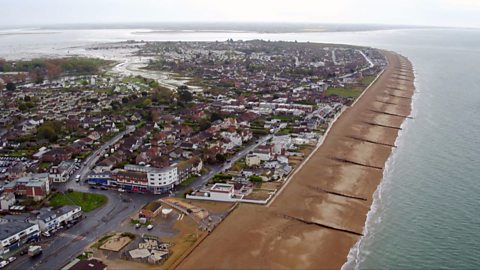
What coastal management techniques are being used on Hayling Island? video
Introduces the coastal management techniques used on Hayling Island in Hampshire to control drift and flooding.
What is a ‘spit’ and how does it form through longshore drift? video
Katie Knapman explains how a spit forms through longshore drift and is a dynamic physical process, constantly changing the coastline.
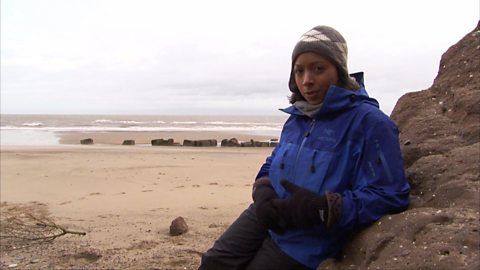
The geology of the Jurassic Coast. video
Exploring the Jurassic coastline and its geological significance with rocks spanning the Cretaceous, Jurassic and Triassic periods.
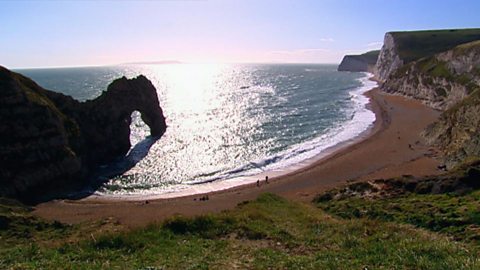
How have physical processes impacted the landscape of Yorkshire? video
Julia Bradbury explains the formation of Malham Cove including limestone pavement, highlighting the impact of glaciers on the landscape.
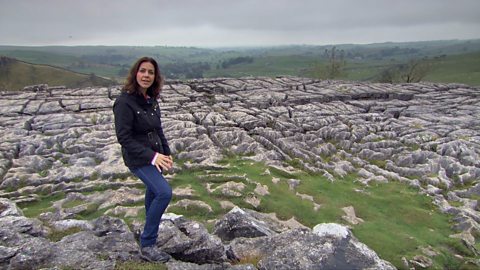
Glaciation and the UK coastline. video
Alice Roberts explains how Britain was once connected to Europe, but changed due to rising sea-levels following the Ice Age.
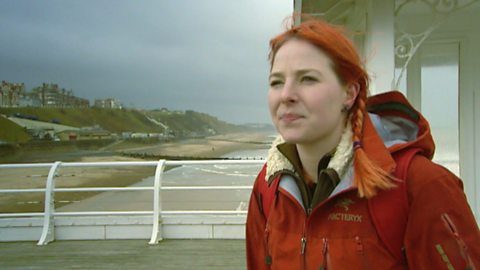
How has glaciation shaped the landforms of the Northern Hemisphere? video
Iain Stewart explains the glaciation of the Northern Hemisphere, focusing on the Yosemite Valley in California.
What evidence is there for climate change in the UK? video
Tom Heap considers the evidence that the UK climate might be changing - with more droughts, higher summer temperatures, but wetter winters.
How can plate tectonics impact oceans? video
Exploring how the plate tectonics impacts the coastline, focusing on California through study of the San Andreas fault.
Plate tectonics in the UK - Anglesey. video
Nick Crane explores the geology and seismology of Anglesey - earthquake hot spot of the UK.
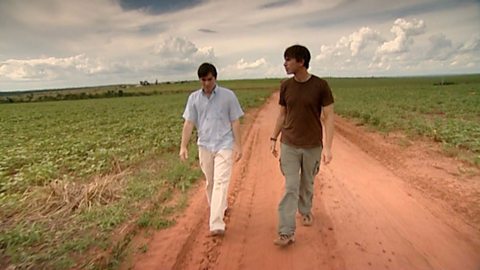
Deforestation and the growth of soya in Paraguay. video
Simon Reeves visits Paraguay to consider the deforestation that has occurred there to grow soy and the challenge of conservation vs development.