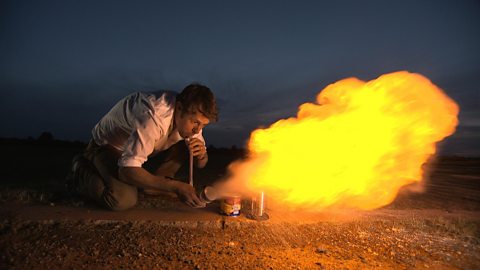
This short film, first published in 2013, is for teachers and review is recommended before use in class.
For our farmers, harvest is the busiest, most important time of the year.
To grow good food, and enough of it, farmers need to understand the science behind the harvest.
Our ability to feed ourselves all hinges on the fact that plants can create their own food through the process of photosynthesis.
Food fanatic Stefan Gates explores what’s going on within the process, and reveals how we can actually see photosynthesis in action with the use of some simple props.
At a massive tomato greenhouse in Kent, Stefan discovers that farmers can artificially create the ideal conditions for photosynthesis to produce a bumper crop of tomatoes, even in winter, and that’s how they keep us supplied with tomatoes all year round.
This is from the series: Science of the Harvest
Teacher Notes
Could be used very effectively to review photosynthesis learned in previous years and illustrate to students the factors that affect the rate of reaction of photosynthesis.
They could complete the pond weed experiment shown in the clip.
In this the light intensity is varied by moving a table lamp progressively further away.
To show that more photosynthesis occurs with high concentrations of carbon dioxide they could simply add more sodium hydrogen carbonate to their solution.
This could also be used for students to understand the uses of glucose.
This is from the series: Science of the Harvest
Curriculum Notes
This clip will be relevant for teaching Biology/Science at KS3 and KS4/GCSE in England and Wales.
Also at Third , Fourth Level, National 4, National 5 and Higher in Scotland.
This topic appears in OCR, Edexcel, AQA, WJEC, CCEA and SQA.
More from the series: Science of the Harvest
Biology KS3 / KS4: How the combine harvester has changed the way we farm. video
How technical mechanisation and combine harvesters have revolutionised the way we farm.
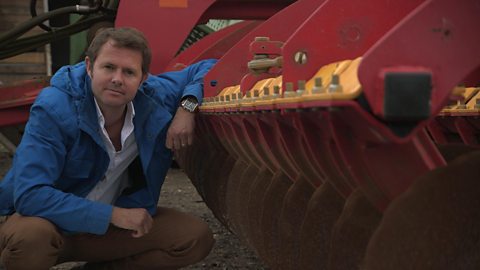
Biology KS3 / KS4: The development of artificial selection in farming. video
Stefan Gates reveals the ways in which plant breeders can speed up natural selection.
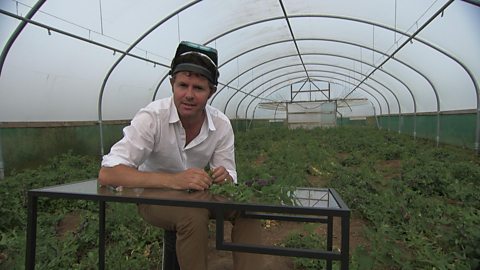
Biology KS3 / KS4: The importance of animal pollinators and their relation to our fruit harvest. video
Focusing on pollination, Stefan Gates reveals the science behind the food that we grow.
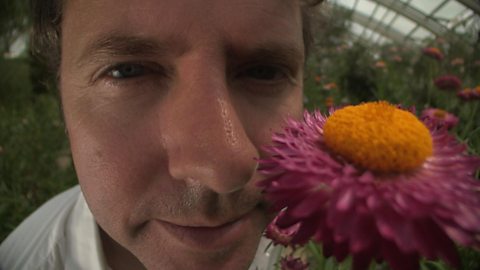
Biology KS3 / KS4: The science of ripening and seed dispersal. video
Stefan Gates reveals the science behind the food we grow and why plants produce fruit.
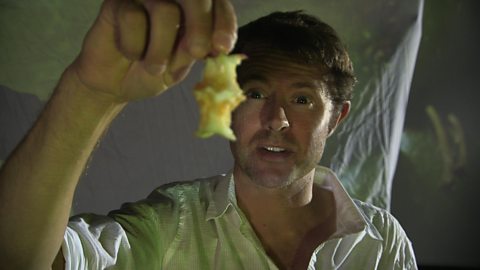
Biology KS3 / KS4: Germination and the conversion and storage of glucose. video
Stefan Gates explores the science of energy storage in plants.