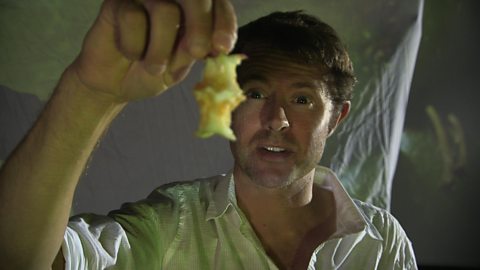
This short film, first published in 2013, is for teachers and review is recommended before use in class.
Stefan Gates explores the science of energy storage in plants, focusing on the conversion of glucose into starch, and the reasons why plants create winter food stores, especially the potato and its importance as a carbohydrate-rich food.
He reveals how some of our most familiar vegetables – including carrots, onions and potatoes – are actually a result of plants’ own survival strategies to provide themselves with enough food over winter.
He reveals the secrets of germination and why seeds also need their own supply of energy.
This is from the series: Science of the Harvest
Teacher Notes
Students could look at the four key uses of energy in plants: (a) used in respiration, (b) stored as starch, © used to make proteins for growth and repair, and (d) used to make cellulose.
Students could then test parts of common fruits and vegetables for starch using iodine and glucose using Benedict’s reagent.
If available, students could then use calorimeters (a metal pot holding water above a flame) to test which foodstuff heats the water the most when burned.
This shows which foodstuff contains the most energy.
How will they make this a valid and reliable experiment?
Please remind students not to try the starch experiment at home.
Curriculum Notes
This clip will be relevant for teaching Biology/Science at KS3 and KS4/GCSE in England and Wales.
Also at Third , Fourth Level, National 4, National 5 and Higher in Scotland.
This topic appears in OCR, Edexcel, AQA, WJEC, CCEA and SQA.
More from the series: Science of the Harvest
Biology KS3 / KS4: How photosynthesis is vital to the success of farming. video
Stefan Gates reveals how we can see photosynthesis in action using some simple props.
Biology KS3 / KS4: How the combine harvester has changed the way we farm. video
How technical mechanisation and combine harvesters have revolutionised the way we farm.
Biology KS3 / KS4: The development of artificial selection in farming. video
Stefan Gates reveals the ways in which plant breeders can speed up natural selection.
Biology KS3 / KS4: The importance of animal pollinators and their relation to our fruit harvest. video
Focusing on pollination, Stefan Gates reveals the science behind the food that we grow.
Biology KS3 / KS4: The science of ripening and seed dispersal. video
Stefan Gates reveals the science behind the food we grow and why plants produce fruit.