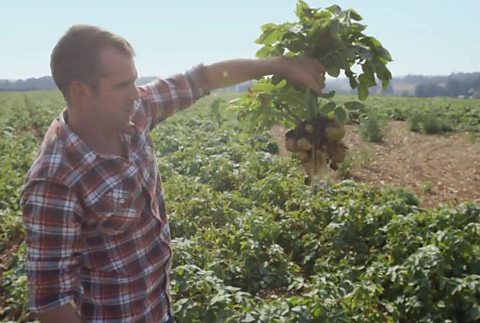
NARRATORWell I hope you're feeling gutsy right now because you are about to go on an incredible and disgusting journey right through the digestive system of someone who has swallowed a camera. A small one. Obviously. Now this is actually something I've done myself, but I don’t want you looking inside me, we've only just met.
NARRATORSo instead, let me introduce you to top science telly presenter and close personal friend of mine, Michael Mosley.
MICHAEL MOSLEYThis pill houses a mini film crew, complete with lights and camera. It will take pictures three times a second and transmit them to screens here in the science museum via sensors on my body.
SCIENTISTSo Michael, ready when you are.
MICHAEL MOSLEYOkay.
SCIENTISTIf you pop that into your mouth?
MICHAEL MOSLEYOkay.
SCIENTISTA few gentle sips of water.
SCIENTISTHas it gone?
MICHAEL MOSLEYIt's gone. It's gone on its long journey. I can't get it back, it's too late.
MICHAEL MOSLEYPropelling the camera down are powerful muscles that line my gullet or oesophagus.
SCIENTISTAnytime you swallow food, the oesophagus will be able to tell that there's a force on its wall and that initiates the process of contraction of the muscle to try and push it further down.
NARRATORThat's called "peristalsis."
SCIENTISTSo this black hole here, soon your see the capsule passing into the stomach. Here it goes.
MICHAEL MOSLEYOh there it goes.
MICHAEL MOSLEYDown here it's a cavernous, alien landscape. And you can see some white blobs of the porridge I ate for breakfast.
NARRATORNow that porridge was soon followed by Michael's lunch that day: steak, chips and a beetroot salad.
MICHAEL MOSLEYSo this is my stomach having eaten and the picture's very different to when it was empty isn't it?
SCIENTISTYeah it shows what a fantastic job the stomach can do, it's really done a blenderizer job here.
MICHAEL MOSLEYAh I think I saw something which was probably the beetroot going past as well. That sort of red thing, oh there's a great big leaf.
SCIENTISTThere's a leaf there.
MICHAEL MOSLEYAnd it looks like a bit of beetroot over there on the top, bit pinkie stuff.
SCIENTISTA bit pinkie there?
MICHAEL MOSLEYYeah.
SCIENTISTYeah so the leaves will be a lot of fibrous material which is much more difficult to digest, so that might stay that way for a little bit longer whereas the white bits are probably the chips, so they're now dissolving in the gastric acid. So that’s more of a mash of stuff.
MICHAEL MOSLEYThe camera has now been traveling inside me for over four hours. It's made its way through the acidic and forbidding world of my stomach and embarked on the longest part of its journey. The small intestine, or small bowel.
MICHAEL MOSLEYAs I snooze, the tight folds on the wall of the small intestine are mixing and churning my mushed up food in a corkscrew motion. Digestive enzymes from the pancreas and gallbladder flood the area. These enzymes induce chemical reactions which break the food down into nutrients that my body can readily absorb.
MICHAEL MOSLEYThe walls of my small intestine look a bit like a fluffy towel. And they are there to aid absorption.
SCIENTISTSo on the folds here, on the folds of the small bowel you can see the finger light projections of the small bowel lining which are called "villi" and what they do is to increase the surface area of the small bowel hugely.
MICHAEL MOSLEYWhat sort of surface area are you talking about?
SCIENTISTAbout a tennis court size. If you strip it all out so it's really huge it's a… there's a huge amount of work that goes on in there.
MICHAEL MOSLEYAnd all this work requires a healthy blood supply. And as this blood rushes through the vessels in the wall of my small intestine, it's picking up digested nutrients and transporting them all over my body. We're at the outer reaches of this alien world. The large intestine or colon.
MICHAEL MOSLEYThrough the flatter, wider surfaces of the colon water is being drawn out from what remains of my food.
SCIENTISTWe have some slightly more formed material in there.
MICHAEL MOSLEYThat’s Mark's polite way of saying that what we're looking at is faeces.
NARRATOROkay we've got to the poo zone, so it is time to bail out and in case you we're wondering, there were no shots of the camera leaving the body. My own experience of that is that you were essentially unaware the camera was traveling around inside you.
NARRATORBut what an amazing trip and an amazing insight into how the digestive system works and looks.
Video summary
Dr Chris van Tulleken introduces the clip in which Dr Michael Mosley swallows a small camera which travels through his digestive system.
Peristalsis is described by another doctor.
Live pictures are broadcast from the camera as it travels into the stomach, where his recent meal can be seen being churned around by the muscular walls of the stomach.
Animations and narration describe and explain the digestive process, and the villi are described in detail.
The journey concludes in Michael’s large intestine. Dr Chris gives a short conclusion to the clip.
Teacher Notes
Key Stage 2
Before watching the clip, ask students to list the organs of the digestive system in order.
After watching the clip, students can self-assess their list.
They could also complete a piece of extended writing, imagining what it would be like to travel through the digestive system.
Key Stage 3
After watching the clip, students could list the organs in the digestive system, their functions, and their adaptations that enable them to complete their functions efficiently.
These could be the columns in a table, for example.
This clip will be relevant for teaching Biology/Science at KS2 and KS3 in England Wales and Northern Ireland. Also at 2nd and 3rd Level in Scotland.
What is a calorie? video
Jem Stansfield explains what the term calorie actually means and then an explosion which releases the energy in breakfast cereal instantaneously.
What a human stomach looks like. video
Dr Chris van Tulleken has a close look at the human digestive system and explains what the different organs do during digestion.
Photosynthesis - where does the energy in our food come from? video
Dr Chris van Tulleken explains the link between photosynthesis and the energy stores in our foods.