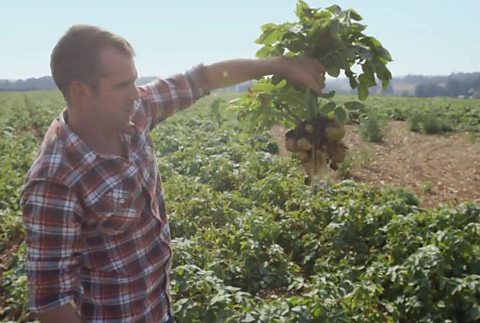
DR CHRIS VAN TULLEKEN:If I said to you that inside your body right about here there's an organ that's longer than the average family car, you'd say that I was lying. Well I'm not, and I was lucky enough to have a look at one in the flesh. Get it?
DR CHRIS VAN TULLEKEN:I hope you've had your lunch because this one's a bit stomach churning. Okay, I'll stop.
DR CHRIS VAN TULLEKEN:'What we're about to see is something truly fascinating, 'but not for the feint-hearted. 'Anatomist, Claire Smith, is showing me a real human digestive system. 'It's a vast, alien-looking mass of tubes. 'And this is the stomach.'
DR CHRIS VAN TULLEKEN:I guess I thought it would be a really big bag, if I think of how much I feel I can stuff into it.
CLAIRE SMITH:So it is capable of stretching, so if you've eaten a large meal with a couple of glasses of water, it is able to stretch.
DR CHRIS VAN TULLEKEN:Okay.
CLAIRE SMITH:It typically holds about one litre of fluid.
DR CHRIS VAN TULLEKEN:One litre of fluid looks like this, that's quite a lot to get in isn't it.
CLAIRE SMITH:And then from the stomach… You then have a region here where you're then going into the small intestines, and all of these that you can see here, this is all small intestines.
DR CHRIS VAN TULLEKEN:This is where the action happens, as it were.
CLAIRE SMITH:So this is the small intestine running along here. This is our special structure called the mesentery, which delivers all the arteries and the veins to the small intestines.
CLAIRE SMITH:So the arteries are bringing nice fresh oxygen to the intestines and the veins are taking our calories back to be used around the rest of the body.
DR CHRIS VAN TULLEKEN:The mesentery, I really like that.
CLAIRE SMITH:If you hold it up to the light enough, you can see the blood vessels.
DR CHRIS VAN TULLEKEN:So the small intestine has a fabulous blood supply.
DR CHRIS VAN TULLEKEN:It has a very thin lining, only one cell thick, and this enables all those small molecules that have been broken down in the stomach and the small intestine, to be absorbed into the blood stream and taken to the parts of the body where they're needed.
DR CHRIS VAN TULLEKEN:'Despite its extensive blood supply, and enormous length, 'the gut still takes hours to break food down 'into a form that it can be burned by the rest of our body.'
CLAIRE SMITH:There's on average about six metres of small intestines.
DR CHRIS VAN TULLEKEN:Six metres? So three of me and a bit.
CLAIRE SMITH:And a bit, but as you can tell it's all coiled up, and in a way that doesn't get tangled.
DR CHRIS VAN TULLEKEN:I guess kind of amazed at how it all works.
CLAIRE SMITH:It's always amazing, every time you look at different parts of the anatomy, and you understand. It is always fascinating.
DR CHRIS VAN TULLEKEN:What you couldn't see is that inside the small intestine are tiny villi, which are finger like projections which increase the surface area, and that makes absorption even faster.
DR CHRIS VAN TULLEKEN:It's amazing to think that all that's inside you, isn't it? Felt very odd to be holding it. It's like handling a cold, wet pooey smelling garden hose made of putty.
Video summary
Dr Chris visits an anatomist to take a close look at the digestive system of a human.
The stomach can stretch to hold approximately one litre of fluid or food.
The small intestine is examined and the role of this organ in digestion and absorption is described, and the importance of the impressive blood supply.
Dr Chris then describes the villi and their role in absorption.
Teacher Notes
Key Stage 2
Ask students to list the organs in order during the passage through the digestive system, and next to each one to say what its major roles are.
After watching the clip, they can self or peer assess their work.
Key Stage 3
Before watching the clip, ask students to list in order the organs in the digestive system from memory, and what their major functions are.
After the clip, students can research the adaptations of the digestive system that maximise absorption of the nutrients.
This clip will be relevant for teaching Biology/Science at KS2 and KS3 in England Wales and Northern Ireland. Also at 2nd and 3rd Level in Scotland.
What is a calorie? video
Jem Stansfield explains what the term calorie actually means and then an explosion which releases the energy in breakfast cereal instantaneously.
Journey through the digestive system. video
Dr Michael Mosley swallows a tiny camera which travels through his digestive system.
Photosynthesis - where does the energy in our food come from? video
Dr Chris van Tulleken explains the link between photosynthesis and the energy stores in our foods.