DR CHRIS VAN TULLEKEN:Now this rather yummy sandwich that I'm eating for my lunch apparently has calories in it. As does this banana. And… These crisps. But what are calories? Well, I've found a clip that should explain things a bit.
JEM STANSFIELD:Well, simply, it's a measure of energy. Like we measure length in metres, and mass in kilos, we measure energy in all its many forms in calories. But what does one calorie look like?
JEM STANSFIELD:I mean, I know what a metre looks like, and I can sort of estimate a kilo of weight, but what would I need to do to experience a calorie?
JEM STANSFIELD:'The scientific definition is the amount of energy needed to heat one gram of water by one degree Celsius But how about one scientific calorie in another form of energy.
JEM STANSFIELD:We'll say for example a calorie of kinetic energy. That's the, the amount of energy a moving thing has. What would that feel like? That's one calorie of kinetic energy.
DR CHRIS VAN TULLEKEN:Right, so did you get that? A calorie is just a unit that can be used to measure energy in the same way that a centimetre is a unit that can be used to measure length.
JEM STANSFIELD:'Gravity gives things potential energy too.' That's the energy that you put into something when you use effort to lift it. Now that energy stays stored until it drops and then it comes back out.
JEM STANSFIELD:RIGHT, I've now had enough of calories. Well, enough of those kinds of calories. I want to get to food calories.
JEM STANSFIELD:See, there's big news here. Where it says 83 calories on the front of that, that's 83 food calories. But that's 83 thousand scientific calories. It admits to this in the small print on the back. It says, "83 kcal". That's 83 thousand calories.
JEM STANSFIELD:What it's saying is in here, there's 83 thousand times more chemical potential energy then there is in that falling cricket ball. Seems astonishing? I'd like to prove it.
DR CHRIS VAN TULLEKEN:So if we look here at the packet of my delicious sandwich, it says on the back that it contains 289 k calories. So to work that out in scientific calories, I need to multiply by a thousand, because the K stands for kilo which gives me a whopping 289 thousand scientific calories.
JEM STANSFIELD:'I've come to a secret laboratory to meet explosives expert, 'Dr. Sidney Alford. 'I've bought him a box of breakfast cereal, and after grinding it all up, 'we've put it safely in the corner of Sidney's quarry.
JEM STANSFIELD:'If food really contains so many calories, 'he's the man to help me unleash them.' As human beings, we get the energy out of our food by reacting it with the oxygen in the air we breathe. But that takes quite a long time, and we can't see it.
JEM STANSFIELD:So Sidney here… Has agreed to mix our flakes directly with oxygen to speed up the process a bit. Now, this has never been done before, so I'm more than a little intrigued as to the result.
JEM STANSFIELD:'Remember, Sidney's using nothing except breakfast cereal, 'oxygen, and a little detonator to start the reaction.'
DR SIDNEY ALFORD:Firing! Four, three, two, one!
LOUD BANG
JEM STANSFIELD:The energy that you see in that explosion is exactly the same energy that you produce in your body chemically from a packet of these. And to know there's that's going off in my body between breakfast and lunch is almost concerning.
DR CHRIS VAN TULLEKEN:Well that was mind-blowing, wasn't it? So, whenever you eat something, whether it's cereal or a delicious sandwich, you're consuming a store of chemical energy, which then combines with the oxygen you've breathed in to power your body throughout the day.
DR CHRIS VAN TULLEKEN:Now, obviously, we don't literally have explosions going off in our cells, but just think about all that energy inside us, powering our brains or our arms and legs.
Video summary
Dr Chris van Tulleken introduces a clip from Bang Goes the Theory in which Jem Stansfield explains that a calorie is a unit of energy.
Jem goes on to exemplify one calorie in different forms of energy: kinetic energy, and gravitational potential energy.
He then explains that kilocalories in food are actually 1000 calories.
Jem enlists the help of an explosive expert to release the energy in a small packet of breakfast cereal in an instant.
The quantity of energy is quite astonishing. Dr Chris concludes that the chemical energy stored in our food is released much more slowly.
Teacher Notes
Ask students to list different forms of energy that they have learned about in physics and biology.
Can they name the unit of energy? Ask them what energy transfers take place in the human body.
After the clip, ask for their reactions, and challenge them to explain why humans need so much energy every day just to stay alive._
Approximately 75% of our energy goes into just keeping us alive (basal metabolism).
This clip will be relevant for teaching Biology at KS3 in England Wales and Northern Ireland. Also at 3rd Level in Scotland.
What a human stomach looks like. video
Dr Chris van Tulleken has a close look at the human digestive system and explains what the different organs do during digestion.

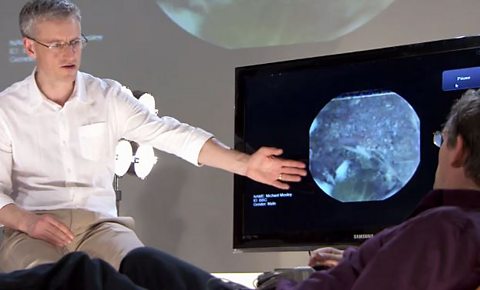
Journey through the digestive system. video
Dr Michael Mosley swallows a tiny camera which travels through his digestive system.
Photosynthesis - where does the energy in our food come from? video
Dr Chris van Tulleken explains the link between photosynthesis and the energy stores in our foods.