Marie Adeyemi:
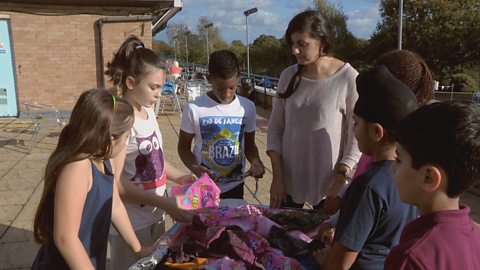
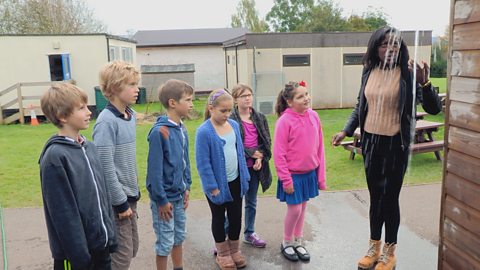
Hi, I'm Marie, and I'm a mechanical engineer working on a nuclear energy project. Today, I'm meeting some children at St Peter's primary school in Portishead and I thought I would share some lovely raspberries with them. The only problem is that they are all squished!
Children:
Ugh!
Marie:
Our design challenge today is to research, design, and make a better package for our raspberries. What do you think the problem is with the packaging?
Girl:
I think the packaging needs to be a bit stronger because it might not be strong enough to hold all those raspberries.
Marie:
So, what we're going to do now is look at other packaging. I like this one. It's got an interesting shape inside. Do you think that's good for our raspberries?
Neil:
It's not THAT good because the raspberries could slide around in it.
Marie:
Yeah, they could slide inside here. This is another rectangle shape, but this one's a little bit different.
Girl:
I think that box is good because it has a window and you can see the raspberries inside of it.
Marie:
Oh, I like this. It slides in and out.
Girl:
I think it's a good idea to have a slidey-out box because then you can see if the raspberries are fresh or not.
Boy:
I think the design is good because, if you've got a friend, you can, like, push it open and say 'Would you like a raspberry?'
Marie:
In all these different designs, what do you think's really important about them?
Girl:
I think it's good for the packaging to be attractive.
Girl:
I think the box should be made out of recyclable materials, so then it's better for the planet.
Marie:
We split into two teams to model our ideas.
Girl:
So, now we need to think of a way of getting the raspberries in the box safely.
Marie:
The girls have decided that a row of spikes would be a good way to support the raspberries. The spikes will be made by a 3-D printer. Iain Major is an expert in using these new machines that print solid objects.
Iain Major:
A bit like a hot glue gun, it's going to squirt plastic down and the plastic is going to go down in layers, and each layer is twice the melting point. So, it melts the previous layer and then they stick together as they cool down and become one object.
Marie:
The printer is controlled by its own modelling software. While the girls work on the 3-D printer, the boys are designing a box for the raspberries. Packages are often made of a single piece of folded cardboard called a net.
Marie:
OK, so if I wanted to recreate this net using 2-D technology, do you know how I could do it?
Boy:
Well, on the computer we can make the net bigger, different shapes or sizes.
Marie:
To combine the 3-D printed rows of spikes and the net that will contain them, the boys need some precise measurements from the girls.
Girl:
We need to measure the biggest and the smallest raspberry. My biggest is two centimetres.
Girl:
Same.
Girl:
And my smallest is one centimetre.
Boy:
We need to know how tall it's going to be altogether.
Girl:
1.9 centimetres.
Girl:
But if you've got the raspberry on top of it, it might be a little bit more.
Neil:
So, altogether the height will be 2.5.
Boy:
This is our final design. We've got a picture here of raspberries exploding, our name and our mascot, Robbie Raspberry.
Marie:
Next, we print, cut out and fold our net.
Girl:
It's amazing because it's not printing 2-D, it's actually printing 3-D.
Marie:
Now it's time to combine the 2-D and 3-D elements of the design.
Iain:
I think this is a fabulous design, I really do. The raspberries are actually sat on little spikes individually which is going to make sure that they don't bash into one another. Each raspberry has its own space. I think it's a very marketable product.
Marie:
I think it's a great design and you all came together as a team. Teamwork's really important in engineering. We've achieved all our packaging design aims. Well done teams!
Video summary
Engineer Marie Adeyemi helps a team of children to research and design some packaging for raspberries using 2D and 3D design software.
They discuss the purposes of packaging, and look at the pros and cons of different existing designs.
One group model an idea for a new design out of plasticine, and use 3D modelling software to convert it to something a 3D printer can produce.
While the other group uses 2D design software to design a net shape for the box.
They work together to get the measurements for both designs right, decorate their box and get feedback on their design.
This clip is from Design Challenge, a series in which groups of children tackle some difficult creative projects with the help of talented young engineers.
Teacher Notes
The clip could be used to introduce and support the delivery of a designing, making and evaluating project for children to develop suitable packaging for soft fruit.
It could stimulate a class discussion on evaluating packaging, and designing and making processes.
Sections of the clip can be used to increase children’s technical knowledge of the use of Computer Assisted Design (CAD) and 3D printing to develop packaging.
This clip will be relevant for teaching Art and Design and Design and Technology at KS2 in England, KS1 and KS2 in Northern Ireland, Design and Technology at KS2 in Wales and at 2nd Level in Scotland.
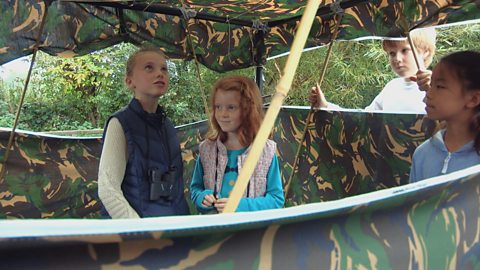
How to design a portable bird hide for children to use at a nature reserve. video
Engineer, Abbie Hutty, helps a team of children to design a portable bird hide.
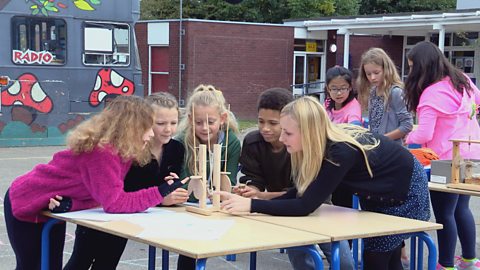
How to design and make a moving shop window display. video
Engineer, Abbie Hutty, helps a team of children to design a moving shop window display.
How to design a nightlight for a toddler. video
Engineer, Yasmin Ali, helps a team of children design and make a nightlight for a toddler.
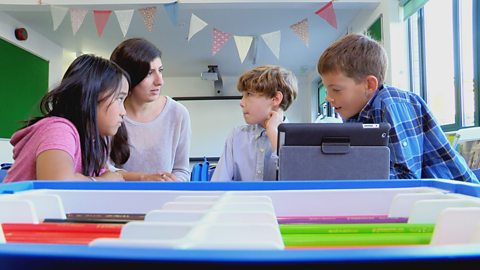
How to design and make a rainwater harvester. video
Engineer, Marie Adeyemi, helps a team of children design and make a rainwater harvester.
How to design and make a swimming bag. video
Engineer, Yasmin Ali, helps a team of children to design and make a swimming bag.